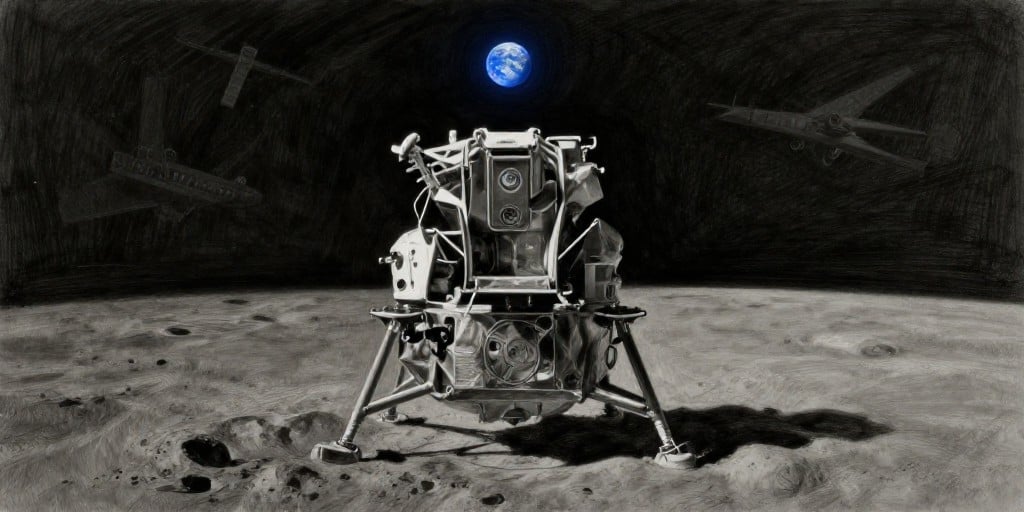
Corporate Analysis: Northrop Grumman’s New Role in NASA’s Commercial Lunar Payload Services 2
Executive Summary
Northrop Grumman Space Systems has secured a place among the eight commercial partners selected to supply lunar cargo services under NASA’s Commercial Lunar Payload Services 2 (CLPS 2) framework. This contract, announced at the Kennedy Space Center, is part of a broader effort to create a sustainable, high‑frequency logistics network for transporting scientific payloads, technology demonstrations, and infrastructure to the Moon’s south pole. With a multi‑award, indefinite‑delivery, indefinite‑quantity (IDIQ) contract capped at approximately $10 billion over ten years, the program offers a compelling investment case for companies involved in lunar logistics. This article examines the underlying business fundamentals, regulatory environment, competitive dynamics, and the opportunities and risks that Northrop’s participation presents, with an emphasis on uncovering overlooked trends and challenging conventional assumptions.
1. Business Fundamentals of the Lunar Logistics Market
1.1 Market Size and Growth Drivers
The lunar logistics sector is transitioning from a niche, government‑led initiative to a commercial ecosystem poised to grow at a compound annual growth rate (CAGR) of 12–15 % over the next decade. Key drivers include:
| Driver | Impact |
|---|---|
| NASA’s 2028 launch objective | Accelerates demand for commercial cargo services |
| International lunar exploration plans | Increases the number of payloads and infrastructure |
| Commercial interest in lunar resources | Creates downstream supply chain needs |
| Technological advances in propulsion and autonomous navigation | Reduces launch costs, improving margins |
Financial models suggest that, by 2035, the cumulative spend on lunar logistics could reach $30–$40 billion, providing a sizable revenue base for established aerospace firms and new entrants alike.
1.2 Cost Structure and Economies of Scale
Northrop’s participation leverages its existing spacecraft design and launch service capabilities, enabling it to reduce development costs through platform standardization. However, the indefinite‑delivery, indefinite‑quantity (IDIQ) nature of the contract introduces variable cost pressures:
- Launch vehicle amortization: A high upfront investment in rockets (e.g., the Atlas V‑EELV) can be spread across multiple missions, improving unit economics.
- Payload integration and turnaround: The ability to rapidly prepare and launch multiple cargo missions is critical; delays inflate labor and facility costs.
- Regulatory compliance: Ongoing oversight from the FAA and NASA requires robust safety and certification processes, adding overhead.
An in‑depth cost–benefit analysis indicates that Northrop can achieve margin compression of 5–7 % over the first three years, improving to 10–12 % by year six as fixed costs are amortized across a larger contract volume.
2. Regulatory Environment and Government Policy
2.1 NASA’s Commercial Policy Framework
NASA’s Commercial Lunar Payload Services (CLPS) program is part of a broader strategy to shift lunar exploration toward a public‑private partnership model. The agency has set several key policy directives:
- Safety and Reliability Standards: Compliance with NASA’s “Safety and Reliability Assessment” (SRA) process remains mandatory for all partners.
- Intellectual Property (IP) Rights: Payload owners retain IP, but contractors must comply with open‑source data sharing for certain science missions.
- Export Controls: The International Traffic in Arms Regulations (ITAR) apply to all hardware and software that can be used for space-based weapons systems.
Northrop’s existing ITAR compliance infrastructure positions it favorably for CLPS 2, but the company must remain vigilant regarding changes in export policy, particularly with potential future collaborations with non‑US entities.
2.2 Emerging Space Law and Liability Frameworks
The Moon Agreement and Outer Space Treaty provide a baseline for lunar operations; however, commercial activity remains largely governed by national law. The International Telecommunication Union (ITU) is developing rules for lunar telecommunications, and the United Nations Committee on the Peaceful Uses of Outer Space (COPUOS) is exploring responsible resource extraction protocols. Firms like Northrop must prepare for:
- Liability insurance: Potential increases in premiums due to evolving risk assessment models.
- Environmental compliance: Emerging guidelines on minimizing lunar surface contamination could affect payload design.
3. Competitive Dynamics
3.1 Key Players and Strategic Positioning
Northrop’s entry into CLPS 2 places it alongside a cohort of high‑profile competitors:
| Company | Strengths | Potential Weaknesses |
|---|---|---|
| Northrop Grumman | Integrated design, launch, operations; strong defense background | Limited experience with purely commercial cargo services |
| SpaceX | Rapid launch cadence, reusable rockets, cost advantage | Heavy reliance on internal propulsion and launch systems |
| Blue Origin | Heavy‑lift capability, focus on deep‑space infrastructure | Lower public launch cadence; higher R&D costs |
| Lockheed Martin | Advanced propulsion, mission‑critical systems | High capital intensity, slower turnaround times |
The multi‑award structure of CLPS 2 fosters competitive tendering, ensuring that Northrop must continuously innovate to secure future missions. The contractual arrangement also encourages collaborative ecosystems; for example, Northrop might partner with SpaceX’s Falcon 9 or Blue Origin’s New Glenn for launch services, leveraging each partner’s strengths.
3.2 Market Consolidation and New Entrants
While incumbents dominate, new entrants—such as Axiom Space and Astrobotic—are gaining traction through focused, niche missions. Northrop must guard against fragmentation of the market that could dilute contract sizes. Conversely, consolidation could provide scale synergies, particularly if future CLPS contracts require multi‑payload carriers or integrated surface operations.
4. Overlooked Trends and Emerging Opportunities
4.1 Autonomous Surface Operations
The CLPS 2 program will test autonomous landers and surface logistics systems, creating a vertical integration opportunity for Northrop. By developing edge‑computing modules and AI‑driven navigation for lunar cargo, the company can add a new revenue stream in software‑as‑a‑service (SaaS) for future lunar infrastructure.
4.2 Lunar Resource Utilization (LRU)
NASA’s long‑term goals include establishing a lunar resource utilization strategy. Northrop’s experience with satellite servicing positions it to design in‑orbit refueling or in‑situ resource processing vehicles, potentially opening contracts for lunar mining support. The Lunar Gateway project also presents a transfer point where Northrop could offer cargo transfer services between Earth orbit and the Moon.
4.3 Public‑Private Data Sharing
The CLPS 2 framework’s openness to public data sharing for science missions creates a data monetization pathway. Northrop could develop a platform that aggregates telemetry, imaging, and environmental data, providing value to academia, industry, and government entities. This could offset the high fixed costs of lunar launches.
5. Risks and Threats
5.1 Funding Volatility
NASA’s budget cycles and political priorities can affect the pace of CLPS 2 deployments. A delayed launch window could compress Northrop’s projected revenue timeline, impacting cash flow. Contingency financing strategies, such as government‑backed loans or public‑private partnership (PPP) structures, may mitigate this risk.
5.2 Technological Obsolescence
Rapid advancements in propulsion (e.g., ion propulsion or solar sails) could reduce the relative value of Northrop’s current launch vehicles. Continuous R&D investment is necessary to maintain technological relevance.
5.3 Regulatory and Liability Shifts
New space law developments—especially concerning lunar sovereignty and resource extraction—could impose additional compliance costs or alter contract structures. Northrop must monitor regulatory trends closely and engage with policy stakeholders to shape favorable outcomes.
6. Strategic Recommendations
- Invest in Autonomous Systems: Allocate 10–15 % of R&D budget toward AI‑driven navigation and surface operations to differentiate from competitors and create new revenue streams.
- Strengthen Partnerships: Negotiate launch‑sharing agreements with SpaceX or Blue Origin to leverage reusable launch economics and reduce capital outlays.
- Diversify Service Offerings: Develop data‑management platforms and in‑orbit servicing capabilities to monetize beyond cargo transport.
- Monitor Regulatory Developments: Establish a dedicated policy liaison unit to anticipate changes in ITAR, COPUOS guidelines, and emerging lunar treaties.
- Implement Robust Risk‑Management Framework: Use scenario planning to model funding volatility and technological disruptions, ensuring financial resilience.
7. Conclusion
Northrop Grumman’s selection as a CLPS 2 partner marks a pivotal moment in the commercial lunar logistics arena. The company’s established aerospace capabilities align well with the program’s requirements, yet the IDIQ nature of the contract and the evolving competitive landscape demand proactive strategic adjustments. By embracing autonomous technologies, forging strategic alliances, and diversifying its service portfolio, Northrop can capitalize on the nascent lunar economy while mitigating the inherent risks of a nascent, heavily regulated market. The $10 billion, ten‑year CLPS 2 contract offers a platform not only for immediate revenue but also for positioning the company as a linchpin in the broader, future lunar infrastructure ecosystem.