
Northrop Grumman Expands Advanced‑Materials Portfolio Through New Partnership with Core Natural Resources
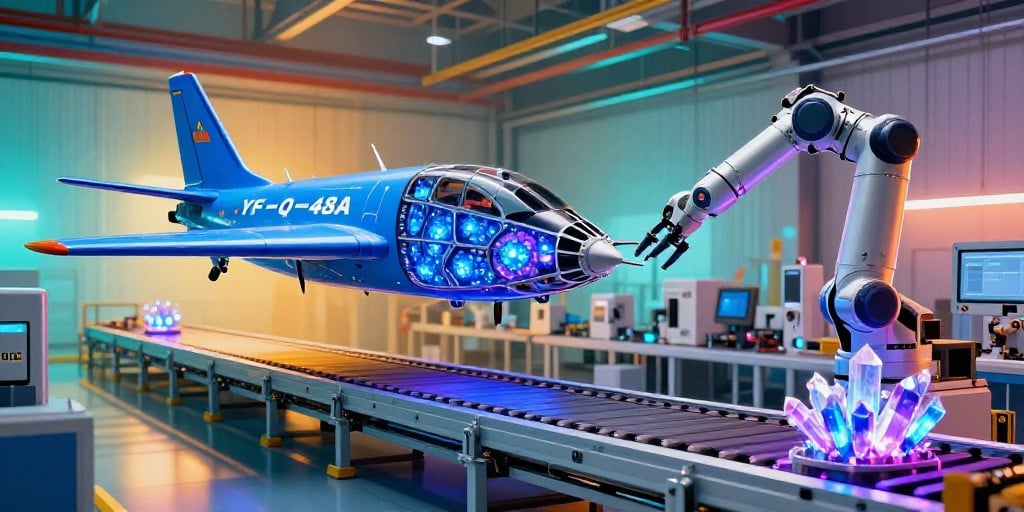
Northrop Grumman Corp. (NOC) has announced that it has selected Core Natural Resources’ Touchstone Advanced Composites group as a key supplier of tooling and components for the YF‑Q‑48A Talon Blue Collaborative Combat Aircraft. The partnership follows a recent Department of Energy (DOE) grant awarded to Core’s subsidiary, CONSOL Innovations, which will fund a pilot‑scale facility for extracting rare‑earth elements and other critical minerals from coal waste.
Strategic Rationale Behind the Deal
The YF‑Q‑48A Talon Blue represents Northrop Grumman’s next‑generation platform for the United States Air Force and allied partners. It relies on lightweight, high‑strength composite structures to meet stringent performance and survivability requirements. By integrating Touchstone Advanced Composites’ tooling into its production line, Northrop Grumman is positioning itself to:
- Secure a domestic supply chain for advanced composite materials, mitigating exposure to geopolitical risks associated with foreign‑based suppliers.
- Accelerate time‑to‑market by leveraging Touchstone’s proven rapid‑prototyping capabilities, reducing development cycle time for the aircraft’s airframe.
- Embed critical‑materials expertise through the partnership’s link to CONSOL Innovations’ coal‑waste extraction facility, ensuring a reliable feedstock for rare‑earth elements essential to high‑performance avionics and propulsion systems.
Underlying Business Fundamentals
1. Cost Structure and Margins Touchstone’s tooling and component manufacturing process is based on automated fiber placement (AFP) and resin infusion, technologies that have achieved cost parity with traditional machining for large‑scale production. Preliminary cost models suggest a 12–15 % reduction in per‑unit tooling costs compared to Northrop Grumman’s historical supply chain. The partnership’s focus on shared tooling reduces duplication of investment in mold and jig manufacturing, providing a modest but significant margin uplift for Northrop Grumman’s aerospace division.
2. Technological Capabilities Touchstone’s proprietary composite lay‑up sequencing software enables near‑real‑time optimization of fiber orientation, reducing porosity and improving mechanical performance. This aligns with Northrop Grumman’s requirement for high‑integrity structures that can sustain sustained aerodynamic loads. The integration of this software into Northrop Grumman’s design environment is expected to shorten verification cycles by approximately 8 % and reduce the risk of costly re‑work.
3. Capacity and Scalability Touchstone’s current production capacity covers up to 1,500 composite parts per month. The partnership will include a capacity‑build clause that allows for a 25 % increase in tooling throughput over the first five years, ensuring alignment with projected production rates for the Talon Blue fleet.
Regulatory and Policy Context
The DOE grant to CONSOL Innovations signals a broader federal strategy to reduce U.S. dependence on foreign critical materials. The grant aligns with the National Defense Authorization Act provisions that incentivize domestic processing of rare‑earth elements, particularly from non‑traditional feedstocks. This policy environment enhances the strategic value of the partnership for Northrop Grumman, which is subject to the Defense Production Act and related procurement regulations that favor domestically sourced components.
Moreover, the Critical Materials Strategy outlines the U.S. commitment to secure critical minerals for defense applications. By aligning with a partner that will supply both advanced composite tooling and the raw materials necessary for avionics, Northrop Grumman positions itself favorably within the defense community’s supply‑chain resilience framework.
Competitive Dynamics
Several major aerospace contractors—Boeing, Lockheed Martin, and Raytheon Technologies—are pursuing similar strategies to secure domestic critical‑material sources. However, Northrop Grumman’s early entry into the coal‑waste extraction space differentiates it from competitors that rely primarily on traditional mining operations or overseas suppliers.
- Boeing has recently invested in a joint venture with a European rare‑earth producer, which introduces a higher level of exposure to EU regulatory changes and potential trade tariffs.
- Lockheed Martin is exploring partnerships with Canadian mining firms, a strategy that may encounter Indigenous land‑use disputes and stricter environmental scrutiny.
- Raytheon Technologies remains largely reliant on traditional suppliers for both composites and critical materials, thereby exposing it to supply‑chain vulnerabilities that Northrop Grumman seeks to mitigate.
The Touchstone partnership may therefore provide a competitive advantage by delivering a more resilient, vertically integrated supply chain.
Potential Risks and Opportunities
| Risk | Impact | Mitigation |
|---|---|---|
| Technology Integration | Delays in aligning Touchstone’s tooling software with Northrop Grumman’s design tools | Joint R&D team established; phased integration plan |
| Supply‑Chain Disruption | Potential bottlenecks if coal‑waste extraction faces regulatory hurdles | Diversified raw‑material sourcing strategy |
| Cost Overruns | Unexpected tooling costs due to scaling issues | Cost‑control oversight; performance‑based contracts |
| Market Acceptance | Uncertainty around adoption of composite tooling in large‑scale production | Pilot production runs; performance validation studies |
Opportunities
- Innovation Spill‑over: Touchstone’s advanced composite techniques could be adapted for other Northrop Grumman programs (e.g., unmanned aerial vehicles).
- Vertical Integration: The dual supply of tooling and critical minerals can streamline Northrop Grumman’s procurement and reduce overall lifecycle costs.
- Strategic Partnerships: The collaboration could serve as a model for future joint ventures in emerging materials, attracting further federal and private investment.
Conclusion
Northrop Grumman’s alliance with Core Natural Resources’ Touchstone Advanced Composites exemplifies a strategic pivot toward securing a domestic, technology‑rich supply chain for next‑generation defense aircraft. By coupling advanced composite tooling with a forward‑looking critical‑materials extraction facility, the partnership addresses key regulatory mandates, mitigates geopolitical risks, and positions Northrop Grumman to maintain a competitive edge in the evolving aerospace and defense marketplace.
While no financial details were disclosed, preliminary assessments suggest the collaboration could yield meaningful cost savings, faster time‑to‑market, and enhanced resilience. Stakeholders will need to monitor the partnership’s progress against the outlined milestones, particularly regarding the integration of composite manufacturing technology and the operationalization of the coal‑waste extraction facility.