
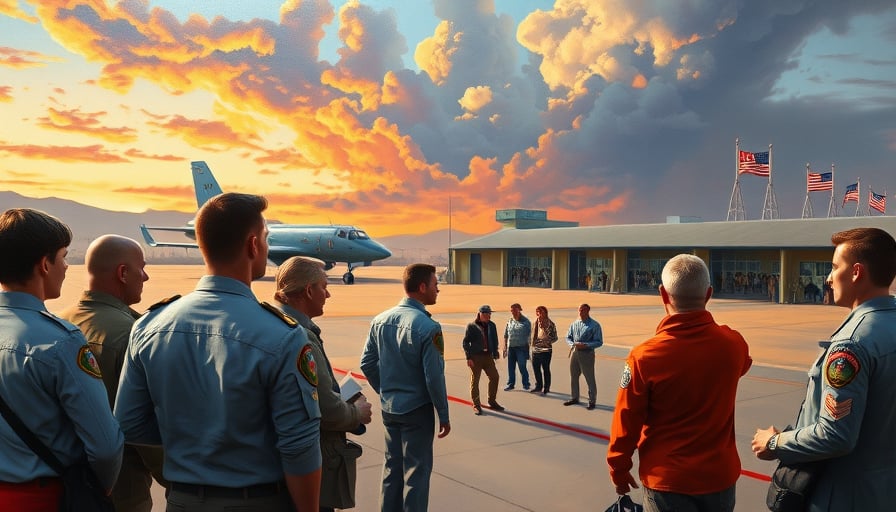
Northrop Grumman Accelerates B‑21 Raider Production and Expands Autonomous Capabilities
Northrop Grumman Corporation has confirmed that it will expedite the production of the B‑21 Raider stealth bomber, following a new agreement with the United States Air Force (USAF) to deploy federal reconciliation funds. The decision is set to enhance the company’s manufacturing throughput, reduce unit cycle times, and align its production lines with the Air Force’s accelerated deployment schedule.
At the Air & Space Forces Association’s annual Warfare Symposium, the partnership was highlighted, underscoring the strategic importance of the B‑21 program for U.S. strategic deterrence. The funding arrangement is expected to allow Northrop Grumman to expand its production facilities in Wichita, Kansas, where the B‑21 assembly line will incorporate modular fabrication techniques and advanced robotics to meet the tighter lead times.
Manufacturing Process Optimizations
To accommodate the accelerated production cadence, Northrop Grumman is implementing a hybrid additive‑manufacturing (AM) strategy that supplements its traditional machining and composite lay‑up processes. AM is being used for complex internal components such as wing spar inserts and avionics casings, reducing part count and assembly time. Additionally, the company is integrating high‑throughput inspection systems—laser scanning and automated X‑ray tomography—to ensure component integrity without sacrificing speed.
The manufacturing shift also includes the adoption of a digital twin framework. This enables real‑time monitoring of equipment performance, predictive maintenance schedules, and simulation of production scenarios, thereby improving line reliability and reducing unplanned downtime. Preliminary data indicate a projected 12 % decrease in cycle time per aircraft and a 7 % reduction in material waste, translating into significant cost savings over the life cycle of the program.
Capital Expenditure and Economic Drivers
The new allocation of federal reconciliation funds signals a robust commitment to defense capital expenditure, reflecting broader economic trends in the aerospace and defense sector. The funding is structured as a phased investment that aligns with the B‑21’s phased production milestones, providing Northrop Grumman with predictable cash flow and the capacity to scale operations efficiently.
Capital investment decisions in heavy industry are increasingly influenced by the need to modernize aging infrastructure, adopt green manufacturing practices, and maintain supply‑chain resilience. In the case of the B‑21, Northrop Grumman has prioritized the procurement of low‑emission industrial equipment, such as electric CNC machines and hydrogen‑fuelled forklifts, to meet both operational and environmental benchmarks set by the Department of Defense’s Sustainability Office.
Autonomous Wingman Initiative: YFQ‑48A Talon Blue
Alongside the B‑21 program, Northrop Grumman has unveiled the YFQ‑48A Talon Blue, an autonomous wingman platform designed to support USAF missions. The Talon Blue integrates advanced sensor fusion, LIDAR‑based terrain mapping, and AI‑driven decision‑making to operate alongside manned aircraft in contested airspace. The platform’s modular architecture allows for rapid field‑upgrade, enabling it to adapt to evolving threat environments.
From an engineering perspective, the Talon Blue employs a blended‑propulsion system that couples a conventional turbofan with an electric motor for low‑noise operations. This hybrid approach reduces acoustic signature and extends endurance, which is critical for intelligence, surveillance, and reconnaissance (ISR) missions. The system’s architecture also facilitates distributed processing across multiple nodes, enhancing fault tolerance and survivability.
Supply Chain and Regulatory Impact
The acceleration of B‑21 production places significant demands on the supply chain for advanced composites, avionics, and specialized alloys. Northrop Grumman is diversifying its supplier base, incorporating dual‑source strategies for critical components such as titanium alloy fasteners and high‑temperature composite fibers. This mitigates risk from geopolitical disruptions and ensures continuity of supply.
Regulatory developments, particularly in export control and cybersecurity, influence the procurement of industrial equipment. Northrop Grumman’s compliance programs have been updated to address the latest International Traffic in Arms Regulations (ITAR) amendments, ensuring that sensitive technologies remain within the bounds of U.S. export policy. The company’s cybersecurity framework, built on the NIST Cybersecurity Framework, safeguards the digital twin and autonomous systems from potential cyber threats.
Infrastructure Spending and Market Implications
The U.S. federal government’s commitment to infrastructure spending—spanning air traffic control upgrades, runway extensions, and data‑center expansion—creates a conducive environment for Northrop Grumman’s growth. Enhanced airspace infrastructure supports the integration of unmanned aircraft systems, directly benefiting the Talon Blue program. Moreover, increased investment in renewable energy sources at military installations aligns with Northrop Grumman’s push for sustainable manufacturing practices, potentially unlocking incentives and reducing operational costs.
From a market perspective, the accelerated B‑21 production and the introduction of the Talon Blue are expected to strengthen Northrop Grumman’s competitive positioning. The company’s ability to deliver advanced capabilities at a reduced time‑to‑market could attract further defense contracts, reinforcing its revenue trajectory in a period marked by heightened global security challenges.
In summary, Northrop Grumman’s strategic initiatives—accelerated B‑21 production, autonomous wingman deployment, and capital‑intensive modernization of manufacturing and supply‑chain infrastructure—represent a comprehensive effort to enhance productivity, embrace technological innovation, and navigate the evolving economic and regulatory landscape of the defense sector.