
Corporate Announcement: NextEra Energy and Brookfield Joint Venture for Paducah Data‑Center Campus
Project Overview and Technical Specifications
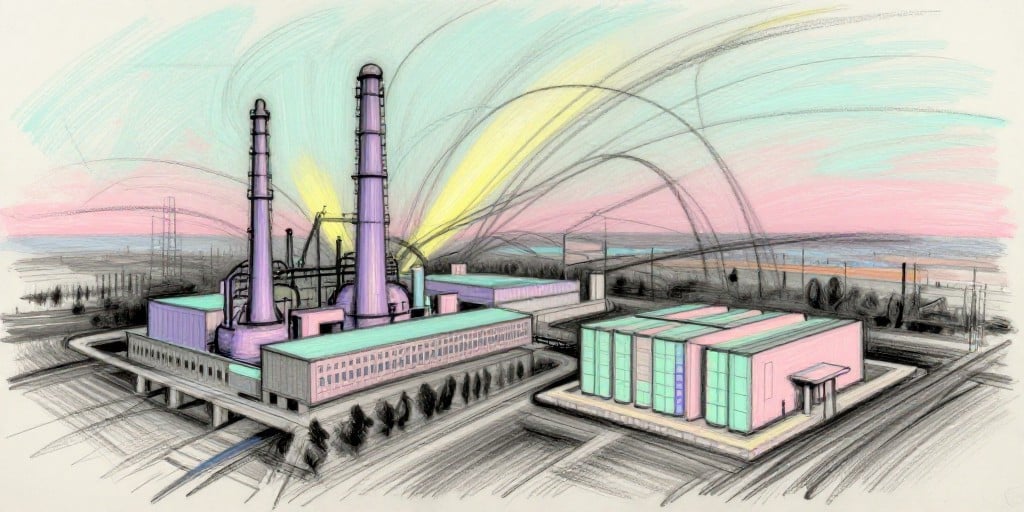
NextEra Energy and Brookfield announced a joint venture to transform the former U.S. Department of Energy enrichment site in Paducah, Kentucky, into a large‑scale data‑center campus. The development will feature a 1.8 GW computing capacity, a 2 GW natural‑gas‑fired power plant, and a 2.6 GW battery storage system. The campus will occupy 3,556 acres of land that already hosts high‑voltage transmission lines, water infrastructure, and fiber‑optic connectivity, allowing for a shortened construction schedule.
From an engineering perspective, the planned 2 GW gas‑fired plant will be a combined‑cycle configuration, providing both peak‑load support and a baseline power output with improved thermal efficiency (≈ 55 %). The 2.6 GW battery bank will be a lithium‑ion fleet managed by advanced battery management systems (BMS) that will deliver fast frequency response, voltage ride‑through, and reserve services. The data‑center itself will rely on high‑efficiency modular cooling systems and advanced airflow management to minimize PUE (Power Usage Effectiveness) below 1.4— a benchmark for next‑generation facilities.
Grid Stability and Renewable Integration
The Paducah campus will be fed through an existing high‑voltage corridor that currently serves the region’s electric cooperatives: Big Rivers Electric, Jackson Purchase Energy, and Paducah Power. Integrating a 1.8 GW data‑center load and a 2 GW generation facility into the local grid presents both opportunities and challenges.
- Demand Response and Flexibility – The data‑center’s massive, controllable load can be leveraged for demand response programs, allowing the grid to modulate consumption during peak periods or in response to renewable variability.
- Frequency Regulation – The battery system will provide high‑frequency services (10 ms‑scale) to help dampen oscillations caused by intermittent wind and solar resources that increasingly dominate the regional mix.
- Voltage Support – The combination of on‑site generation and storage can mitigate voltage sagging, especially during storm events or sudden loss of distributed resources.
However, the project will also need to address the potential for congestion on the existing 345 kV and 138 kV lines. Detailed transmission studies will determine whether reinforcement or new corridor construction is required to maintain a 99.999 % reliability threshold.
Infrastructure Investment Requirements
Beyond the plant and battery installations, significant investments are required in substations, medium‑voltage feeders, and protective relaying to accommodate the new power flow. A dedicated 345 kV substation upgrade, estimated at $250 million, will be necessary to interface the gas‑fired plant with the regional transmission system.
Additionally, the campus’s high‑capacity fiber network demands further investment in redundant high‑bandwidth backhaul links, ensuring low latency connectivity for AI workloads. These infrastructure upgrades will support the long‑term resilience of the data‑center against cyber‑physical threats and natural disasters.
Regulatory Frameworks and Rate Structures
The partnership is explicitly aligned with the federal “rate‑payer protection” pledge. Under the current regulatory structure, the local cooperatives will provide wholesale and retail service to the campus without necessitating rate increases for existing customers. This is made possible by a cost‑of‑service rate base that allows the utilities to recover investment through capital cost recovery mechanisms, such as cost‑of‑service (COS) rate design and rate‑base adjustments.
However, the project’s scale introduces potential conflicts with the Public Utility Regulatory Policies Act (PURPA) and the Federal Energy Regulatory Commission (FERC) Order 2222 on wholesale electricity markets. The joint venture will need to ensure that any power generated from the gas plant is sold at market rates, while the battery storage’s ancillary services are compensated in accordance with the FERC Order 745 on ancillary services markets.
Economic Impacts of Utility Modernization
From an economic standpoint, the venture demonstrates a classic case of utility asset diversification. By deploying a large‑scale data‑center, NextEra effectively converts a traditional fossil‑fuel asset into a hybrid energy‑storage‑generation platform that can serve both commercial customers and the grid. This approach offers several benefits:
- Revenue Diversification – The gas plant can sell power to the wholesale market during periods of low renewable output, while the battery can participate in ancillary services markets, creating multiple revenue streams.
- Job Creation – The project is expected to create thousands of construction jobs and hundreds of permanent positions, contributing to regional economic development.
- Consumer Cost Neutrality – By securing a cost‑of‑service rate base, the utilities can deliver the necessary capacity without raising retail rates, aligning with consumer protection mandates.
Nevertheless, the long‑term viability of the gas‑fired plant may be impacted by future carbon pricing, emissions regulations, and the increasing penetration of renewables that could reduce the value of fossil generation. Utilities may need to implement “flexible resource planning” models to manage this transition, incorporating predictive analytics to optimize dispatch and maintenance schedules.
Implications for the Energy Transition
The Paducah data‑center venture sits at the intersection of high‑density computing demand and the ongoing energy transition. It showcases how utilities can repurpose legacy assets to support emerging industries while maintaining grid reliability. Key implications include:
- Accelerated Deployment of Flexible Resources – The integration of large batteries and controllable loads will help utilities meet the grid stability challenges posed by higher renewable penetration.
- Reduced Emissions through Efficient Dispatch – A highly efficient combined‑cycle gas plant can operate at lower emissions per unit of electricity when used in conjunction with renewables and storage, reducing the carbon intensity of the local grid.
- Model for Public‑Private Partnerships – The collaboration between a utility and a real‑estate developer demonstrates a scalable model for future projects, potentially guiding policy frameworks that encourage similar public‑private partnerships.
In summary, the NextEra–Brookfield joint venture exemplifies a strategic move toward a more resilient, flexible, and economically viable grid infrastructure that can support the data‑intensive demands of the 21st‑century economy while staying aligned with regulatory mandates and consumer protection goals.