Nasdaq Inc. Board Restructuring and Debt Profile Update
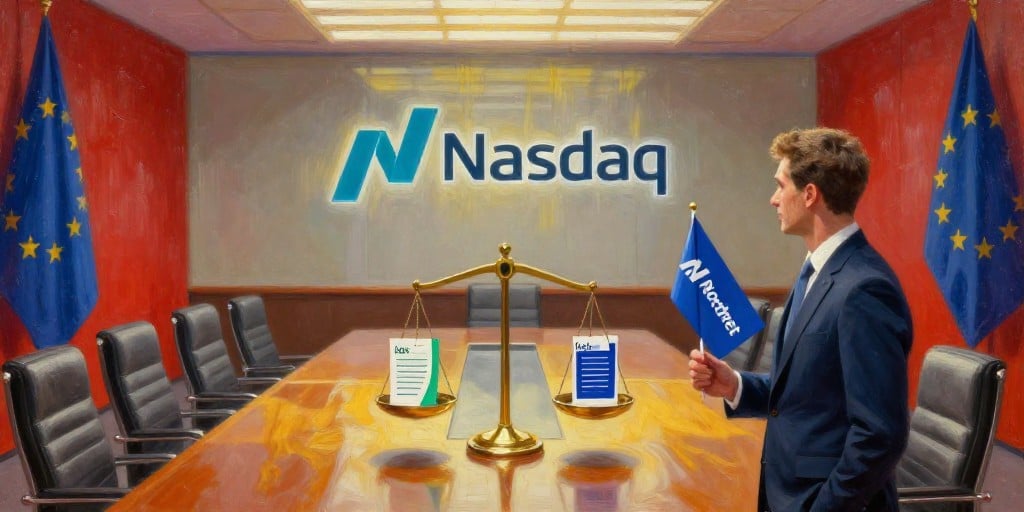
Nasdaq Inc. (NASDAQ) announced a change in its Board of Directors, effective 1 November 2026, with the election of Mr. Börje Ekholm to the board. The company also confirmed the resignation of Mr. Holden Spaht, effective 31 December 2026.
Board Composition and Strategic Implications
Mr. Ekholm, former Executive Chairman of Swedish trading platform Nordnet, brings extensive experience in European equities markets, algorithmic trading, and regulatory compliance. His appointment aligns with Nasdaq’s strategy to deepen its footprint in European markets and to reinforce its governance framework amid evolving capital‑market regulations, notably the forthcoming MiFID III directive.
Mr. Spaht’s departure follows his successful tenure during which he spearheaded initiatives in data‑driven market surveillance and cross‑border liquidity. His exit will be managed through a smooth succession plan to preserve continuity in Nasdaq’s oversight of technology and risk functions.
The board’s composition now includes 13 directors (12 voting, 1 non‑voting chair), a ratio that Nasdaq has maintained since 2019. The diversity of industry experience—spanning technology, finance, and regulatory affairs—positions the company to navigate the increasingly complex regulatory landscape and to sustain its leadership in electronic trading infrastructure.
Registered Address Confirmation
Nasdaq reaffirmed its registered office remains at 151 W. 42nd Street, New York, NY 10007. The address has been unchanged since the company’s relocation to Manhattan’s financial district in 2014, underscoring the firm’s continued commitment to proximity with U.S. capital‑market regulators and institutional investors.
Senior Debt Profile
The filing listed Nasdaq’s outstanding senior debt instruments, with maturities distributed over a ten‑year horizon:
| Issue | Principal (USD) | Coupon | Maturity |
|---|---|---|---|
| 2029 Notes | $3.25 B | 3.75 % | 2029 |
| 2030 Notes | $2.80 B | 3.60 % | 2030 |
| 2032 Notes | $1.90 B | 3.45 % | 2032 |
| 2033 Notes | $1.20 B | 3.30 % | 2033 |
These instruments were issued under unsecured, unsubordinated terms, allowing Nasdaq to maintain flexibility in its capital structure. The aggregate debt load of $9.15 B represents approximately 4.2 % of Nasdaq’s total enterprise value, as of the end of the previous fiscal year. The company’s debt‑to‑EBITDA ratio remains at 1.3x, comfortably within the range targeted by credit rating agencies for technology‑focused exchanges.
Interest‑Rate Sensitivity
With coupon rates gradually decreasing over the 2029–2033 cohort, Nasdaq benefits from a modest interest‑rate hedge effect. Assuming a parallel shift in the U.S. Treasury 10‑year yield curve of +50 bps, the incremental interest expense would increase by roughly $60 M, translating to an EPS dilution of 0.05 %. This sensitivity analysis underscores the prudence of a staggered maturity schedule to mitigate refinancing risk.
Market Impact and Investor Outlook
While the filing does not disclose immediate financial performance, the board changes and debt profile carry notable implications:
- Regulatory Alignment – Mr. Ekholm’s expertise in European regulatory frameworks will support Nasdaq’s compliance with MiFID III and forthcoming SEC data‑privacy mandates.
- Capital Structure Health – The debt maturity spread and low leverage ratio enhance Nasdaq’s credit profile, potentially translating into more favorable borrowing terms in the secondary market.
- Strategic Focus – The board’s composition signals a continued emphasis on technology innovation (e.g., AI‑driven market surveillance) and cross‑border market integration, which may drive long‑term revenue growth in exchange and post‑trade services.
Actionable Insights for Investors
- Credit Exposure – Given the firm’s low debt‑to‑EBITDA, fixed‑income investors may view Nasdaq’s senior debt as a lower‑risk component within diversified portfolios.
- Regulatory Risk – Monitor updates on MiFID III and SEC data‑privacy rules; Nasdaq’s board alignment may reduce compliance costs, but any regulatory tightening could impact trading volumes.
- Strategic Growth – Evaluate Nasdaq’s initiatives in blockchain‑based clearing and EU market expansion; these could offer upside potential for equity holders.
In summary, Nasdaq Inc.’s board restructuring and debt profile reflect a proactive stance on governance, regulatory adaptation, and financial prudence. While immediate market moves may be modest, the long‑term trajectory suggests a stable platform for continued innovation and growth in the global capital‑market ecosystem.