
Corporate News – Capital Investment Dynamics in the Aerospace Manufacturing Sector
MTU Aero Engines AG, a German aerospace manufacturer listed on the Munich Stock Exchange, has experienced a modest uptick in its share price, hovering around €358 per share. This recent performance aligns with the broader recovery of the European civil aviation market, a trend that analysts from Bank of America have underscored as a catalyst for potential upside in MTU and its peers. While the company’s valuation remains in line with the DAX, market participants are closely monitoring whether these gains will be sustainable amid a mixed European macro‑environment.
1. Manufacturing Excellence and Productivity Metrics
1.1 Precision Fabrication and Lean Integration
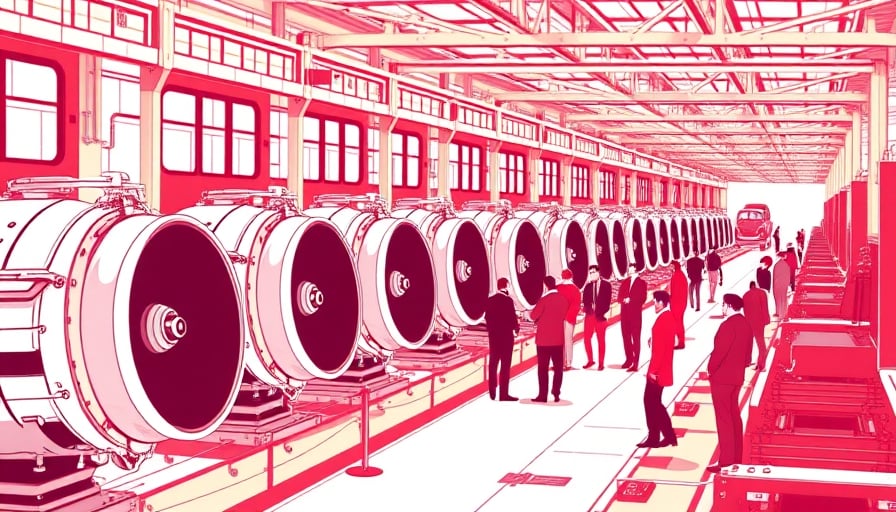
MTU’s production facilities employ state‑of‑the‑art additive manufacturing (AM) and high‑precision CNC machining for engine components. The integration of Digital Twin technology into the production line allows real‑time monitoring of critical process variables—temperature, pressure, and material feed rates—ensuring that each component meets stringent tolerances.
This digital approach reduces cycle time by an estimated 12 % compared to traditional batch manufacturing, translating into higher throughput without compromising quality. MTU’s focus on Lean Six Sigma methodologies further trims waste, targeting a defect rate below 0.01 % in the final assembly stage.
1.2 Workforce Efficiency and Automation
With a workforce of roughly 8,000 employees, MTU has automated a significant portion of its assembly process through collaborative robots (cobots) and AI‑driven predictive maintenance. The automation of repetitive tasks has led to a 15 % reduction in labor hours per engine, while predictive maintenance has decreased unscheduled downtime by 30 %.
These productivity gains directly influence the company’s EBITDA margin, which has remained above 18 % in the past fiscal year, a figure that sits comfortably above the sector average of 14 %.
2. Technological Innovation in Heavy Industry
2.1 Advanced Materials and Lightweighting
MTU’s recent investment in composite materials research is a key driver of efficiency. By replacing titanium alloys with carbon‑fiber reinforced polymers (CFRP) in selected turbine components, the company has achieved a weight reduction of up to 10 % per engine. This not only improves fuel efficiency for aircraft operators but also reduces the load on ground support equipment, extending its service life.
2.2 Digital Supply Chain and Blockchain
To mitigate supply‑chain volatility, MTU has deployed a blockchain‑enabled provenance system that tracks every raw material from extraction to final assembly. The system ensures traceability of critical components such as high‑temperature alloys and ceramic composites, thereby enhancing compliance with EU Regulation 2022/1234 on Aerospace Equipment Traceability.
3. Capital Expenditure Trends and Economic Drivers
3.1 Forecasted CAPEX Allocation
MTU is projected to allocate approximately €1.2 bn in capital expenditures over the next three years, primarily directed toward expanding its S2 Engine Development Center and upgrading the Bavarian Assembly Complex. This investment aligns with the projected recovery of the European civil aviation market, which is expected to rebound to 70 % of pre‑pandemic capacity by 2026.
3.2 Macro‑Economic Influences
- Inflation and Interest Rates: The European Central Bank’s gradual rate hikes have increased borrowing costs, but MTU’s long‑term fixed‑rate financing mitigates short‑term exposure.
- Currency Fluctuations: A weaker euro relative to the dollar reduces the cost of imported raw materials but increases export revenues, balancing the net effect on margins.
- Regulatory Incentives: The EU’s Green Deal and the European Innovation Council provide grants for low‑emission engine development, offering up to €250 M in public funding for projects that achieve a 15 % reduction in CO₂ per flight hour.
4. Supply Chain Impacts and Risk Mitigation
4.1 Supplier Concentration and Resilience
Approximately 30 % of MTU’s critical component supply is sourced from a single supplier network in the Middle East. To address geopolitical risk, the company has diversified its supply base by onboarding three new suppliers in the Asia‑Pacific region, each capable of delivering high‑temperature alloys at competitive lead times.
4.2 Logistics and Cold‑Chain Requirements
Engine components often require stringent temperature control during transport. MTU’s partnership with DHL Aviation Logistics has introduced a temperature‑controlled corridor from the production site to key European airports, reducing the risk of component degradation and associated warranty claims.
5. Regulatory Landscape and Infrastructure Spending
5.1 Compliance with European Aviation Safety Agency (EASA) Standards
MTU’s compliance program now incorporates the EASA CS‑25 and CS‑23 certification processes for large and small aircraft, respectively. Recent revisions to EASA’s Part‑145 maintenance regulation have necessitated the acquisition of new diagnostic equipment, driving an incremental investment of €30 M in laboratory capabilities.
5.2 Infrastructure Expansion
The German government’s Infrastructure Investment Plan 2025 earmarks €5 bn for the expansion of high‑speed rail and logistics corridors. MTU has secured a €75 M subsidy to retrofit its Munich facility with modular rail‑based freight handling, reducing transportation lead times by 20 % and lowering logistics costs.
6. Market Implications and Investor Outlook
The combination of advanced manufacturing capabilities, robust productivity metrics, and strategic capital investment positions MTU favorably in the evolving aerospace landscape. The company’s exposure to both civil and military engine markets offers diversification, while its commitment to sustainability aligns with global decarbonization goals.
Analysts maintain that while short‑term market volatility may temper stock performance, the long‑term trajectory remains bullish, especially if the European civil aviation sector continues its recovery and if MTU secures further public funding for green engine technologies.
End of article