Microsoft’s November 13, 2026 Cloud Outage: A Case Study in Systemic Risk and Inter‑Firm Dependence
Immediate Impact and Timeline
On the morning of 13 November 2026, Microsoft Corp experienced a prolonged service disruption that rippled through several of its flagship cloud‑based products—Outlook, Teams, and the newly rolled‑out Copilot AI assistant. The outage began in the United States early in the day, expanded throughout the United States and the United Kingdom over the next few hours, and persisted into the evening, ultimately affecting users worldwide.
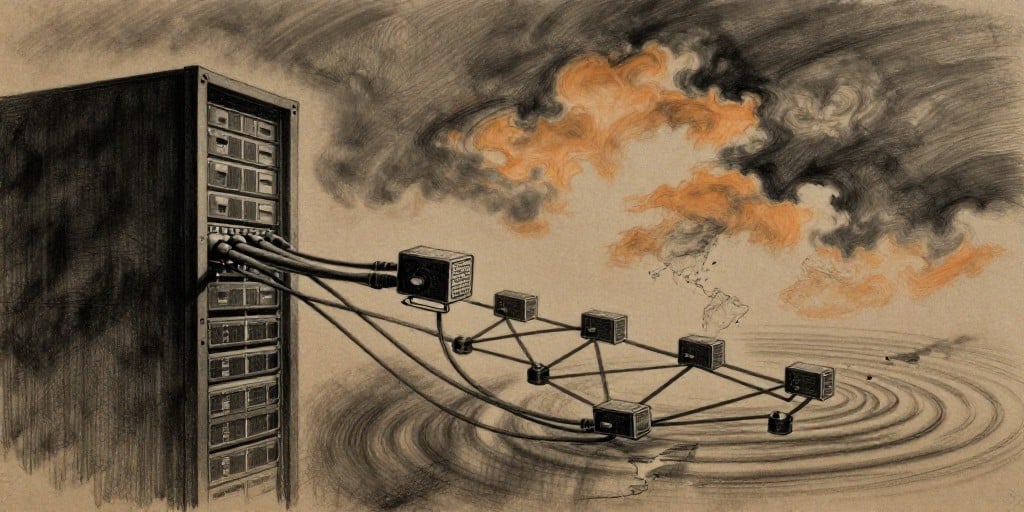
Microsoft’s technical teams traced the root cause to a process overload on a set of critical servers. When the load exceeded the servers’ capacity, the process entered a repeated shutdown cycle, triggering intermittent service failures. While traffic was redirected to backup routes, partial recovery was observed in some regions, yet a full restoration remained elusive as of the latest updates.
Ripple Effects Across the Technology Ecosystem
The outage’s reach extended beyond Microsoft’s own services. Microsoft 365 users—who rely on Outlook, Teams, and the Copilot AI for daily productivity—were disrupted, creating a cascade that touched partner platforms. Notably, OpenAI and Anthropic reported that their proprietary connectors, which feed into Microsoft’s Copilot and other AI‑driven workflows, suffered service interruptions. The inter‑dependency of cloud services became starkly apparent, underscoring how a single node’s failure can propagate across multiple ecosystems.
Market Repercussions and Investor Sentiment
The incident contributed to volatility in technology sector trading on 13 November 2026. Key indices such as the NASDAQ‑100 and the S&P 500 experienced pronounced swings as investors reacted to uncertainty over Microsoft’s reliability and the broader implications for cloud‑service resilience. Analyst commentary highlighted that the outage may influence short‑term pricing dynamics for SaaS and AI‑as‑a‑service products, prompting a reassessment of risk models for both issuers and institutional investors.
Strategic Context: The Cloud‑Reliability Imperative
Microsoft’s outage illustrates a growing trend in the technology landscape: the escalating complexity of interdependent cloud architectures. As firms layer multiple services—email, collaboration, AI assistance—on top of one another, the failure domain expands, and the cost of downtime rises. The event also underscores the importance of robust failover mechanisms and the limitations of current redundancy strategies in the face of unforeseen load spikes.
Moreover, the incident raises questions about the balance between innovation speed and operational resilience. Microsoft’s rapid deployment of Copilot AI—designed to integrate deeply with existing productivity tools—highlights the ambition to embed AI at the core of daily workflows. Yet, as this disruption demonstrates, aggressive feature rollouts can amplify systemic risk if foundational infrastructure is not proportionately hardened.
Challenging Conventional Wisdom
For years, the prevailing narrative has been that cloud‑based services are inherently more reliable than on‑premises solutions, owing to distributed architecture and scale. The 2026 outage challenges this assumption, revealing that distributed does not automatically equal robust. It also forces a re‑examination of single points of failure hidden beneath layers of abstraction, such as the process in question that became overloaded.
Further, the event invites a reevaluation of partner reliance. OpenAI and Anthropic’s connectors were impacted, illustrating that partner ecosystems, while offering added value, introduce new vectors for risk. Firms that rely on external APIs or third‑party integrations must now factor these dependencies into their continuity planning.
Forward‑Looking Analysis
Enhanced Observability and Predictive Analytics Cloud operators will likely invest more heavily in real‑time telemetry and machine‑learning–driven anomaly detection to preempt overload conditions before they culminate in service outages.
Multi‑Layered Redundancy Beyond simple failover, providers may adopt geo‑dispersed, heterogeneous redundancy—combining diverse hardware, software, and network paths—to reduce correlated failure risks.
Contractual Safeguards for Partners As the ecosystem tightens, vendors may codify Service Level Agreements (SLAs) that explicitly address cascading failures, ensuring partners have clear recourse when a primary provider’s outage affects downstream services.
Regulatory Scrutiny of Cloud Resilience Regulators in regions such as the EU and the US may introduce tighter operational resilience requirements for critical SaaS platforms, mirroring the approach taken for financial services and healthcare.
Investor Recalibration of Risk Models The episode will likely prompt analysts to integrate systemic risk metrics—including inter‑dependency indices—into valuation models for cloud‑service providers. This shift could affect capital allocation, M&A activity, and the perceived attractiveness of high‑growth tech stocks.
Conclusion
Microsoft’s November 13, 2026 outage serves as a microcosm of the challenges that accompany the relentless march of cloud‑native innovation. While the event disrupted millions of users and rattled markets, it also offered a sobering reminder that the integration of AI, productivity, and collaboration tools magnifies the stakes of reliability. As the industry evolves, the imperative will be to reconcile rapid feature delivery with the rigorous operational safeguards required to sustain the digital infrastructures that underpin modern commerce and society.