
Meta’s Cloud Ambitions Spark Industry‑Wide Reassessment
Meta Platforms Inc.’s recent announcement that it will expand its proprietary cloud infrastructure has reverberated far beyond its own balance sheet, prompting a comprehensive re‑evaluation of the artificial‑intelligence (AI) and semiconductor ecosystems. The declaration arrived against a backdrop of a pronounced sell‑off in technology equities across key global exchanges, including the U.S. Nasdaq and South Korea’s KOSPI, as investors grappled with the implications of an increasingly saturated computing market.
Immediate Market Reaction
The disclosure triggered a modest, yet discernible, pullback in the technology sector. Shares of German chip‑related companies such as Infineon Technologies, ASML, and the semiconductor‑focused holdings of Deutsche Börse fell between 1 % and 4 % in early trading sessions, reflecting heightened uncertainty about future demand for high‑performance silicon. German construction conglomerate HOCHTIEF, which had recently benefited from AI‑driven infrastructure initiatives, recorded a 0.8 % decline in its share price, underscoring the spillover from semiconductor sentiment to adjacent industrial players.
While the broader market indices exhibited a mixed performance—benefitting from gains in consumer staples and energy equities—the technology segment’s correction was broadly in line with the prevailing sentiment that the sector’s valuation premium may be unsustainable in the face of potential supply‑chain bottlenecks and shifting demand dynamics.
Strategic Implications for AI Infrastructure
Meta’s decision to build and own a dedicated cloud platform signals a pivot away from the prevailing “cloud‑first” paradigm that has dominated the AI research and deployment landscape. By investing in internal data‑centre capacity, Meta aims to reduce latency, enhance data sovereignty, and secure a competitive edge in training large language models. However, analysts interpret the move as evidence that the demand for specialized AI hardware and software may be plateauing, especially after a rapid escalation in spending during the pandemic‑era tech boom.
The shift also raises concerns about potential overlap with the established cloud providers—Amazon Web Services (AWS), Microsoft Azure, and Alphabet’s Google Cloud Platform (GCP)—that currently command the lion’s share of enterprise AI workloads. Meta’s entry could dilute the market share of these incumbents, prompting them to accelerate their own capacity expansions and pricing strategies. Simultaneously, smaller players may face increased pressure to differentiate on niche services or cost efficiencies.
Semiconductor Sector Dynamics
The ripple effect on the semiconductor industry is multifaceted. On the one hand, Meta’s push for in‑house data‑centre capabilities could spur a surge in demand for AI‑optimized chips such as GPUs, tensor‑processing units (TPUs), and application‑specific integrated circuits (ASICs). On the other hand, the perceived slowdown in demand for dedicated AI infrastructure suggests that the recent rally in semiconductor stocks may have been partly speculative. The resulting volatility is evident in the modest declines experienced by European chipmakers and the heightened scrutiny of supply‑chain resilience amid geopolitical tensions.
Moreover, the broader economic backdrop—marked by tightening monetary policy, rising inflation, and slower global growth forecasts—further constrains capital expenditures in the tech space. Companies are increasingly cautious about large‑scale infrastructure investments, preferring to adopt a “cloud‑first” or hybrid approach to mitigate risk.
Cross‑Sector Connections and Macro Trends
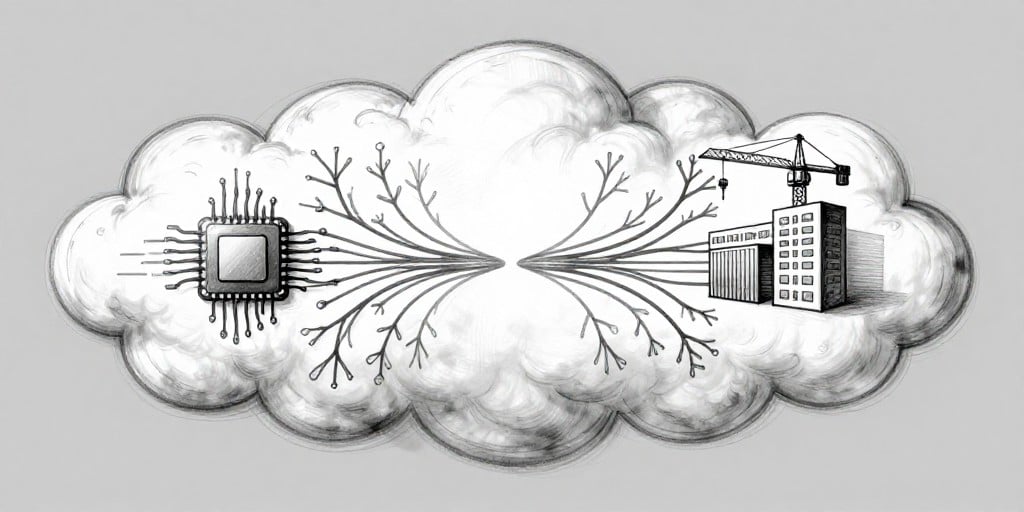
The reaction to Meta’s announcement also highlights inter‑sectoral linkages. For instance, construction firms like HOCHTIEF that are leveraging data‑centres to support AI‑driven logistics and asset management are exposed to the same supply‑chain and technology risk profiles as traditional semiconductor firms. Energy companies, which provide the power backbone for massive data‑centres, are similarly implicated; any slowdown in data‑centre construction could reduce their demand for renewable energy solutions.
Furthermore, the correction in the technology segment may influence broader market dynamics, as investors rebalance portfolios toward more defensively positioned sectors such as healthcare and utilities. This shift can alter the capital flow into technology-focused venture capital and private equity, potentially slowing the pace of innovation funding.
Outlook
In the short term, Meta’s cloud expansion is likely to cause continued volatility in technology equities, as market participants reassess the sustainability of the AI infrastructure boom. Over the medium to long haul, the competitive landscape may evolve toward greater differentiation, with cloud providers and hardware vendors collaborating or consolidating to meet the nuanced needs of AI workloads. Companies across the spectrum will need to maintain rigorous analytical frameworks to navigate the intersection of technological advancement, supply‑chain constraints, and macroeconomic uncertainty.