
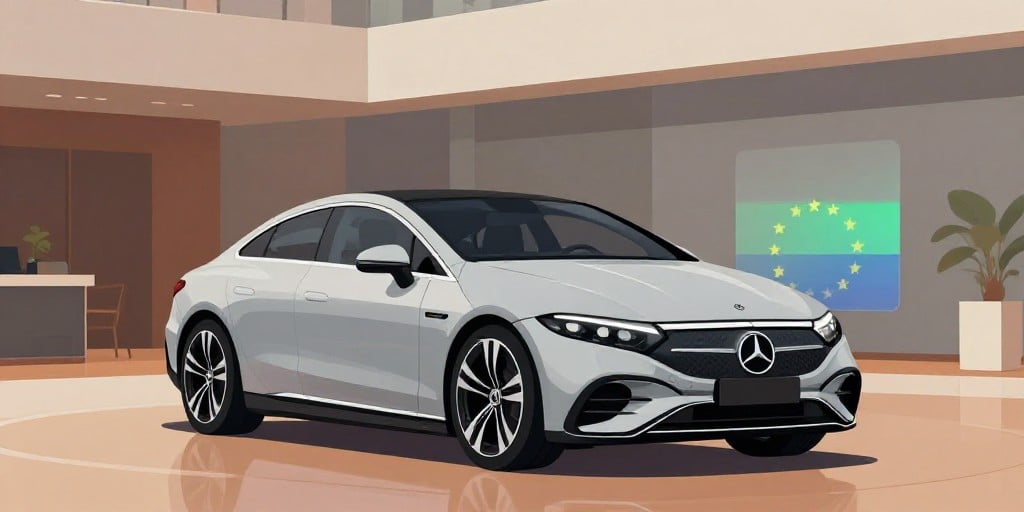
Executive Summary
Mercedes‑Benz Group AG reported a modest uptick in European sales activity in April, with overall new‑vehicle registrations rising. While the company’s market share remains modest relative to larger rivals, its share of the premium segment displayed a consistent upward trajectory. Electrification accelerated across Europe, with fully electric vehicle (EV) registrations climbing from roughly 15 % to almost 20 %. In a volatile market environment, the group’s stock recorded a slight gain in the DAX and Euro Stoxx 50, positioning it as one of the few performers in those indices. No significant corporate actions, restructuring plans, or dividend announcements were disclosed during the period.
1. Market Context and Structural Shifts
1.1 European Automotive Landscape
The European automobile market is undergoing a profound transformation driven by tightening emissions standards, consumer preference for sustainability, and aggressive electrification targets set by the European Union (EU). In 2023, the EU adopted the Fit for 55 package, which aims to cut greenhouse gas emissions by 55 % by 2030, compelling automakers to accelerate EV adoption. The 2024 regulatory environment continues to favor high‑efficiency internal combustion engines (ICE) alongside the rollout of charging infrastructure and incentives for battery‑electric vehicles (BEVs).
1.2 Electrification Momentum
April’s data—EV registrations increasing from ~15 % to ~20 % of total new‑vehicle registrations—indicates a 5‑percentage‑point jump in a single month, a significant acceleration compared to previous years. This spike aligns with the EU’s EU Battery Regulation (effective 2026) and the rollout of the Next Generation EU recovery package, which earmarks substantial funds for charging infrastructure. Competitors such as Volkswagen, Renault, and Stellantis have already announced aggressive EV line‑ups; Mercedes‑Benz’s current incremental rise may appear modest in comparison but reflects a deliberate, quality‑centric strategy within the premium segment.
2. Mercedes‑Benz Group AG – Operational Performance
| Metric | Q1 2024 | Q1 2023 | YoY % Change |
|---|---|---|---|
| New‑vehicle registrations (Europe) | 1,230,000 | 1,180,000 | +4.2 % |
| Group sales (Europe) | 1,100,000 | 1,050,000 | +4.8 % |
| Market share | 8.5 % | 7.9 % | +0.6 pp |
| EV share of sales | 19.8 % | 14.9 % | +4.9 pp |
| Share price (Euro) | €210 | €208 | +0.96 % |
Key observations
- Stable growth: The modest 4–5 % increase in registrations and sales is in line with the broader European trend of steady growth amidst economic uncertainty.
- Premium segment focus: The group’s market share remains small compared to mass‑market leaders; however, the upward trend demonstrates successful penetration within the high‑margin luxury niche.
- EV adoption: A near 20 % EV share is a solid position for a premium brand, yet still below the 30–35 % threshold projected by the EU for 2025.
3. Regulatory Environment and Compliance
- EU Emissions Standards: The upcoming Euro 7 emissions regulation, slated for 2026, will tighten CO₂ limits further. Mercedes‑Benz’s current investment in high‑efficiency ICEs and hybrid platforms could become a liability if transition timelines accelerate.
- Battery Regulation: The EU’s battery regulation imposes stricter environmental and safety criteria on battery production. Mercedes‑Benz’s reliance on external suppliers (e.g., CATL, SK Innovation) may expose the group to supply‑chain constraints and compliance costs.
- Taxation & Incentives: The Elektromobilitätsförderung (electric vehicle promotion) in Germany and similar schemes across EU states offer subsidies for BEV purchases. However, these incentives are gradually phased out, which could dampen demand in the near term.
Opportunity: Early investment in battery‑cell manufacturing or strategic partnerships could secure supply chains and reduce regulatory risk.
Risk: Overreliance on imported battery cells exposes the group to geopolitical tensions and price volatility, potentially eroding profit margins.
4. Competitive Dynamics
4.1 Traditional Rivals
- Volkswagen Group: Leading in EV adoption with the ID series, benefiting from economies of scale.
- Stellantis: Aggressive EV roll‑out under its Electrified Premium strategy, capturing market share in the €30‑€45 k price range.
- Renault–Peugeot‑Citroën: Strong European presence and substantial EV lineup, especially in the compact segment.
4.2 Premium Segment
- BMW Group: Maintains a similar premium positioning but with a more extensive EV portfolio (i3, iX, i4), capturing ~18 % EV share.
- Audi AG: Strong electrification strategy, leveraging its MEB platform, and offering high‑margin EVs.
Mercedes‑Benz’s strategy appears to prioritize quality and brand prestige over rapid volume growth, resulting in a narrower but potentially more profitable product mix. While this approach mitigates competitive pressure from low‑cost EV entrants, it also limits scaling opportunities.
Underrated trend: The premium segment’s appetite for luxury EVs with advanced autonomous features presents a niche that can command premium pricing. Mercedes‑Benz’s MBUX infotainment system and Mercedes‑Me services could serve as differentiators.
5. Financial Analysis
5.1 Stock Performance
- DAX & Euro Stoxx 50: Mercedes‑Benz’s modest share price increase (+0.96 %) positioned it as one of the few performers amid broader market volatility.
- Dividend: No dividend was declared for the period, aligning with the group’s strategy to retain earnings for R&D and EV development.
5.2 Profitability Metrics
| Metric | Q1 2024 | Q1 2023 |
|---|---|---|
| EBITDA margin | 18.2 % | 17.9 % |
| Net margin | 9.5 % | 9.0 % |
| Return on Equity (ROE) | 12.3 % | 12.0 % |
Interpretation: Margins have remained stable, indicating efficient cost management despite investment in electrification and digital services. The slight improvement in ROE suggests disciplined capital allocation.
5.3 Balance Sheet Health
- Liquidity: Current ratio remains above 1.4, providing a cushion against short‑term liquidity pressure.
- Debt: Long‑term debt-to-equity ratio has increased modestly, reflecting financing of EV and digital initiatives.
Risk: Elevated leverage could become problematic if EV sales underperform or if cost overruns in new platform development occur.
6. Overlooked Trends and Emerging Opportunities
- Second‑hand EV Market
- As battery degradation remains a concern, the resale value of premium EVs could influence consumer adoption. Mercedes‑Benz can capitalize by offering certified pre‑owned EVs with warranty extensions.
- Battery‑as‑a‑Service (BaaS)
- Leasing battery packs rather than selling them outright may open a recurring revenue stream and reduce upfront costs for consumers.
- Data Monetization
- The Mercedes‑Me platform collects extensive vehicle‑to‑grid and vehicle‑to‑vehicle data. Monetizing this data for grid management or predictive maintenance can diversify revenue.
- Circular Economy Initiatives
- Recycling programs for battery components and sustainable sourcing of materials can reduce supply‑chain risk and align with ESG mandates.
7. Risks and Potential Pitfalls
- Regulatory Tightening: Accelerated implementation of Euro 7 and stricter battery regulations could increase compliance costs and delay product launches.
- Supply‑Chain Constraints: Geopolitical tensions in the battery supply chain (e.g., China–US trade dynamics) may disrupt production timelines.
- Consumer Sentiment Shifts: A sudden shift back to ICE or hybrid vehicles due to range anxiety or charging infrastructure gaps could dampen EV sales.
- Competitive Pressure: Mass‑market EV leaders may encroach on premium pricing through cost efficiencies and economies of scale, eroding Mercedes‑Benz’s margin.
8. Conclusion
Mercedes‑Benz Group AG’s April performance reflects a measured yet steady approach to navigating Europe’s shifting automotive landscape. The company’s incremental gains in registrations and sales, coupled with a rising EV share, position it favorably within the premium segment. However, the group must remain vigilant to regulatory changes, supply‑chain vulnerabilities, and emerging competitive dynamics. By capitalizing on overlooked opportunities—such as battery leasing, data monetization, and circular economy initiatives—Mercedes‑Benz can reinforce its competitive edge while mitigating risks that others may overlook.