
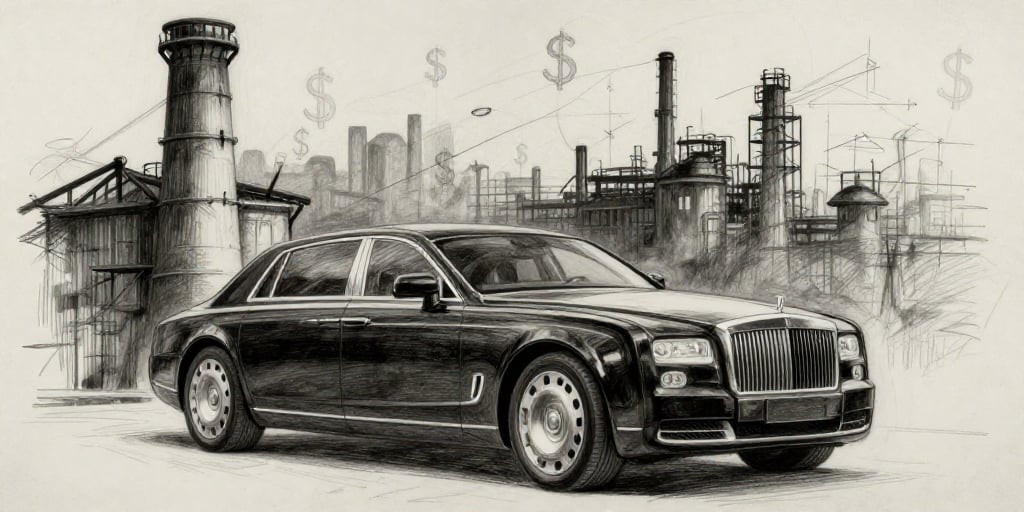
Mercedes‑Benz Group AG Faces Potential 25 % U.S. Import Tariff Amid Renewed Trade Tensions
The recent announcement by U.S. President Donald Trump that will raise the tariff on vehicles imported from the European Union to 25 % has sent ripples through the automotive sector, with immediate repercussions for German automaker Mercedes‑Benz Group AG and its European peers listed on U.S. exchanges. While the United States will continue to offer tariff‑free access to vehicles produced in domestic plants, the move signals a potential shift in U.S. trade policy that could alter the cost structure and competitive positioning of EU‑origin vehicles in the lucrative American market.
1. Context: A New Ceiling on EU Imports
In 2025, the United States and the European Union signed a trade agreement that capped tariffs on most EU goods—including passenger automobiles—at 15 %. The agreement, still under the process of full ratification by the EU, was designed to provide a predictable trade environment for both sides. President Trump’s recent statement indicates that the U.S. government believes the EU has not fully implemented the 15 % ceiling, and therefore intends to apply an elevated tariff of 25 % on all vehicles originating from EU factories, regardless of their eventual destination. Vehicles manufactured in U.S. plants remain exempt from the increased duty.
2. Immediate Market Impact
Shares of Mercedes‑Benz, Volkswagen, and Stellantis fell sharply on the day of the announcement, reflecting investor anxiety about the potential cost implications of a higher import duty. Market analysts attribute the dip to several factors:
| Factor | Expected Impact |
|---|---|
| Tariff Increase | A 10 % jump in cost for EU‑origin vehicles, potentially eroding margin or forcing price adjustments. |
| Export Reliance | Mercedes‑Benz’s premium models account for a significant share of its U.S. sales; a tariff hike could reduce sales volume or compress margins. |
| Competitive Dynamics | U.S.‑made rivals would remain tariff‑free, potentially gaining a price advantage and market share. |
| Investor Sentiment | Uncertainty over the implementation timeline and possible retaliation from the EU could lead to longer‑term valuation adjustments. |
Pre‑market trading data show a 3–5 % decline in Mercedes‑Benz shares, while Volkswagen and Stellantis exhibited similar, albeit slightly less pronounced, movements. The volatility underscores the sensitivity of the sector to trade policy changes.
3. Underlying Business Fundamentals
Mercedes‑Benz Group AG’s revenue mix is heavily weighted toward the United States, where premium models such as the S‑class and G‑class drive profitability. According to the company’s 2023 annual report, U.S. sales contributed roughly 12 % of total revenue and 18 % of operating profit. A 25 % tariff would translate to an incremental cost of approximately $3,750 per vehicle, assuming an average import price of $15,000 for a mid‑tier model. This cost could either be absorbed through margin compression or passed on to consumers, potentially diminishing demand elasticity.
Furthermore, the company’s strategy involves expanding its manufacturing footprint in the U.S., with planned investments in the Alabama and Kentucky plants. While such domestic production would shield the firm from the tariff, the transition is neither instantaneous nor cost‑free. Production lines must be reconfigured, supply chains realigned, and workforce upskilled, all of which entail capital expenditures and operational disruptions.
4. Regulatory Environment and Negotiation Dynamics
The European Union’s response—labeling the tariff hike as a breach of the negotiated agreement—highlights a broader strategic impasse. EU officials have urged a return to the negotiated terms, stressing that the agreement was premised on mutual trust and compliance. The U.S. government, on the other hand, frames the tariff increase as a bargaining chip in ongoing trade discussions, suggesting that it could be leveraged to secure concessions on other trade issues such as intellectual property, digital services, and defense procurement.
The lack of a specified implementation date further complicates matters. Companies like Mercedes‑Benz must decide whether to accelerate their U.S. production plans or absorb the tariff, potentially incurring higher costs for a market that is already price-sensitive. The EU’s ongoing efforts to ratify the trade framework add another layer of uncertainty; any delay could prolong the period of tariff ambiguity.
5. Competitive Dynamics and Market Segmentation
Mercedes‑Benz’s premium positioning may buffer it against tariff increases to some extent, as luxury consumers often exhibit lower price elasticity. However, the U.S. automotive market is increasingly competitive, with domestic brands like Tesla, Ford, and General Motors intensifying their focus on high‑performance vehicles and autonomous technology. The tariff could accelerate a shift toward U.S. production, encouraging domestic suppliers and reducing lead times.
Conversely, the tariff could also create a “tariff‑protected niche” where consumers prefer EU‑made vehicles for their perceived quality, thereby sustaining demand. The outcome will likely depend on the speed at which domestic production ramps up, the elasticity of consumer demand for premium models, and the broader macroeconomic environment, including interest rates and consumer confidence.
6. Risk Assessment and Strategic Opportunities
| Risk | Mitigation | Opportunity |
|---|---|---|
| Tariff-induced cost pressure | Increase domestic production | Expand U.S. manufacturing footprint to reduce reliance on imports |
| Competitive disadvantage | Diversify product portfolio | Introduce new premium models with differentiated features |
| Regulatory uncertainty | Monitor trade negotiations closely | Engage in lobbying and public diplomacy to influence policy |
| Supply chain disruption | Localize supply chain components | Leverage existing U.S. plant infrastructure to attract suppliers |
From an investment standpoint, the tariff increase could be a double‑edged sword. While it may pressure Mercedes‑Benz’s margins, it also opens the door for strategic realignment toward domestic production, potentially leading to higher long‑term profitability if executed efficiently.
7. Conclusion
Mercedes‑Benz Group AG stands at a critical junction where trade policy, production strategy, and market dynamics intersect. The announced tariff hike introduces a new layer of complexity that challenges conventional wisdom regarding the stability of the U.S.–EU trade relationship. While the company’s existing U.S. manufacturing capacity offers a degree of insulation, the broader uncertainty surrounding the implementation timeline and potential retaliatory actions by the EU necessitate a cautious, data‑driven approach. Investors and industry stakeholders alike must remain vigilant, as any subsequent developments could reshape competitive dynamics within the European automotive sector operating in the United States.