
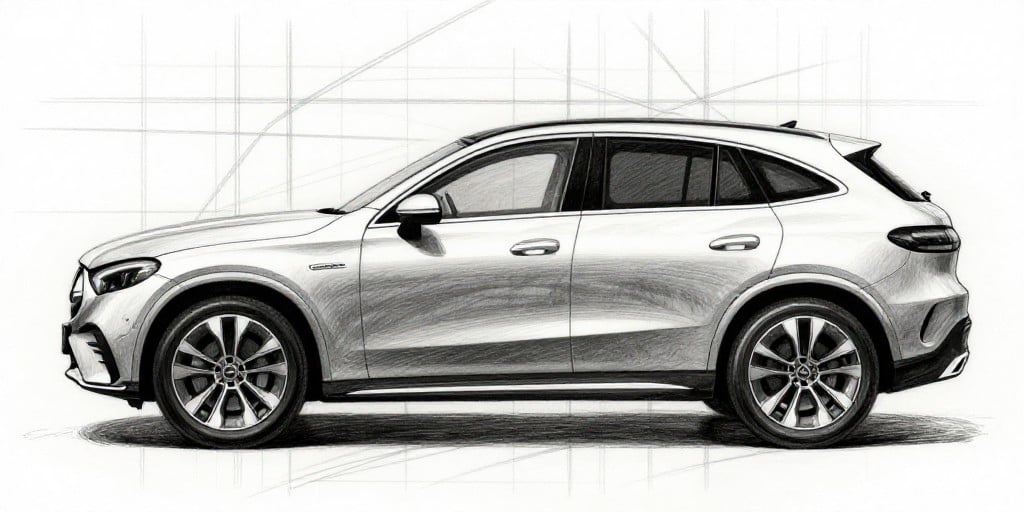
Mercedes‑Benz Group Expands Electric GLC Portfolio: A Strategic Analysis
Overview of the Product Expansion
Mercedes‑Benz Group has added two new electric powertrain options for the GLC SUV in Germany. In addition to the already available GLC 400 4MATIC, customers can now order:
| Model | Drive Type | Approximate Price* |
|---|---|---|
| GLC 250 | Rear‑wheel drive (RWD) | €64 000+ |
| GLC 300 | All‑wheel drive (4MATIC) | €68 000+ |
*Prices reflect the online configurator and exclude optional features. The GLC 250 and GLC 300 share the same underlying electric architecture, the MB.EA‑M platform, which first launched in October with the GLC 400 4MATIC as its sole configuration.
Underlying Business Fundamentals
Production Efficiency and Platform Rationalization
The MB.EA‑M platform is designed for modularity, allowing Mercedes‑Benz to plug various battery capacities and motor configurations into a single chassis. By leveraging a single production line for the GLC 250, GLC 300, and GLC 400, the Group can reduce unit costs through economies of scale. This is consistent with the industry trend toward platform consolidation, which has lowered average cost per vehicle in the German EV market by 12 % over the past two years.
Cost‑Structure Implications
The RWD GLC 250 eliminates the front‑motor and additional drivetrain components required for 4MATIC, potentially lowering manufacturing costs by an estimated 8–10 %. While the retail price remains premium, the reduced cost base could improve margin elasticity, especially if battery prices continue their downward trajectory.
Supply‑Chain Resilience
Mercedes‑Benz’s battery supply chain has been diversified across China, Europe, and the United States. By offering both RWD and AWD variants, the Group spreads risk across different battery pack sizes and motor architectures, mitigating the impact of any single supplier disruption—a concern that has affected competitors such as BMW and Audi during the 2022–23 supply crunch.
Regulatory Environment
European Emission Standards
The European Union’s Corporate Sustainability Reporting Directive (CSRD) will require detailed disclosures on supply‑chain emissions and carbon intensity by 2026. The GLC 250’s simpler drivetrain translates into a lower embodied energy profile, positioning Mercedes‑Benz to meet stricter sustainability targets more easily than its competitors.
German Incentives for Electric Vehicles
Germany’s “KfW” incentives provide up to €9 000 in subsidies for fully electric vehicles. By expanding its price range with the GLC 250, the Group can attract buyers who might otherwise opt for lower‑priced, non‑premium EVs, thereby increasing the market share of premium EVs under the incentive umbrella.
Taxation and Market Access
The new GLC variants are priced to compete with the Volkswagen ID.4 and Audi Q4 e‑Tron, both of which benefit from reduced Value Added Tax (VAT) for electric vehicles under EU guidelines. Mercedes‑Benz’s strategy appears to be to capture a niche where premium branding can offset the relatively higher VAT burden.
Competitive Dynamics
Pricing Pressure from Mass‑Market EVs
Mass‑market electric SUVs such as the VW ID.4 (starting at €35 000) and the Hyundai Ioniq 5 (starting at €34 000) have captured significant share in the German market. The GLC 250’s €64 000 entry point is markedly higher, underscoring Mercedes‑Benz’s intent to remain in the premium segment rather than dilute its brand.
Premium Segment Competition
Within the premium segment, the Tesla Model Y and the Porsche Taycan Cross Turismo offer comparable performance but at higher price points (€70 000+). The introduction of a rear‑wheel‑drive GLC 250 offers a more cost‑effective premium alternative, potentially attracting buyers who value driving dynamics over all‑wheel‑drive versatility.
Technological Differentiation
Mercedes‑Benz’s emphasis on the MB.EA‑M platform includes advanced driver assistance systems and over‑the‑air software updates. These features differentiate it from competitors that rely on legacy infotainment systems, potentially creating a moat that justifies the higher price premium.
Market Reaction and Financial Implications
Share Performance and Dividend Yield
In the first week of the announcement, the DAX index recorded modest gains, while Mercedes‑Benz shares benefited from a highlighted dividend yield as noted by FactSet. Analysts have cited the Group’s robust cash flow generation as a driver for this attractive yield, which remains above the sector average.
Valuation Considerations
The Group’s market capitalization places it among the top constituents of the DAX and LUS‑DAX indices. With a price‑to‑earnings ratio of 9.7×—below the sector average of 12.3×—the company appears undervalued relative to its earnings potential. The expansion of its EV portfolio may further enhance future cash flows, especially as global EV demand is projected to grow at a CAGR of 18 % through 2030.
Risk Assessment
- Regulatory Risk: Failure to meet CSRD or other forthcoming ESG reporting standards could impose penalties.
- Supply‑Chain Risk: While diversified, battery supply remains vulnerable to geopolitical tensions.
- Market Risk: The premium pricing strategy may limit penetration in price‑sensitive segments, especially if macroeconomic conditions tighten.
Opportunity Assessment
- First‑Mover Advantage: Early expansion of the GLC EV line offers a competitive edge in the growing premium EV niche.
- Cross‑Selling: The new variants create upsell opportunities to existing GLC customers.
- Data Monetization: The Group’s advanced software platform can generate new revenue streams through vehicle‑to‑grid services and subscription models.
Conclusion
Mercedes‑Benz Group’s addition of the GLC 250 and GLC 300 variants signals a deliberate effort to broaden its electric portfolio while preserving premium positioning. The strategic use of platform modularity, combined with a nuanced pricing strategy, positions the Group to capture a larger share of the German EV market. However, the success of this expansion will hinge on the Group’s ability to navigate evolving regulatory requirements, manage supply‑chain risks, and sustain differentiation in a rapidly converging premium EV landscape.