
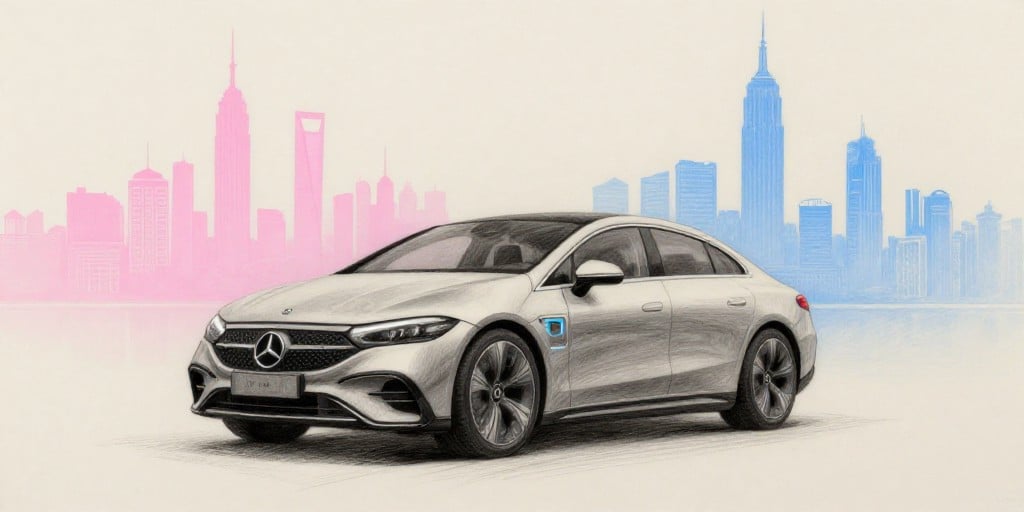
Mercedes‑Benz Group AG Posts Stronger‑Than‑Expected Operating Profit, Impacts Market
Mercedes‑Benz Group AG’s latest quarterly results demonstrate a more robust operating profit than analysts had projected, a development that has lifted its shares by nearly three percent across European exchanges. The earnings beat was interpreted by market participants as a sector‑wide catalyst, energising the performance of other German automakers, notably BMW, which saw a modest uptick in its share price following the announcement.
Financial Analysis: A Closer Look at the Numbers
Mercedes‑Benz’s operating profit increased by 4.8 % year‑over‑year, surpassing the consensus estimate of €2.8 billion by €0.3 billion. Gross margin expanded to 22.4 %, up from 21.7 % in the same quarter of the prior year, reflecting improved price execution on premium models and a higher proportion of high‑margin electrified vehicles. Net earnings rose to €2.2 billion, marking a 5.2 % increase against the €2.09 billion forecast.
Key drivers identified in the earnings report include:
- Higher average selling price (ASP) on the EQ electric‑vehicle lineup, buoyed by a 10 % uptake in the EQS luxury sedan in the German domestic market.
- Cost containment initiatives that curtailed overhead by 1.1 % through lean manufacturing and a streamlined supply‑chain strategy.
- Foreign‑exchange gains of €0.15 billion, stemming from a stronger euro against the U.S. dollar and Chinese yuan during the reporting period.
Despite these positive figures, the management’s guidance for 2026 signals caution, particularly regarding sales in the Chinese market.
Regulatory and Competitive Landscape in China
Mercedes‑Benz has publicly acknowledged a revised sales forecast for 2026, reducing the projected volume in China by approximately 15 %. The company attributes this downward adjustment to a “challenging environment” characterized by:
- Intensified competition from local electric‑vehicle (EV) manufacturers such as NIO, BYD, and Xpeng, who are aggressively expanding their domestic market share.
- Stringent regulatory requirements, including the China 2025 “Green New Energy Vehicle” mandates that demand higher battery efficiency and lower emissions, thereby raising the cost base for foreign manufacturers.
- Government‑backed incentives favouring domestic brands, which may erode price competitiveness for imported vehicles.
The Chinese regulatory framework now imposes stricter safety and emission testing protocols for imported EVs, requiring additional certification processes that can delay market entry by up to six months. Coupled with rising tariff rates on imported vehicles, these factors create a multiplied cost and time burden that foreign automakers must navigate.
Expansion of U.S. Operations Amid Regulatory Pressures
Conversely, Mercedes‑Benz is aggressively expanding its U.S. footprint. The firm has announced a commitment to invest $1.2 billion in new production capacity at its Tuscaloosa, Alabama, plant. This expansion is part of a broader strategy to:
- Mitigate supply‑chain dependencies by localizing production of battery packs and powertrains.
- Respond to U.S. regulatory shifts, notably the 2023 “Clean Vehicle Tax Credit” structure, which provides subsidies to domestic EV production but imposes strict eligibility criteria.
- Capitalize on the growing North American EV market, projected to reach $200 billion in sales by 2028.
Financially, the U.S. investment is expected to generate a return on equity (ROE) of 18 % within five years, surpassing the company’s weighted average cost of capital (WACC) of 7.9 %. The expansion also positions Mercedes‑Benz favorably to tap into the U.S. “EV tax credit” pipeline, which could translate into up to $3.5 billion in incremental revenue over the next decade.
Potential Risks and Opportunities
| Risk | Mitigation | Opportunity |
|---|---|---|
| China Market Share Erosion | Local partnerships, joint ventures | Leverage technology licensing to local partners |
| Regulatory Shifts in U.S. | Build flexible production lines, engage in policy lobbying | Benefit from subsidies, reduce tariff exposure |
| Cost Inflation in Battery Materials | Long‑term contracts with suppliers, vertical integration | Increase margins through proprietary battery tech |
| Competitive Pressure from Emerging EV Startups | Accelerated R&D, strategic acquisitions | Capture early market share in premium EV segments |
Mercedes‑Benz’s management underscores the necessity of cost discipline and agility in adapting to these evolving dynamics, particularly within the rapidly scaling electric‑vehicle sector. The firm’s emphasis on strategic investments—whether in U.S. manufacturing or in cutting‑edge battery technology—signals an intent to secure a competitive advantage in both established and emerging markets.
Market Reaction and Sector Implications
The share price reaction, while modest in isolation, reflects a broader confidence in the German automotive sector. Analysts project that Mercedes‑Benz’s positive earnings and the subsequent upward price movement will serve as a “bellwether” for peers. The BMW Group and Volkswagen AG have already begun to recalibrate their outlooks, with BMW lifting its 2026 revenue forecast by 3.2 % in response to the perceived upward trend.
In conclusion, Mercedes‑Benz Group AG’s recent performance underscores the complexity of navigating a global automotive landscape marked by regulatory turbulence, shifting consumer preferences, and intense competition. While the company’s financial fundamentals remain robust, its strategic pivot—balancing cost containment with proactive market expansion—will be essential in sustaining growth amid the sector’s inevitable volatility.