Mercedes‑Benz Group AG Announces Strategic Adjustments and Sustainability Initiatives
Mercedes‑Benz Group AG has issued several announcements that illustrate its ongoing strategic and operational adjustments across multiple dimensions of its business. The German automaker has reiterated its commitment to a globally integrated reporting framework, advanced its sustainability agenda, clarified its regulatory standing in the United States, and undertaken governance reforms designed to accelerate climate‑related outcomes.
Interim Financial Reporting and Global Reporting Framework
Through its subsidiary Mercedes‑Benz Australia/Pacific Pty Ltd, the Group disclosed the interim financial report for the half‑year ended 30 June 2026. The release confirms the automaker’s adherence to a unified global reporting framework, ensuring consistency across jurisdictions and enhancing transparency for investors and regulators alike. By leveraging its international subsidiary, Mercedes‑Benz demonstrates the operational flexibility required to manage diverse market conditions while maintaining stringent financial controls.
Strengthening the Sustainability Agenda
Reinvestment of ICE Profits in Electrification
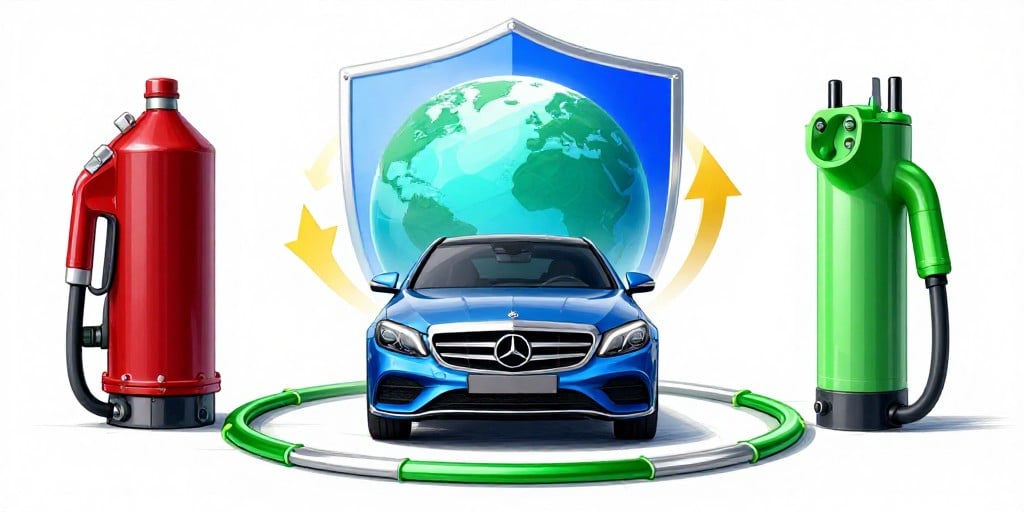
Board member Olaf Schick announced that the profits generated by internal‑combustion‑engine (ICE) vehicles will be systematically reinvested in electrification and decarbonisation initiatives. The transition to electric vehicles (EVs) is acknowledged as exerting short‑term margin pressure; however, the Group projects that parity with conventional models will be achieved by the end of the decade. This outlook aligns with broader industry dynamics wherein automotive manufacturers are reallocating capital from ICE production lines to battery‑electric platforms in anticipation of regulatory tightening and shifting consumer preferences.
Circular‑Economy Materials and Partnerships
Mercedes‑Benz is expanding its use of recycled aluminium and tyre‑derived door handles. In a strategic partnership with Hydro, the company will source aluminium rich in scrap content, thereby reducing the environmental footprint of its vehicle chassis and components. This initiative reflects a cross‑sector trend in which the automotive industry is integrating circular‑economy practices to meet both environmental commitments and cost‑management objectives.
Regulatory Landscape: U.S. Senate Bill and Ownership Structure
A U.S. Senate bill that would restrict the sale of vehicles with significant Chinese ownership does not pose a threat to Mercedes‑Benz’s sales in the United States. Lawmakers confirmed that the automaker’s ownership structure falls below the 15 percent threshold required to trigger the ban. Consequently, Mercedes‑Benz can continue to operate within the U.S. market without restructuring its ownership or supply chains, preserving its market position in a key geographies.
Governance Reforms to Accelerate Climate Targets
Internal governance reforms include a reduction of the sustainability advisory board from eleven to five members. The objective is to streamline decision‑making and accelerate the implementation of climate targets. By consolidating expertise and focusing on core sustainability metrics, the Group aims to translate its climate commitments into tangible operational outcomes more efficiently.
Market Performance and Broader Economic Context
The company’s shares experienced modest declines within the Euro STOXX 50 and German indices, a reflection of broader market volatility rather than a company‑specific issue. Despite the dip, Mercedes‑Benz remains a key constituent of the benchmark, underscoring its resilience and enduring relevance in the European capital market.
Conclusion
Collectively, these developments demonstrate Mercedes‑Benz Group AG’s strategic focus on balancing profitability, regulatory compliance, and a progressive sustainability trajectory. By aligning financial reporting, operational investment, regulatory positioning, and governance structures, the Group is positioning itself to navigate the complex interdependencies that characterize the modern automotive landscape.