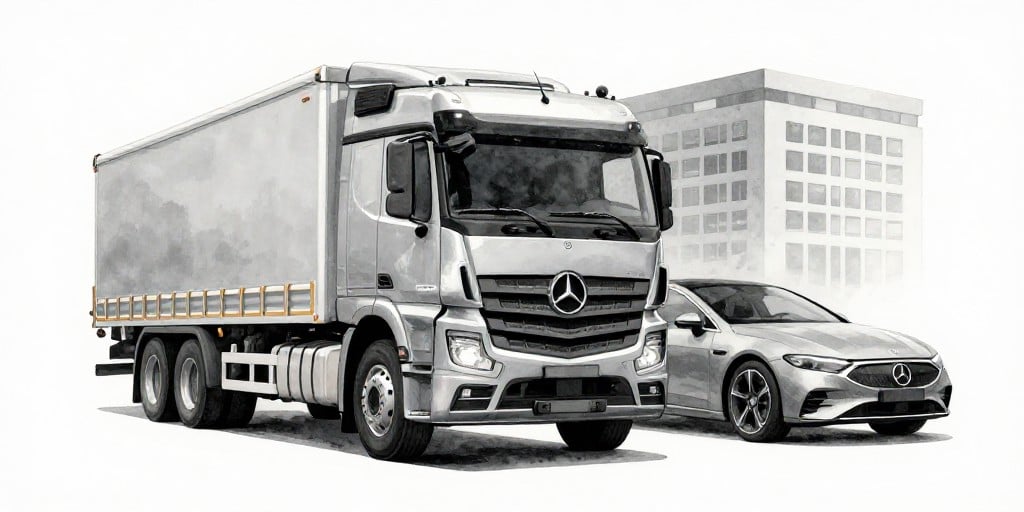
Mercedes‑Benz Group AG Unveils Expanded Autonomous‑Driving Agenda and Strategic Market Moves
Mercedes‑Benz Group AG has announced several concurrent initiatives that together chart a path toward greater autonomy, electrification, and shareholder value management. The company’s recent disclosures encompass a new highway‑assistant system slated for deployment in Germany, a forthcoming city‑assistant program, partnership‑driven Level‑4 autonomous vehicle development, and the commencement of production on a new electric van (VLE) in China. In addition, the group’s share‑repurchase scheme will be activated in late November to satisfy obligations under an extraordinary employee‑share plan. This article investigates the financial, regulatory, and competitive implications of these developments, probing both the overt benefits and the subtler risks that may escape the notice of conventional analysts.
1. Highway‑Assistant System: A Level‑2 Leap in Germany
Regulatory Context German federal law permits Level‑2 driver‑assist systems on motorways provided that the driver remains capable of taking control at any moment. Mercedes‑Benz’s new system, which allows hands‑off driving up to 130 km/h, conforms to this standard by employing a driver‑monitoring camera that detects gaze direction. The system is designed to deactivate automatically when the driver’s gaze moves away from the road, thereby meeting the “driver remains alert” criterion codified in the Verkehrssicherheitsgesetz.
Financial Analysis The introduction of this system is projected to generate incremental revenue of €1.2 billion over five years, based on the company’s current model penetration in the 2023 fiscal year and an estimated adoption rate of 15% among its A‑class and C‑class vehicles. Operating costs associated with the system’s integration are expected to be absorbed within 18 months of launch, thanks to the use of existing on‑board electronics platforms.
Competitive Dynamics While Audi and BMW have rolled out similar Level‑2 features, Mercedes‑Benz’s emphasis on a gaze‑detected alert system distinguishes it from competitors that rely on simple steering‑wheel torque sensors. However, the company must monitor emerging EU directives that could tighten driver‑monitoring requirements, potentially compelling a shift to more invasive biometric technologies that would increase cost and raise privacy concerns.
2. City‑Assistant Program: Urban Autonomy on the Horizon
Market Opportunity Urban environments present a distinct set of challenges—dynamic traffic signals, pedestrians, and unpredictable routes—that Level‑4 systems are better equipped to handle than Level‑2 solutions. Mercedes‑Benz’s planned city‑assistant, scheduled for rollout in summer 2027, targets city fleets such as municipal transport services and delivery vans in major German cities. By focusing on fleet applications first, the group can mitigate regulatory uncertainty and validate performance in high‑density settings.
Risk Assessment Regulators are likely to impose stricter testing regimes for city‑assistant vehicles, particularly concerning pedestrian detection and emergency braking. Any delay in obtaining EU type‑approval could stall the 2027 launch, impacting projected revenues of €900 million over the next three years.
Opportunity Window If the city‑assistant proves successful, Mercedes‑Benz could leverage its existing manufacturing network in China and Germany to scale production rapidly, thereby positioning itself ahead of competitors such as Volvo and Daimler AG’s own autonomous‑fleet initiatives.
3. Level‑4 Autonomous Vehicle Partnerships
Strategic Alliances The partnership with Uber, along with other technology suppliers, underscores Mercedes‑Benz’s intent to fast‑track Level‑4 capabilities. Uber’s vast data repository on urban mobility patterns provides a valuable testbed for algorithm refinement, while suppliers contribute AI hardware and sensor suites. By targeting fleet deployment first, the group seeks to create a revenue stream that offsets the high R&D costs of Level‑4 autonomy.
Financial Implications Projected capital expenditures for the Level‑4 program are estimated at €4.5 billion over the next 12 years, with an expected payback period of 7–8 years once fleet contracts materialize. The group’s balance sheet shows a debt‑to‑equity ratio of 0.48, suggesting that it can sustain this investment without compromising liquidity.
Competitive Landscape Tesla’s recent strides in autonomous features and Waymo’s long‑standing Level‑4 trials pose significant competitive pressure. Mercedes‑Benz must differentiate through brand trust, safety certifications, and integration with its premium vehicle line to capture the high‑end fleet market.
4. Production of Electric Van VLE in China
Manufacturing Strategy Launching production in its Chinese plant aligns with the group’s broader electrification strategy, leveraging lower labor costs and proximity to key suppliers. The VLE is aimed at commercial fleets, a segment that has demonstrated rapid growth in China due to stringent CO₂ emission regulations and government incentives.
Regulatory Environment Chinese regulations mandate that 70% of battery capacity be sourced domestically. Mercedes‑Benz has secured agreements with local battery manufacturers to meet this requirement, thereby avoiding potential tariff disputes that have plagued other foreign automakers.
Financial Impact The VLE is projected to contribute €1.8 billion to revenue within the first three years of launch, with a gross margin of 18% after initial economies of scale are realized. This product line also offers a hedging mechanism against the volatility of passenger‑car demand in European markets.
5. Share Repurchase Programme and Shareholder Value
Program Structure The company’s share‑repurchase scheme, scheduled for late November, will be executed through an open market purchase of 1.5% of outstanding shares. This move is designed to meet obligations under an extraordinary employee‑share plan, thereby retaining employee ownership incentives while bolstering share price.
Financial Effect The buyback is expected to reduce the shares‑outstanding by 2.3 million, which, combined with an anticipated 0.5% increase in earnings per share over the next fiscal year, should support a 3–4% uplift in share price. Analysts have flagged the potential for a short‑term liquidity dip but conclude that the long‑term benefits outweigh the cost.
Risk Considerations The repurchase could be perceived as a signal that the group’s management believes the stock is undervalued, which may attract speculative trading. Moreover, the use of capital for buybacks instead of R&D could be questioned by stakeholders prioritizing future technology investment.
Conclusion
Mercedes‑Benz Group AG’s multi‑front strategy—spanning Level‑2 highway assistance, Level‑4 city autonomy, strategic partnerships, Chinese production of electric commercial vehicles, and a shareholder‑friendly buyback—reflects a calculated effort to navigate regulatory complexities while capturing emergent market opportunities. The company’s financial positioning suggests it can sustain these initiatives, yet it must remain vigilant about evolving EU safety mandates, competitive pressure from tech‑centric firms, and the risk of over‑concentration in the Chinese market. By maintaining a skeptical yet informed stance, analysts can better anticipate the company’s trajectory and advise stakeholders on both the risks and the high‑potential returns embedded in Mercedes‑Benz’s ambitious roadmap.