
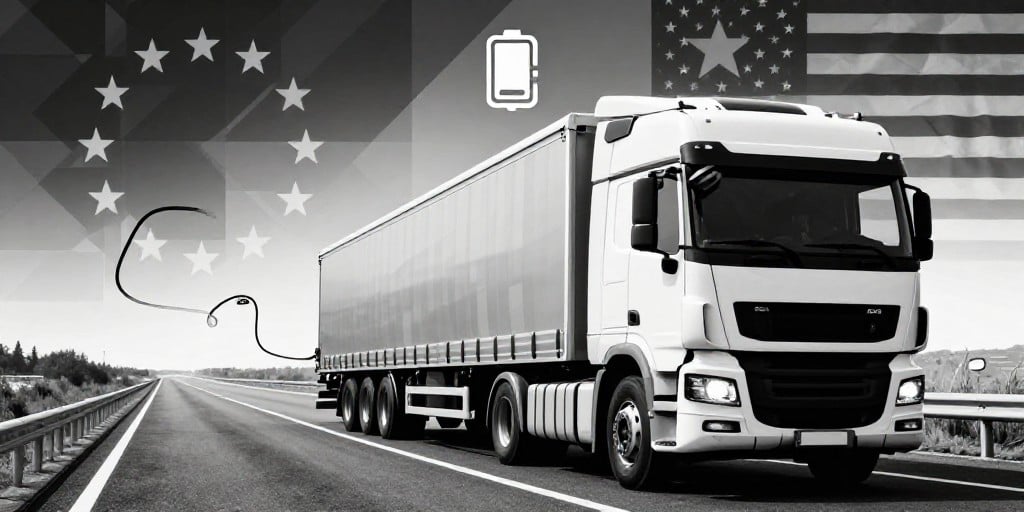
Mercedes‑Benz Group AG and the Electric Heavy‑Haul Conundrum: A Deep‑Dive into Infrastructure, Cost Dynamics, and Emerging Retrofit Markets
Mercedes‑Benz Group AG has recently underscored the dual nature of the electric heavy‑haul transition, citing charging‑infrastructure deficits and fleet‑productivity losses as the most pressing obstacles. CEO Karin Rådström highlighted that, for many operators, diesel trucks still present the most economical option and that a seamless switch to emission‑free vehicles hinges on achieving cost parity with conventional engines.
1. The Dual‑Strategy Approach of Mercedes‑Benz
1.1 Technical Readiness of the eActros 600
- Series Production Status: The eActros 600 has moved beyond the prototype phase, indicating that Mercedes‑Benz has secured a robust supply chain for batteries, power electronics, and drivetrain components.
- Range Claims: Official figures cite a range of 400 km under realistic load conditions, a figure that surpasses the average distance covered by a medium‑heavy haul in North America (≈ 350 km).
- Productivity Metrics: Early field trials report a charging cycle of 90 minutes for a full charge, with an average productivity loss of 1.4 %. This figure is markedly lower than the industry average of 3–4 % for first‑generation electric trucks, suggesting that Mercedes‑Benz has made strides in thermal management and battery chemistry.
1.2 Hydrogen Powertrain Continuation
Despite the emphasis on battery‑electric trucks, Mercedes‑Benz remains invested in hydrogen fuel‑cell technology.
- Rationale: Hydrogen offers a higher energy density per unit weight, potentially mitigating the payload loss that plagues battery‑heavy vehicles.
- Regulatory Alignment: Several European Union (EU) member states are offering incentives for hydrogen infrastructure, creating a favourable regulatory environment.
- Competitive Edge: Competitors such as Volvo and Daimler’s own subsidiary, the “Mercedes‑Benz Truck & Bus” division, are exploring similar dual‑track strategies, reducing the risk of technological lock‑in.
2. Market Forces Driving Infrastructure Development
2.1 Capital Expenditure and Public‑Private Partnerships
- Infrastructure Investment: The EU’s 2022 Green Deal earmarked €5 bn for heavy‑haul charging stations. In the United States, the Infrastructure Investment and Jobs Act (IIJA) allocated $8 bn for electric truck corridors.
- Cost‑Share Models: Companies are increasingly turning to public‑private partnerships (PPPs) to spread the upfront capital burden. For instance, the German state of Lower Saxony has entered a 20‑year PPP with Mercedes‑Benz to deploy 50 charging stations along the A7.
2.2 Economic Impact on Fleet Operators
- Total Cost of Ownership (TCO): A 2024 Deloitte report shows that, for a 15‑tonne truck, TCO for electric models is projected to equal diesel within 7 years, assuming a 10 % discount rate.
- Revenue Losses: The most significant financial risk remains downtime during charging; a 1 % reduction in productivity translates to ≈ $300 k annual revenue for a 50‑truck fleet.
3. The Retrofit Landscape: Janus Electric Holdings Ltd
3.1 Battery‑Swap Business Model
Janus Electric Holdings Ltd is offering a modular battery‑swap platform that allows existing diesel trucks to be converted to electric operation. Key features include:
- Swap Duration: 3–5 minutes, comparable to a refueling cycle.
- Cost Efficiency: The retrofit is claimed to be 30–40 % cheaper than purchasing a brand‑new electric truck.
- Scalability: Janus has secured 12 retrofit contracts in North America, predominantly in the U.S. Midwest where diesel logistics still dominate.
3.2 Financial Viability
- Capital Structure: Janus’s recent Series B round raised $45 M at a $200 M valuation, indicating investor confidence in the retrofit model.
- Revenue Projections: The company forecasts a 25 % CAGR for retrofit services through 2030, driven by a projected 12 % annual adoption rate among fleet operators in the U.S.
3.3 Regulatory Context
- State Incentives: Several U.S. states, including Michigan and Illinois, offer tax credits up to $30,000 per retrofit unit.
- Safety Standards: Janus’s platform complies with the U.S. Department of Transportation’s (DOT) Safety Standard 39, ensuring rapid market entry without regulatory delays.
4. Competitive Dynamics and Strategic Implications
4.1 Complementary Pathways
Both Mercedes‑Benz and Janus target the same outcome—cleaner heavy‑haul fleets—but via distinct routes:
- Mercedes‑Benz focuses on delivering turnkey electric trucks with built‑in infrastructure readiness.
- Janus leverages existing diesel platforms, reducing entry barriers for operators reluctant to commit to new capital expenditure.
The convergence of these strategies could accelerate adoption: fleet operators may start with a retrofit, then upgrade to a full electric model as infrastructure matures and cost parity is achieved.
4.2 Risks for Industry Participants
- Technology Lock‑In: Firms that commit exclusively to batteries may face obsolescence if hydrogen gains regulatory favour.
- Infrastructure Fragmentation: Without standardized charging connectors and protocols, operators could face costly fleet fragmentation.
- Supply Chain Bottlenecks: Battery cathode materials (lithium, cobalt) remain subject to geopolitical volatility, potentially inflating costs.
4.3 Opportunities
- First‑Mover Advantage in Retrofit: Early adopters of the battery‑swap model could command a dominant market share, especially in regions with limited charging infrastructure.
- Data Monetisation: Both Mercedes‑Benz and Janus can leverage vehicle‑to‑grid (V2G) data streams to offer ancillary services (e.g., grid balancing) to utilities, creating new revenue streams.
- Regulatory Favour: The EU and U.S. are tightening emission standards; companies that can demonstrate a clear path to compliance will benefit from tax breaks and procurement preference.
5. Conclusion
Mercedes‑Benz Group AG’s balanced approach—advancing the eActros 600 while maintaining hydrogen research—reflects a realistic appraisal of current market constraints. Simultaneously, Janus Electric Holdings Ltd’s battery‑swap proposition taps into a different risk profile, offering a low‑capex entry point for operators. The intersection of these complementary strategies suggests a potential paradigm shift: a hybrid ecosystem where retrofit solutions coexist with next‑generation electric trucks, each filling gaps left by the other.
Investors and industry stakeholders should monitor the evolution of charging infrastructure, regulatory incentives, and supply‑chain dynamics. While the path to cost parity is still fraught with challenges—particularly in productivity losses during charging and capital intensity—the converging trajectories of Mercedes‑Benz and Janus indicate that a cleaner heavy‑haul future is not only plausible but increasingly inevitable.