Corporate News
McDonald’s Corp. has announced a comprehensive investment program aimed at sustaining its U.S. store network and enhancing the overall customer experience. The company will commit $8.5 billion through 2036 to provide direct cash support and rent relief for franchise operators, mitigating the impact of rising food and equipment costs. Management projects that the initiative will generate incremental cash flow of roughly $100,000 per store each year.
Omnichannel Innovation and Drive‑Through Efficiency
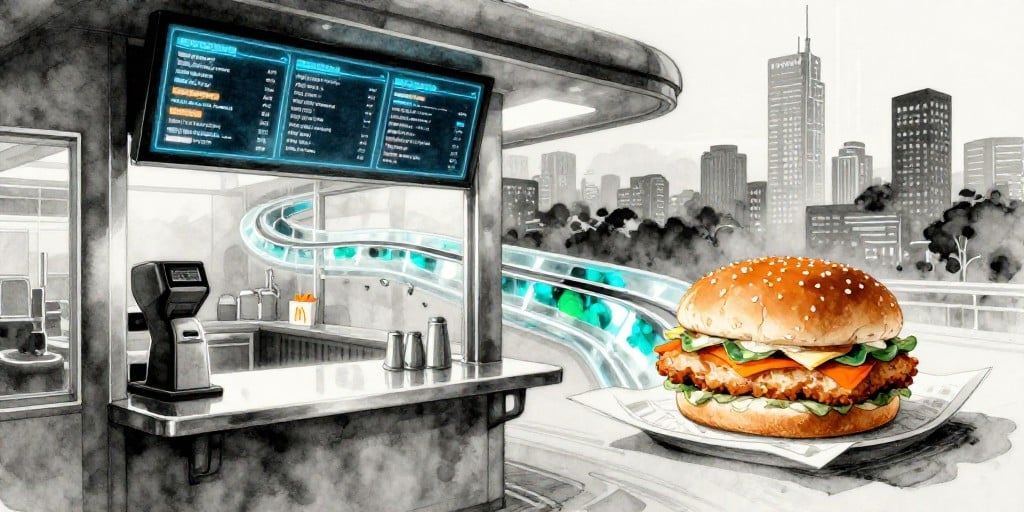
A central pillar of the upgrade is the deployment of voice‑enabled artificial‑intelligence tools in drive‑through lanes. By enabling order taking in both English and Spanish, McDonald’s seeks to reduce wait times, improve staff workflow, and elevate customer satisfaction scores. The introduction of third‑party advertising on digital menu boards represents an ancillary revenue stream that aligns with broader industry trends toward monetizing digital customer interfaces.
Across the fast‑food sector, companies such as Chick‑Fil‑A and Starbucks have already leveraged AI‑driven order systems to cut service times by 30‑40 %. McDonald’s initiative positions it to close the efficiency gap and maintain its leadership in quick‑service operations. In the long term, these advancements support a seamless omnichannel experience—customers can place orders via mobile apps, voice assistants, or in‑store kiosks, then receive them quickly at the drive‑through or through delivery platforms.
Menu Development: Health, Value, and Brand Positioning
McDonald’s is simultaneously testing higher‑protein offerings to cater to health‑conscious diners and users of weight‑loss medications, while refreshing its value menu with items priced under $3. The $2 breakfast sandwich promotion is a targeted effort to attract budget‑conscious consumers who have felt the strain of recent price increases.
These dual strategies reflect a broader market movement where fast‑food brands are balancing the demand for healthier options with the need to sustain profitability through value propositions. For example, Wendy’s introduced a plant‑based burger in 2023 to appeal to health‑centric consumers, while Burger King launched a $1 value menu in select markets. McDonald’s approach integrates both health and affordability, positioning the brand as adaptable to shifting consumer priorities.
Supply‑Chain Innovations and Cost Management
The $8.5 billion investment also covers supply‑chain innovations that aim to reduce food and equipment cost volatility. By negotiating bulk contracts and investing in predictive analytics for inventory management, McDonald’s seeks to mitigate the impact of commodity price fluctuations. Industry analysts note that the capital outlay and rent concessions will compress corporate margins in the short term; however, the long‑term benefits of a more resilient supply chain and lower operational costs are expected to offset these initial deficits.
Similar supply‑chain strategies have been adopted by KFC and Subway, where data‑driven forecasting has lowered waste by up to 15 %. McDonald’s alignment with these practices underscores a sector-wide shift toward smarter logistics as a competitive differentiator.
Consumer Behavior Shifts and Market Dynamics
Recent data indicate a pronounced shift in consumer behavior toward quick, convenient, and affordable food options. A Nielsen study in 2025 found that 57 % of U.S. fast‑food customers prioritize speed of service, while 43 % value menu items priced under $3. McDonald’s is responding directly to these preferences through its drive‑through AI and revamped value menu.
Furthermore, the rise in health‑conscious purchasing—driven by increased awareness of diet‑related health conditions and the proliferation of weight‑loss medications—has prompted consumers to seek higher‑protein and lower‑calorie alternatives. McDonald’s testing of higher‑protein items aligns with this trend, positioning the brand as a viable option for health‑aware customers without abandoning its core value proposition.
Short‑Term Market Movements and Long‑Term Transformation
In the short term, the announcement is likely to trigger modest upside potential in McDonald’s stock, reflected in a consensus moderate‑buy rating among analysts. The immediate impact may include:
- Margin Compression – due to the upfront capital outlay and rent relief.
- Improved Cash Flow per Store – from the projected $100,000 incremental cash flow.
- Enhanced Brand Perception – through AI‑driven service efficiency and menu innovation.
Long‑term, the program is expected to:
- Solidify Market Share – by maintaining relevance in a fiercely competitive landscape.
- Drive Operational Scalability – via AI, omnichannel ordering, and smarter supply‑chain logistics.
- Elevate Consumer Loyalty – through consistent service quality and menu offerings that cater to evolving health and value expectations.
By linking short‑term financial adjustments with strategic investments in technology and product development, McDonald’s is positioning itself for sustainable growth in an industry that increasingly rewards agility, data‑driven decision making, and customer‑centric innovation.