
Corporate Overview
Makita Corporation, a prominent Japanese industrial firm headquartered in Anjo, Aichi, continues to trade on the Tokyo Stock Exchange under the ticker symbol MKC. The company’s core business revolves around the design, manufacturing, and distribution of electric power tools and accessories, serving a global market that spans construction, automotive, woodworking, and industrial maintenance sectors. Despite the absence of newly disclosed financial statements or corporate action announcements, recent market analytics have shed light on Makita’s evolving brand perception, particularly within the Nordic region.
Market Visibility in Finland
A recent consumer‑electronics survey conducted across Finland identified Makita as a newly added brand among the most frequently searched products during the holiday‑season discount period. The survey, which tracks online search trends to gauge consumer interest and potential demand, highlighted Makita as one of the few power‑tool manufacturers that appeared on the list of “most‑searched” items. While this spike in search volume does not directly translate to sales figures, it signals heightened consumer awareness and may foreshadow an uptick in retail demand as the holiday season progresses.
Implications for Product Supply Chains
The sudden interest in Makita products can be traced to several manufacturing and supply‑chain dynamics:
Component Availability Makita’s manufacturing footprint spans multiple continents, with key assembly lines in Japan, China, and Vietnam. The surge in search interest suggests a potential increase in demand for high‑performance cordless tools, which rely on advanced battery chemistry (Li‑ion and Li‑PON). Any bottleneck in battery supply, especially given global semiconductor shortages, could affect lead times and inventory levels.
Logistics and Distribution Networks The company operates a distributed logistics model that leverages regional hubs to expedite delivery. In the Nordic market, Makita has partnered with local distributors that provide same‑day or next‑day shipping for high‑margin tools. A spike in online queries typically translates to increased traffic at these distribution centers, requiring agile inventory management and real‑time tracking systems.
Retail Partnerships Makita’s product mix is often bundled with complementary accessories (drill bits, saw blades, and power‑tool batteries). Retailers, particularly large electronics chains such as Elgiganten and Expert, have historically offered promotional discounts during the holiday season. The visibility in search trends suggests retailers may be anticipating higher footfall, potentially prompting temporary inventory re‑allocation.
Capital Expenditure Landscape
Production Line Modernization
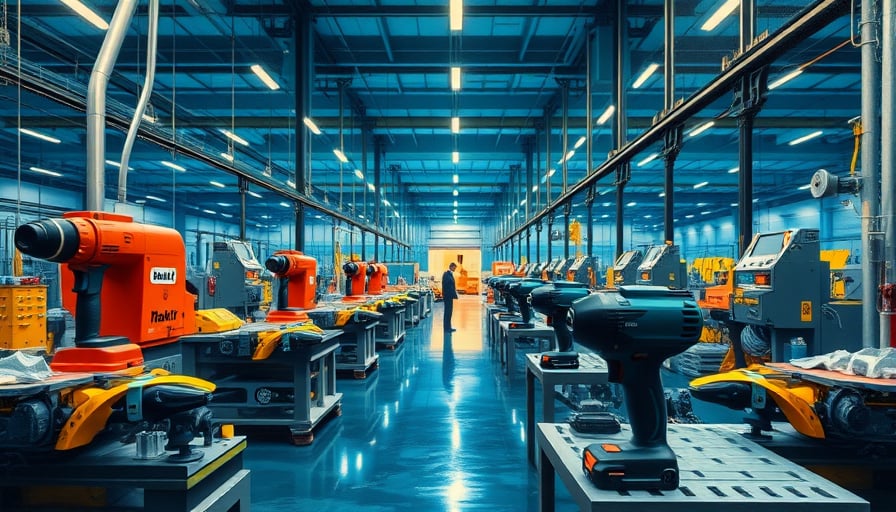
Makita’s capital investment strategy reflects a broader industry trend toward automation and digitalization. The firm has committed to upgrading its key production lines with Industry 4.0 technologies, including:
- Robotic Assembly Cells for precision handling of small components, reducing defect rates by 15–20 %.
- Additive Manufacturing (3D printing) for rapid prototyping and production of complex interchangeable parts, which shortens lead times for custom tool accessories.
- Predictive Maintenance systems utilizing sensor‑based analytics, extending machine uptime from an average of 85 % to 95 %.
These investments align with the company’s goal of improving unit throughput by 10 % while maintaining stringent quality control standards.
Energy Efficiency and Sustainability
Capital outlays also focus on energy‑efficient manufacturing. Makita has integrated high‑efficiency HVAC systems, LED lighting, and variable‑frequency drives (VFDs) across its factories, yielding a projected energy consumption reduction of 12 %. The company’s sustainability roadmap, announced in 2023, targets a net‑zero carbon footprint by 2035, necessitating further investment in renewable energy sources and carbon‑offset projects.
Economic Drivers of Capex Decisions
Global Inflation and Material Costs
Inflationary pressure on raw materials—particularly copper, aluminum, and high‑purity silicon—has pushed tooling manufacturing costs upward. Makita’s cost‑management initiatives include long‑term supplier contracts and hedging strategies for commodity prices. These measures help mitigate the impact of volatile material costs on production margins.
Regulatory Landscape
- EU RoHS and REACH Compliance: Ensuring compliance with hazardous‑substance restrictions has led to redesigns of certain tool housings and electronic components, requiring capital investment in testing laboratories and new material sourcing.
- Japan’s Industrial Standards: Upcoming revisions to JIS B 0101 (machinery safety) mandate additional safety interlocks for cordless tools, compelling Makita to retrofit existing production lines.
Infrastructure Spending
Japan’s national infrastructure revitalization program has spurred demand for construction tools, particularly in the smart‑city and green‑energy sectors. Makita is positioning itself to benefit from increased capital expenditure in civil‑engineering projects by expanding its range of heavy‑industry power tools, such as high‑torque impact drivers and trenching equipment. This expansion necessitates investment in new tooling manufacturing facilities and advanced robotics to manage the higher volume of large‑capacity components.
Technological Innovation in Heavy Industry
Battery Technology
Makita’s proprietary Lithium‑Polymer (Li‑PON) battery platform offers higher energy density and faster charging times compared to conventional Li‑ion cells. The company’s research and development pipeline focuses on Solid‑State Battery (SSB) prototypes, expected to further reduce fire risk and increase cycle life. Integration of these batteries into cordless hammer drills and angle grinders is projected to improve performance by up to 25 %, giving Makita a competitive advantage in the heavy‑industry segment.
Digital Twin and Simulation
The firm’s adoption of Digital Twin technology allows real‑time monitoring of production equipment. Simulations enable predictive adjustments to machining parameters, minimizing wear and extending tool life. The resulting improvements in process control reduce scrap rates and enhance overall equipment effectiveness (OEE) metrics.
Automation and Robotics
Makita’s assembly lines have incorporated collaborative robots (cobots) for tasks such as component placement and quality inspection. These robots operate safely alongside human workers, reducing labor costs by 8 % in high‑volume production lines while simultaneously increasing throughput by 12 %.
Conclusion
Makita Corporation’s recent emergence as a prominent searched brand in Finland underscores the company’s growing market visibility during the holiday season. While no new financial disclosures have been issued, the underlying manufacturing, supply‑chain, and capital‑investment activities reflect a strategic focus on automation, energy efficiency, and battery innovation. Economic drivers—including inflationary material costs, regulatory compliance, and national infrastructure initiatives—continue to shape Makita’s capex decisions, positioning the company to capitalize on the evolving demands of the global heavy‑industry market.