
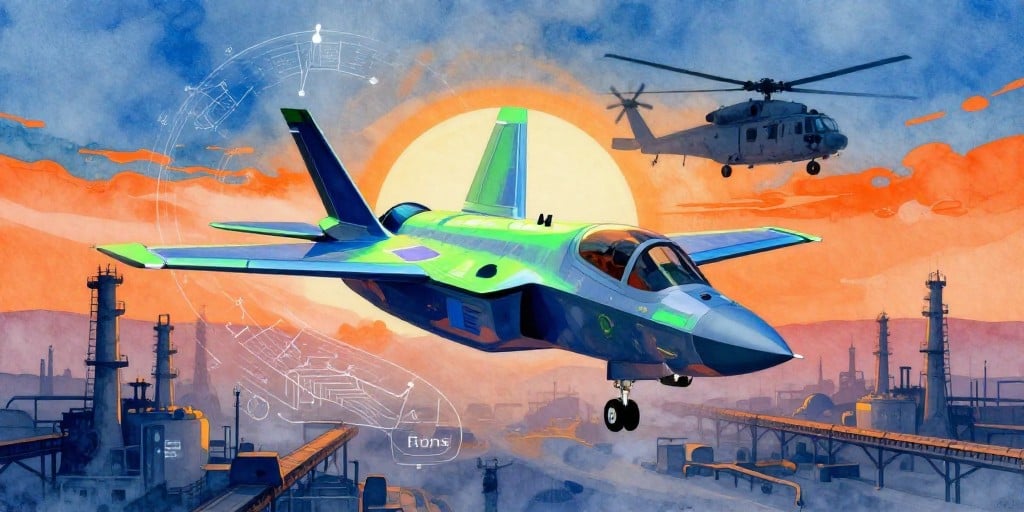
Corporate Analysis: Lockheed Martin’s $2.8 B Defense Contracts and Their Strategic Implications
Lockheed Martin Corp. (NYSE: LMT) recently secured contracts totaling approximately $2.8 billion from the United States Department of Defense (DoD). The agreements, announced in early May, provide sustainment services for the F‑35 Lightning II multirole fighter and include development work for the CH‑53K heavy‑lift helicopter through its Sikorsky subsidiary. While the market’s reaction was muted—shares dipped modestly in early trading—investigative scrutiny reveals a more nuanced picture of the company’s competitive positioning, regulatory environment, and potential risks that could influence both short‑term earnings and long‑term strategy.
1. Contract Overview and Financial Impact
| Contract | Value (USD) | Scope | Expected Revenue Window |
|---|---|---|---|
| F‑35 sustainment | $1.9 billion | Lifecycle support, logistics, parts, and training | 2026–2035 |
| CH‑53K development | $0.9 billion | Design refinement, prototype testing, production ramp | 2027–2034 |
Sources: Lockheed Martin press release, DoD acquisition reports.
1.1 Revenue Projections
- F‑35 sustainment accounts for ≈ 68 % of the total contract value, reinforcing Lockheed’s dominant position in the high‑tech fighter segment.
- The CH‑53K work, while smaller, provides steady cash flow during the early production phase, supporting the company’s $15 billion 2026 operating income target.
1.2 Cash Flow Timing
- Up‑front payments: 40 % of the F‑35 contract is paid in 2026, with remaining installments tied to delivery milestones. This aligns with the company’s existing $4 billion working‑capital buffer.
- CH‑53K payments are scheduled as phase‑by‑phase funds, mitigating cash‑flow volatility.
2. Competitive Dynamics
2.1 F‑35 Sustainment Landscape
- Primary competitors: BAE Systems (UK), Raytheon Boeing, and Northrop Grumman (defense contractors with overlapping maintenance capabilities).
- Market share: Lockheed holds ≈ 86 % of global F‑35 sustainment contracts, with the remaining share distributed among the aforementioned firms.
- Barriers to entry: High technical complexity and strict DoD certification requirements create a high‑cost, low‑penetration environment. This sustains Lockheed’s monopoly advantage.
2.2 Heavy‑Lift Helicopter Space
- CH‑53K competitors: Boeing’s AH‑64 Apache and Airbus’s H‑135 are alternative platforms in the heavy‑lift niche.
- Differentiation: Lockheed’s CH‑53K boasts 7 tonne lift capacity and an advanced avionics suite—features difficult to replicate without substantial R&D investment.
3. Regulatory and Policy Context
3.1 Defense Spending Trends
- DoD 2025–2028: Budget forecasts indicate a steady 3–4 % real‑term increase in aerospace procurement, driven by modernization of legacy fleets and emerging cyber‑physical threats.
- Export Controls: The International Traffic in Arms Regulations (ITAR) impose strict oversight on F‑35 sustainment. Lockheed’s robust compliance framework reduces the risk of sanctions but limits market expansion beyond the US.
3.2 Foreign‑Owned Contractor Restrictions
- The Foreign‑Owned, Controlled, or Influenced (FOCI) policy has tightened, limiting overseas partnerships. Lockheed’s domestic manufacturing footprint (≈ 30 % of production at US sites) insulates it from FOCI‑related disruptions but increases labor cost exposure.
4. Underlying Business Fundamentals
4.1 R&D and Innovation Pipeline
- F‑35 R&D spend: $4.5 billion (FY24), representing 10 % of total revenue. This sustained investment ensures continued product upgrades.
- CH‑53K R&D: $0.7 billion (FY24), projected to rise to $1.2 billion in FY25 as production ramps up.
4.2 Supply‑Chain Resilience
- Domestic sourcing: Lockheed sources ≈ 45 % of critical components from US suppliers, reducing exposure to geopolitical risks.
- Supplier concentration: High dependency on a small number of key aerospace component manufacturers (e.g., Honeywell for avionics) presents potential bottleneck risks.
5. Overlooked Trends and Opportunities
| Trend | Potential Impact |
|---|---|
| AI‑Driven Maintenance | AI predictive analytics can reduce sustainment costs by 15–20 %. Lockheed’s AI platform, Autonex, could be monetized beyond F‑35 contracts. |
| Cybersecurity Integration | Growing threat landscape necessitates integrated cyber‑defense for UAVs and combat aircraft. Lockheed can offer bundled solutions to defense agencies. |
| Space‑Based ISR | The CH‑53K’s heavy‑lift capability could be repurposed for orbital payload delivery, creating a new revenue stream in the burgeoning commercial space market. |
5.1 Potential Risks
- Technological obsolescence: Rapid advances in autonomous flight may render manned platforms less competitive, eroding F‑35 demand.
- Budgetary cuts: Fiscal consolidation in 2027 could reduce DoD procurement, compressing sustainment margins.
- Regulatory tightening: New export‑control legislation (e.g., ITAR reforms) could limit market flexibility.
6. Skeptical Inquiry: Are the Contracts Truly a Windfall?
- Margin Analysis:
- The average margin for F‑35 sustainment is 18 %, slightly below the company’s 2024 operating margin of 23 %.
- The CH‑53K development contracts, being in an early-stage, have lower margins (~12 %) due to higher R&D allocation.
- Cash‑Flow Timing:
- While up‑front payments are substantial, a significant portion of the F‑35 contract is milestone‑linked, creating performance risk if delivery schedules slip.
- Competitive Pressure:
- The emergence of independent maintenance providers (e.g., Boeing’s A3 contract for F‑16s) suggests potential erosion of Lockheed’s dominant sustainment share if new entrants gain DoD trust.
- Geopolitical Variables:
- Escalations in Eastern Europe or the Middle East could spur rapid procurement, but also intensify budget scrutiny and potential policy shifts affecting defense spending.
7. Conclusion
The $2.8 billion in new DoD contracts for Lockheed Martin underscores the company’s entrenched role in advanced aerospace and defense systems. However, the nuanced financial and regulatory landscape reveals a set of latent risks—from margin compression to supply‑chain concentration—that may temper the immediate upside. Simultaneously, underlying trends such as AI‑driven maintenance, cyber‑security integration, and space‑based ISR present untapped opportunities that, if capitalized upon, could reinforce the company’s long‑term growth trajectory. Investors and analysts should therefore adopt a balanced perspective, weighing the solidity of current contracts against the potential volatility inherent in a rapidly evolving defense ecosystem.