
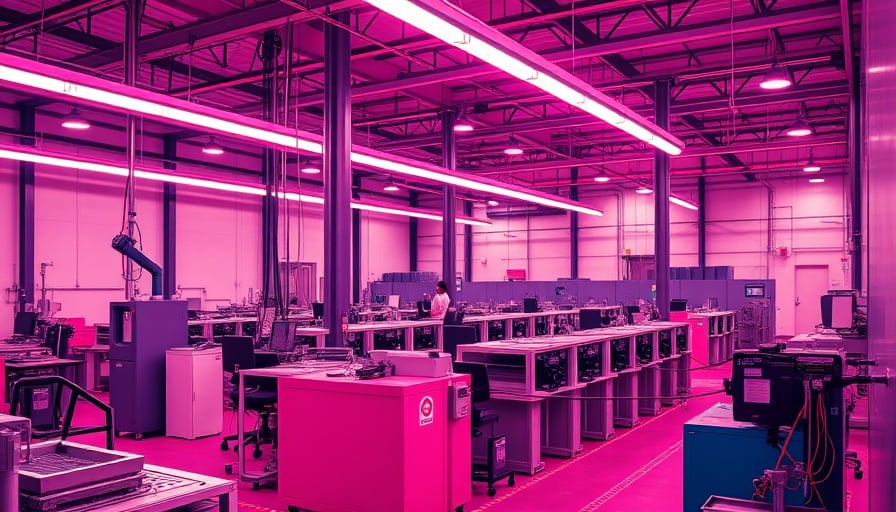
Corporate Update: Lam Research Corporation
Lam Research Corporation (NASDAQ: LRCX), a leading supplier of semiconductor processing equipment, disclosed a series of corporate developments that underscore its continued commitment to investor relations and domestic manufacturing expansion. Executive Vice President and Chief Financial Officer Doug Bettinger will attend the Morgan Stanley Technology, Media & Telecommunications Conference in early March, signaling ongoing engagement with the capital‑markets community. Additionally, the company announced the opening of a new office in Boise, Idaho, a strategic move that broadens its U.S. footprint and supports projected growth in domestic semiconductor fabrication.
Contextualizing Lam Research’s Actions within the Industry
The semiconductor industry is presently navigating a pivotal phase characterized by the relentless push toward sub‑10‑nm process nodes, aggressive yield optimization, and the integration of advanced manufacturing techniques such as EUV lithography, directed‑self‑assembly, and novel doping methods. In this environment, equipment suppliers like Lam Research play a decisive role: they supply the wafer‑etch, deposition, and cleaning systems that enable foundries to translate architectural designs into manufacturable devices.
Node Progression and Yield Optimization
Transitioning from the 7‑nm to the 5‑nm node, and now to the emerging 3‑nm and 2‑nm nodes, requires unprecedented precision in etch uniformity, dopant control, and defect suppression. Yield, defined as the proportion of functional chips per wafer, remains the ultimate profitability lever. Even marginal improvements in process control—achieved through advanced sensor integration, closed‑loop feedback, and machine‑learning‑driven predictive maintenance—translate into measurable cost reductions. Lam’s portfolio of plasma etch and CVD tools is designed to deliver the sub‑nanometer uniformity required for these nodes, thereby directly contributing to yield gains.
Capital Equipment Cycles and Foundry Capacity Utilization
Capital equipment cycles are intrinsically tied to the foundry’s capacity utilization rate. Foundries typically operate near 70–80 % capacity to maintain a healthy margin, with higher utilization accelerating the return on equipment investment. Lam’s new Boise facility positions the company closer to the U.S. foundry ecosystem—particularly the burgeoning Advanced Process Technology (APT) plants that aim to capture a larger share of the domestic market. Proximity reduces lead times, facilitates quicker system integration, and enables rapid response to field service requests, all of which improve customer satisfaction and can lead to higher utilization of Lam’s tools.
Interplay Between Chip Design Complexity and Manufacturing Capabilities
Modern integrated circuits increasingly embed heterogeneous components: high‑performance CPUs, AI accelerators, memory, and emerging photonics or quantum‑compatible layers. Designers employ sophisticated electronic design automation (EDA) flows that generate intricate patterning data, demanding higher fidelity from the lithography and etch steps. This complexity challenges the manufacturing floor: as design rules tighten, the probability of process window violations rises. Lam’s advanced plasma chemistry and process control platforms mitigate these risks by enabling more selective etch chemistries and tighter process windows, thus preserving design intent while maintaining throughput.
Enabling Broader Technological Advances
The ripple effect of semiconductor innovations extends beyond computing. Enhanced transistor scaling drives lower power envelopes, which are critical for battery‑powered edge devices, autonomous vehicles, and massive data‑center deployments. Moreover, the integration of silicon photonics—leveraging Lam’s etch tools—facilitates on‑chip optical interconnects that can dramatically increase bandwidth while reducing latency and energy consumption. These capabilities, in turn, support the next generation of high‑speed networking, 5G/6G infrastructure, and artificial‑intelligence workloads.
Strategic Implications for Lam Research
- Investor Confidence: By actively participating in high‑profile conferences, Lam reinforces transparency and signals robust financial stewardship.
- Domestic Market Penetration: The Boise office not only diversifies geographic risk but also aligns with national policy incentives aimed at revitalizing U.S. semiconductor manufacturing.
- Technological Leadership: Continuous investment in R&D—particularly in plasma‑based processes—ensures that Lam remains indispensable as foundries tackle ever more demanding nodes.
In summary, Lam Research’s recent corporate actions reflect a dual strategy: fortifying its position within the United States while sustaining its core mandate of enabling the next wave of semiconductor innovation. As the industry advances toward deeper scaling, tighter design rules, and higher complexity, Lam’s equipment and expertise will remain central to achieving the yield, speed, and reliability required to keep the semiconductor supply chain resilient and competitive.