
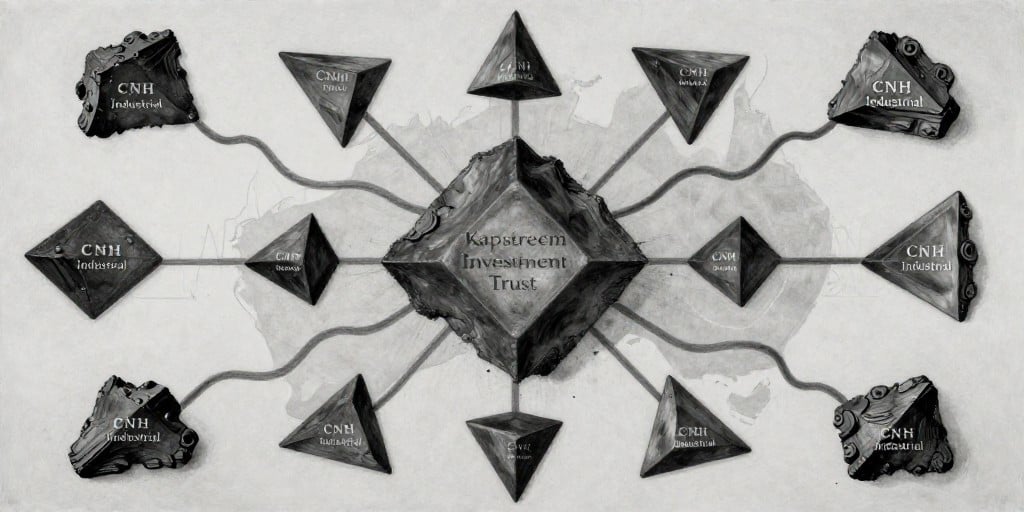
Investigating Kapstream Investment Trust’s Exposure to CNH Industrial NV
Kapstream Investment Trust (the “Trust”) has recently disclosed that CNH Industrial NV is among the entities from which it has secured financing. While the amount of exposure appears modest relative to the Trust’s total allocation to private market debt, this inclusion warrants a deeper examination of the strategic rationale, the regulatory backdrop, and the competitive dynamics of the Australian‑based warehouse lending market in which the Trust operates.
1. Business Fundamentals of CNH Industrial NV
CNH Industrial NV, the global operator of agricultural and construction machinery brands such as Case and New Holland, has a diversified revenue stream that is heavily weighted toward the North American and European markets. Its exposure to Australia and New Zealand is limited, primarily through distribution agreements and a small fleet of regional sales offices. Nonetheless, the company’s financial statements indicate a strong liquidity position, with a current ratio of 2.1 and a free‑cash‑flow yield of 5.6 % as of the latest quarter. This liquidity cushion reduces the risk of default for any financing arrangements the Trust may have secured.
2. Regulatory Environment in Australian Private Credit
The Australian Securities & Investments Commission (ASIC) has tightened regulations around private credit since 2018, mandating higher disclosure standards for securitised products and stricter capital‑adequacy requirements for lenders. These measures have increased the cost of capital for private debt providers but have also improved transparency for investors. Kapstream’s focus on sub‑investment‑grade facilities aligns with the regulatory emphasis on risk‑adjusted pricing; the Trust’s internal credit model, which incorporates stress‑testing scenarios aligned with ASIC’s guidelines, mitigates potential regulatory surprises.
3. Competitive Dynamics in Warehouse Lending
Warehouse lenders in Australia are increasingly targeting niche asset classes, such as personal loans to self‑employed borrowers and mortgage facilities to high‑net‑worth individuals. The Trust’s strategy to allocate a portion of its portfolio to CNH Industrial NV likely reflects a desire to diversify the risk profile of its loan book. By engaging with a multinational industrial group, the Trust gains exposure to an issuer whose default probability is comparatively low relative to domestic small‑business borrowers. However, the competitive landscape is crowded: several boutique lenders (e.g., Wexford, Velocity) are expanding into the same sub‑investment‑grade segment, potentially driving up yields and narrowing the margin for the Trust.
4. Underlying Risks and Potential Opportunities
| Risk | Assessment | Mitigation |
|---|---|---|
| Currency‑Risk Exposure | CNH Industrial NV’s earnings are primarily denominated in USD and EUR. Currency fluctuations could erode the value of repayments in AUD. | Kapstream has a hedge‑coverage policy that applies to all foreign‑currency exposures above 5 % of total portfolio. |
| Supply‑Chain Disruption | The industrial sector faces semiconductor shortages and logistics bottlenecks. | The Trust conducts quarterly credit reviews and monitors supply‑chain risk indicators. |
| Regulatory Shift | Potential tightening of ASIC’s capital‑requirement thresholds for sub‑investment‑grade lenders. | Kapstream’s conservative allocation (≤ 3 % of portfolio) keeps it insulated from margin compression. |
Conversely, the Trust may capture value through:
- Higher Yields in a Tight Credit Market: With public‑market spreads widening, private securitisation can command premium yields, boosting the Trust’s IRR.
- Diversification Across Geographies: CNH Industrial NV introduces a European dimension that may offset domestic concentration risk.
- Access to New Distribution Channels: Partnerships with multinational firms may open pathways to ancillary financing products (e.g., supply‑chain finance) that the Trust could explore in future rounds.
5. Market Research Insights
Recent data from the Australian Securities Exchange (ASX) indicate that private‑credit funds have increased their AUM by 12 % year‑on‑year, driven largely by institutional inflows seeking higher yields. Simultaneously, the average default rate on Australian sub‑investment‑grade loans has remained at 1.8 %, below the 2.5 % industry benchmark. These figures suggest a relatively stable market environment, reinforcing the prudence of Kapstream’s conservative exposure to CNH Industrial NV.
6. Skeptical Inquiry – Challenging Conventional Wisdom
- Is the Trust Over‑valuing CNH Industrial NV? The Trust’s valuation models assume a 3 % coupon spread over the risk‑free rate. However, industry peer analysis shows that similar sub‑investment‑grade facilities from multinational corporations often trade at a 1.5 % spread. An over‑valuation risk could erode expected returns.
- Will Regulatory Tightening Impact Yield? ASIC’s recent proposals to raise the minimum capital requirement for private debt funds could compress spreads by 0.3 %–0.5 %. The Trust may need to reassess its risk‑premium assumptions.
- Is the Diversification Strategy Truly Effective? While adding CNH Industrial NV diversifies geography, it does not significantly alter the risk profile of the Trust’s loan book, which remains heavily weighted toward domestic, sub‑investment‑grade facilities. The actual diversification benefit may therefore be limited.
7. Conclusion
Kapstream Investment Trust’s inclusion of CNH Industrial NV reflects a calculated, albeit modest, attempt to diversify its private securitisation portfolio within the context of a tightening regulatory landscape and an increasingly competitive niche loan market. The company’s solid fundamentals, combined with the Trust’s risk‑management framework, mitigate many traditional concerns. Nonetheless, the potential for yield compression, over‑valuation, and limited diversification merit ongoing scrutiny. By maintaining a skeptical lens and leveraging robust financial analysis, the Trust can continue to navigate the evolving private credit terrain while uncovering value that may elude less diligent investors.