
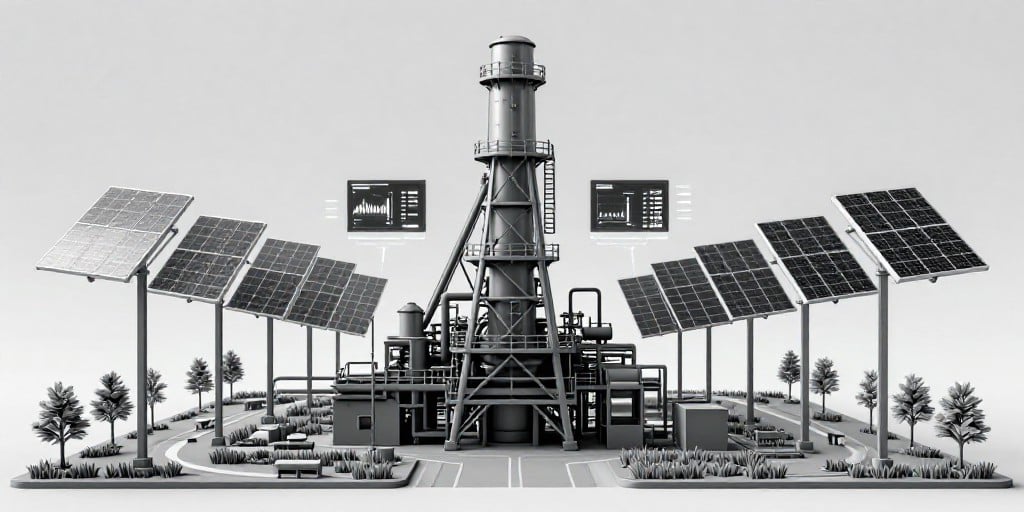
Overview of Jai Balaji Industries Limited’s 2025‑26 Business Responsibility and Sustainability Report
Jai Balaji Industries Limited (JBIL), a steel‑manufacturing firm listed on the National Stock Exchange, has published its Business Responsibility and Sustainability Report (BRSR) for the fiscal year 2025‑26. The document, produced in compliance with SEBI’s Listing Obligations and Disclosure Requirements (LODR), offers a comprehensive snapshot of the company’s operations, governance, environmental and social initiatives, and the regulatory framework that governs its activities.
1. Corporate Footprint and Operational Context
Geographic and Production Capacity
Five steel‑producing plants and six administrative offices spread across India.
The firm’s export penetration remains modest, at just under six per cent, indicating a primary focus on domestic demand.
Product Mix and Revenue Drivers
Core products: ferroalloys, pig iron, ductile iron pipe, and steel bars.
The bulk of revenue is derived from sales to large Original Equipment Manufacturers (OEMs) and government contracts, underscoring a high‑dependency on the public‑sector procurement cycle.
Workforce Composition
Permanent employees exceed 3,000; total workforce approximates 6,000.
Differently‑abled employees represent an almost negligible share, while female representation on the board stands at 20 %.
2. Material Sustainability Issues and Strategic Priorities
| Issue | Rationale | Proposed Initiative |
|---|---|---|
| Energy Efficiency & Renewable Adoption | Rising production costs and tightening carbon‑border levies amplify the need for lower‑carbon, cost‑effective energy sources. | Invest in high‑efficiency furnaces and solar photovoltaics; target 15 % of energy mix from renewables by 2030. |
| Supply‑Chain Resilience | Raw‑material price volatility (iron ore, coal, scrap) exposes margins. | Diversify suppliers, maintain strategic inventories, and develop dual‑source contracts for critical inputs. |
| Regulatory Compliance | Environmental clearances and emerging carbon‑border adjustment mechanisms could impose significant cost drivers. | Strengthen environmental compliance teams; adopt GHG accounting in line with GHG Protocol and ISO 14064. |
| Market & Technological Dynamics | Demand fluctuations in the automotive and infrastructure sectors; rapid digitalisation threatens competitive positioning. | Allocate 5 % of R&D spend to smart manufacturing; pilot digital twins for process optimisation. |
| Workforce & Community Relations | Safety incidents can erode productivity and brand reputation; community goodwill mitigates social license to operate. | Expand safety training; launch CSR programmes aligned with the Companies Act turnover‑based contribution. |
3. Governance and Accountability Framework
Business Responsibility Architecture
A dedicated BRSR framework, chaired by the CFO and supervised by the CSR committee, operationalises the nine National Guidelines for Responsible Business Conduct (NGRC) principles.
Board‑approved policies are translated into SOPs for both internal staff and external value‑chain partners.
Compliance and Standards
The company holds ISO 9001 (Quality), ISO 14001 (Environmental Management), ISO 45001 (Occupational Health & Safety), and adheres to GHG accounting standards.
Active pursuit of science‑based emission reduction targets, aligned with the Paris Agreement trajectory.
Review Cadence
Internal audits occur biannually; future plans include engagement of independent external assessors to benchmark against peers.
4. Risk Landscape and Mitigation Measures
| Category | Identified Risk | Mitigation Approach |
|---|---|---|
| Operational | Energy supply disruptions and price spikes | Adopt renewable energy contracts; improve energy efficiency. |
| Regulatory | New carbon‑border tariffs, environmental clearance delays | Proactive compliance, scenario modelling for tariff impacts. |
| Market | Cyclical downturns in infrastructure spending | Diversify product portfolio; deepen relationships with non‑government OEMs. |
| Human Capital | Workforce safety incidents, low diversity | Enhanced safety protocols; targeted recruitment for under‑represented groups. |
| Reputational | Community grievances, investor concerns | Robust grievance mechanisms; transparent ESG disclosures. |
5. Financial Implications of Sustainability Commitments
Cost Savings
Energy efficiency upgrades could reduce energy spend by up to 8 % annually, translating to ₹30–40 crore in savings over a five‑year horizon.
Revenue Growth
Digitalisation and R&D investments may unlock premium pricing for technologically advanced products, potentially adding 2–3 % to top‑line growth.
Capital Expenditure
Renewable energy and plant retrofit projects estimate a CAPEX of ₹200–250 crore for 2025‑26, with a projected payback period of 4–5 years.
Risk‑Adjusted Return
Incorporating ESG risk factors into the company’s cost of capital could reduce the WACC by 0.15–0.25 %, improving net present value for long‑term projects.
6. Conclusion: Opportunities Missed by Conventional Analysis
While JBIL’s BRSR aligns with regulatory expectations, a deeper analytical lens reveals several overlooked avenues:
Strategic Shift Toward High‑Value Export Markets – The current export share is low; targeted investment in quality and certification could open lucrative international contracts, diversifying revenue streams.
Data‑Driven Supply‑Chain Optimization – Leveraging AI for demand forecasting and inventory management can reduce carrying costs and buffer against price shocks.
Talent Development as a Competitive Edge – Structured upskilling in digital metallurgy could create a niche workforce, enhancing both operational efficiency and innovation capacity.
Community Investment as a Risk Mitigation Tool – Proactive social licensing, beyond mandatory CSR spend, can pre‑empt regulatory scrutiny and secure future land-use approvals.
By systematically interrogating these facets, stakeholders can better assess JBIL’s resilience and growth trajectory in a sector where conventional wisdom often overlooks the intersection of sustainability, technology, and market dynamics.