
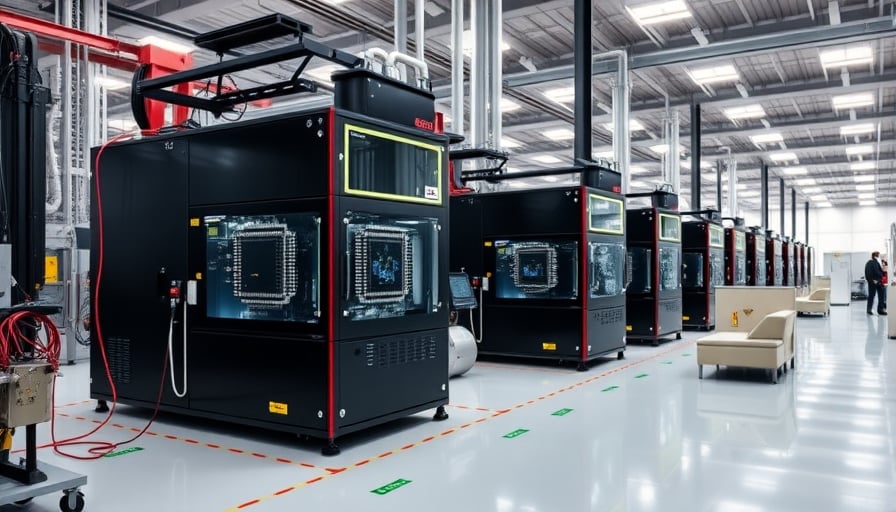
Financial Results Announcement from a Leading Japanese Semiconductor Equipment Manufacturer
On 13 January 2026 the company disclosed that its financial statements for the quarter ended 31 December 2025 will be released on 28 January. Market observers anticipate a modest uptick in earnings per share (EPS) relative to the preceding quarter, a change that the company attributes to incremental gains in profitability.
The announcement coincides with a broader rally in Japanese equity markets. The Nikkei 225 has posted substantial gains, driven in part by recent political developments that have stabilized investor sentiment and by a depreciation of the yen, which improves export‑oriented companies’ earnings prospects. Within the information technology sector, the company’s guidance aligns with prevailing expectations of a steady earnings trajectory, reinforcing its status as a reliable contributor to the sector’s resilience.
Semiconductor Technology Trends and Node Progression
The industry is currently transitioning from the 5 nm node toward the 3 nm and 2.5 nm nodes, with advanced nodes incorporating Gate‑All‑Around (GAA) FinFET structures and EUV lithography. Yield optimization at these nodes remains a critical challenge: defect densities have risen due to tighter process windows, and any contamination can drastically reduce functional yield. The manufacturer’s equipment portfolio—particularly its advanced EUV toolset and metrology solutions—directly supports the ability of foundries to maintain high yields as node complexity escalates.
Recent data suggest that foundries operating 3 nm technologies are achieving yields above 80 % for logic fabs, a significant improvement over early 5 nm deployments. This uptick is attributed to the adoption of in‑line defect inspection and advanced statistical process control (SPC) that enable real‑time yield correction. The equipment provider’s contribution to these capabilities is evident in its real‑time monitoring systems, which feed into machine‑learning models that predict defect clustering patterns.
Manufacturing Processes and Technical Challenges
Advanced chip production now relies heavily on multiple lithography steps, each requiring sub‑nanometer alignment precision. The integration of multiple EUV masks within a single wafer cycle demands rigorous control over mask defectivity and resist performance. Additionally, the introduction of high‑k dielectric materials in channel stacks introduces variability in threshold voltage (Vth) and mobility degradation, necessitating refined doping profiles and precise spacer control.
The company’s line‑rate monitoring tools address these challenges by providing sub‑nanometer surface roughness measurements and real‑time overlay error detection. These measurements feed back into the process control system to adjust exposure dose and focus, thereby preserving pattern fidelity across the wafer. The resulting stability in critical dimensions (CD) translates into lower defect densities and higher functional yield.
Capital Equipment Cycles and Foundry Capacity Utilization
Capital expenditure (capex) cycles in the semiconductor equipment market are governed by the lag between research‑and‑development milestones and mass production adoption. Typically, a new equipment generation—such as a next‑generation EUV tool—enters the market 18–24 months after prototype validation. During this window, foundries expand capacity to meet demand for advanced nodes, often securing pre‑orders for multiple tool instances.
The manufacturer’s recent pipeline includes a 2.5 nm‑capable lithography system, slated for full commercial delivery in late 2027. Foundries that have secured pre‑orders are already integrating these tools into their fabrication lines, which will increase overall capacity utilization rates. Current utilization averages around 65 % for 3 nm fabs, indicating a healthy demand curve that aligns with the equipment provider’s growth forecasts.
Interplay Between Chip Design Complexity and Manufacturing Capabilities
Modern system‑on‑chip (SoC) designs integrate heterogeneous cores—CPU, GPU, AI accelerators—within a single package. The increased design complexity demands tighter interconnect specifications, higher bandwidth, and lower latency. Manufacturing capabilities must adapt by offering finer pitch interconnects, improved dielectric reliability, and advanced packaging technologies such as 3‑D TSVs and fan‑out wafer‑level packaging (FOWLP).
The company’s equipment supports these needs through high‑resolution imaging tools that facilitate defect inspection at TSV pitches below 50 nm. Furthermore, its process monitoring systems enable the verification of dielectric integrity under high electric fields, a critical factor for reliable TSV operation. By bridging the gap between design intent and manufacturability, the equipment provider helps reduce design‑to‑silicon time and mitigate cost overruns.
Enabling Broader Technology Advances
Semiconductor innovations, underpinned by advanced manufacturing equipment, are the cornerstone of many emerging technologies:
| Technology Domain | Key Semiconductor Innovation | Equipment Contribution |
|---|---|---|
| Artificial Intelligence | 2.5 nm GAA FinFET AI accelerators | EUV lithography, in‑line metrology |
| 5G/6G Connectivity | Ultra‑high‑frequency RF ICs | Advanced process control, defect inspection |
| Automotive Electronics | High‑temperature silicon carbide (SiC) FETs | Specialized tool suites for compound‑semiconductor fabrication |
| Quantum Computing | Quantum‑dot transistors | Precision alignment tools, low‑defect environment |
The synergy between cutting‑edge fabrication tools and the increasing complexity of chip architectures drives a virtuous cycle: more powerful devices enable new applications, which in turn demand further process refinement. The manufacturer’s strategy of delivering high‑precision, high‑yield equipment is therefore central to sustaining industry momentum.
Conclusion
The forthcoming financial disclosure from the Japanese semiconductor equipment maker is anticipated to reflect a modest EPS improvement, underscoring incremental gains in profitability amid a supportive market environment. From a technical perspective, the company’s portfolio plays a pivotal role in addressing the challenges of node progression, yield optimization, and process control that define advanced chip manufacturing. As the industry advances toward smaller nodes and increasingly heterogeneous designs, the alignment between equipment capability and design ambition remains essential for sustaining growth across the semiconductor value chain.