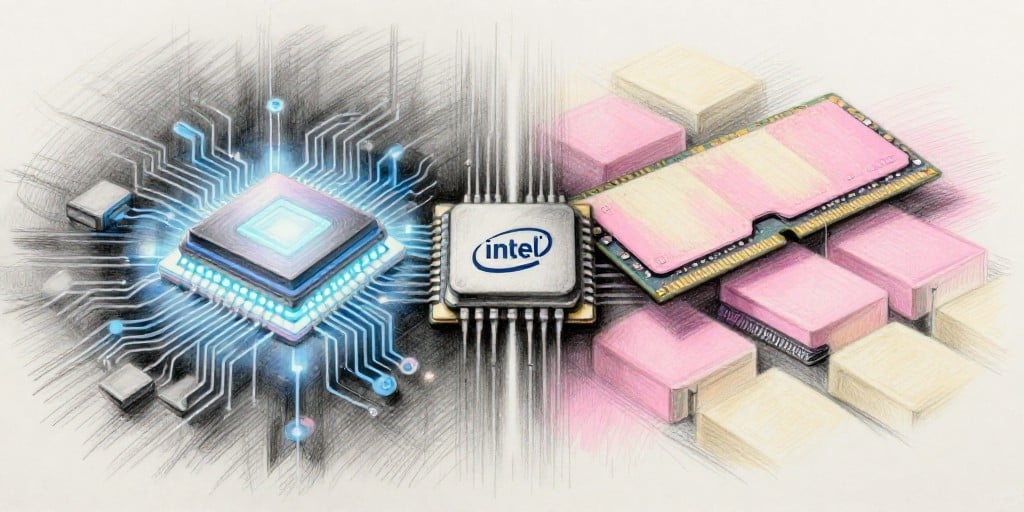
Intel Corp. Navigates Strategic Pivot in Advanced Chip Manufacturing and Memory Support
Intel Corp. is currently navigating a complex period of strategic recalibration amid heightened scrutiny of its semiconductor operations. The company’s confirmed participation in the proposed Terafab facility—an ambitious joint venture with Tesla and SpaceX—signals a decisive move toward advanced chip manufacturing in Texas. Yet, the precise nature of Intel’s role remains undefined, raising questions about the allocation of capital, control of intellectual property, and long‑term competitive positioning.
The Terafab Initiative: Opportunity or Risk?
The Terafab facility is poised to become the first U.S. location capable of producing 3‑nanometer (3 nm) chips, a technology that has largely been the preserve of Taiwanese and Japanese fabs. By aligning with Tesla and SpaceX, Intel is leveraging these partners’ existing automotive and aerospace supply chains, potentially unlocking economies of scale. However, the partnership also introduces significant risks:
| Aspect | Potential Benefit | Potential Risk |
|---|---|---|
| Capital Expenditure | Shared investment reduces individual burden, enabling faster deployment of cutting‑edge nodes. | Joint ownership may dilute Intel’s strategic flexibility, making it harder to pivot if market demand shifts. |
| Intellectual Property | Collaborative R&D could accelerate innovation, especially for automotive‑grade reliability. | IP conflicts could arise if proprietary processes or designs are inadvertently shared across partners. |
| Supply Chain Resilience | Domestic production reduces exposure to geopolitical tensions and shipping bottlenecks. | Concentration of advanced manufacturing in Texas could create a single point of failure if regional disruptions occur. |
Intel’s shares dipped shortly after announcing the partnership, reflecting market uncertainty. This reaction underscores the delicate balance between aggressive expansion and the need for clear, measurable milestones. Analysts are urging Intel to define the scope of its investment—whether it will be a minority stake, a technology licensing arrangement, or a full‑scale production partnership—to alleviate investor anxiety.
DDR4 Resurgence Amid Memory Market Turbulence
Simultaneously, Intel has reintroduced support for DDR4 memory alongside its newer DDR5 offerings. This strategic decision appears driven by two intertwined forces: ongoing supply constraints and price volatility in the RAM market. By maintaining DDR4 compatibility, Intel provides consumers and enterprise customers with a more cost‑effective upgrade path, potentially stabilizing demand in a market that has been experiencing rapid price swings.
The move is part of a broader industry trend. AMD, for example, has also extended support for older platforms to accommodate legacy hardware in data centers and high‑performance computing environments. This cautious approach reflects a shift in the memory ecosystem:
- Supply Constraints: Production of DDR5 requires advanced semiconductor equipment, leading to bottlenecks during periods of surging demand.
- Price Pressures: With the global memory market experiencing a cyclical downturn, offering DDR4 can help keep entry costs lower for budget‑conscious segments.
- Market Demand: The high‑performance sector still demands DDR5 for AI and machine learning workloads, while mid‑tier applications can satisfactorily operate on DDR4.
Intel’s dual‑memory strategy illustrates how major players are balancing innovation with practical market considerations. By keeping legacy options open, they mitigate the risk of alienating existing customer bases while still investing in future‑oriented technologies.
Industry Landscape: Optimism Meets Caution
Beyond Intel, the semiconductor sector is experiencing a mixed sentiment. Nvidia’s recent earnings, heavily focused on AI-related revenue, prompted a modest retreat in its share price. This decline suggests that investors are cautious about the sustainability of AI‑driven capital expenditures, especially given the capital intensity of building next‑generation GPU and silicon‑on‑insulator (SoI) fabs.
Conversely, TSMC and Micron have reported robust revenue growth, indicating resilience in the face of volatile demand. TSMC’s expansion into 3 nm and 2 nm nodes, coupled with its diversified customer base (ranging from consumer electronics to automotive), positions it well for sustained demand. Micron’s focus on memory for high‑performance computing and data center workloads further underscores the sector’s confidence in advanced memory technologies.
Broader Societal, Privacy, and Security Implications
The push toward domestically produced advanced chips carries significant societal implications. A U.S.-based 3 nm fab could reduce dependence on foreign supply chains, enhancing national security. However, it also raises concerns about:
- Privacy: Advanced chips enable more sophisticated data collection and AI analytics, potentially increasing surveillance capabilities.
- Security: Concentrating high‑end manufacturing in a single location may create a vulnerability to sabotage, cyber attacks, or natural disasters.
- Ethics: The rapid development of AI hardware intensifies debates about algorithmic bias, data ownership, and equitable access to technology.
Intel’s involvement in the Terafab project may influence how these risks are managed. By collaborating with Tesla and SpaceX—companies that operate in highly regulated industries—it could bring a heightened emphasis on security protocols and ethical manufacturing practices.
Conclusion
Intel’s strategic pivot—simultaneously engaging in an ambitious domestic fab partnership while revisiting memory support—illustrates a broader industry trend of balancing aggressive innovation with pragmatic market responses. The company’s decisions will not only shape its own competitive trajectory but also reverberate through the broader technology ecosystem, affecting everything from supply chain stability to societal concerns over privacy and security. As the semiconductor sector continues to evolve, stakeholders must remain vigilant about the interplay between technological advancement and its wider implications.