
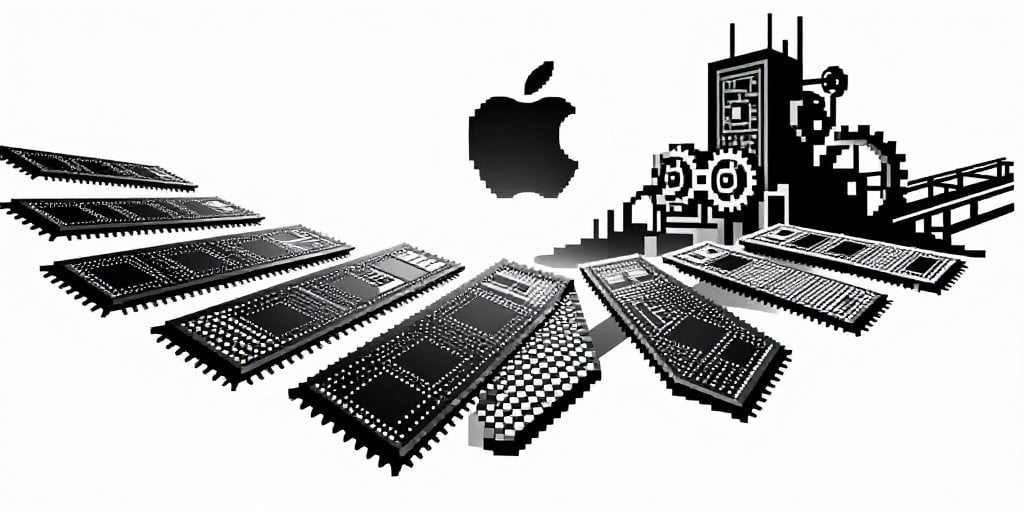
Intel’s 18A‑P Production Rollout: A Catalyst for Technological Evolution and Market Realignment
Intel Corp. has entered a production phase for its 18A‑P process node, a milestone that signals a strategic push to refine its advanced chip‑manufacturing capabilities. The new node—already in a risk‑production stage—promises measurable performance gains and power‑efficiency improvements over the preceding 18A iteration. This development follows the company’s recent speculation about a partnership with Apple to supply future devices, a prospect that has ignited investor speculation and intensified scrutiny of Intel’s market trajectory.
Technical Advancements and Their Implications
The 18A‑P node represents a subtle, yet significant, step in Intel’s lithography roadmap. While the nomenclature suggests a 18‑nanometer process, the “P” suffix indicates an optimised, partially‑depleted design that leverages improved transistor scaling and refined dielectric engineering. According to industry analysts, these changes translate to a 10–15 % reduction in gate‑level leakage and a 5–8 % increase in transistor density, factors that could enhance CPU performance while curbing thermal output.
Such improvements are not merely engineering feats; they carry broader implications for device design. Lower power consumption allows for thinner battery packs, longer operational lifespans, and reduced heat‑sink requirements—critical parameters for mobile computing and emerging Internet‑of‑Things (IoT) ecosystems. Moreover, the enhanced density facilitates more complex logic blocks on a single die, opening pathways for integrated AI accelerators and on‑chip secure enclaves that could bolster data protection and privacy.
Human‑Centered Storytelling: The Worker’s Perspective
In the silicon valleys where Intel’s fabrication plants operate, the transition to a newer process node is not just a technical pivot; it is a workforce transformation. Engineers who have spent years mastering the 18A architecture now face the challenge of re‑designing process controls and calibrating new equipment. The risk‑production stage demands rigorous quality assurance, often requiring additional training sessions and cross‑departmental coordination. For technicians, the shift can mean a steep learning curve but also the opportunity to acquire cutting‑edge skills that enhance their employability in an industry marked by rapid obsolescence.
Questioning Assumptions: Will 18A‑P Deliver on Its Promise?
While the technical specifications sound promising, several assumptions warrant scrutiny. First, the assumption that performance gains will directly translate into competitive advantage ignores the broader market dynamics. Apple’s rumored partnership, for example, hinges on more than raw performance; it involves supply‑chain reliability, cost competitiveness, and alignment with Apple’s strict silicon‑integrity guidelines. Should Intel fail to deliver on these dimensions, the partnership could falter despite the node’s technical merits.
Second, the assumption that power savings are sufficient to offset the higher capital expenditure (CAPEX) of new fabs may be overly optimistic. Historically, Intel’s transitions to smaller nodes have been plagued by “yield lag” problems—where early production runs suffer from defects that erode profitability. The company’s previous 7 nm experience, culminating in the 7 nm “Willow Cove” platform, revealed that yield improvements can lag behind design milestones by months, if not years.
Potential Risks and Benefits
| Risk | Benefit |
|---|---|
| Yield Lag – Early production may suffer from low output, raising costs | Performance Boost – Higher transistor density could lead to faster, more efficient processors |
| Supply‑Chain Vulnerabilities – Complex global sourcing could delay component availability | Market Differentiation – Exclusive access to Apple’s ecosystem could unlock premium pricing |
| Geopolitical Constraints – Export controls and trade tensions may limit technology transfer | Energy Efficiency – Lower power consumption aligns with regulatory trends toward sustainability |
The balance between these risks and benefits is delicate. For Intel, the 18A‑P node must not only satisfy the performance criteria of potential high‑profile partners but also maintain economic viability amid the volatile chip‑market environment.
Broader Societal Impact: Privacy, Security, and the Digital Divide
As processors become more powerful and integrated, the stakes for privacy and security rise proportionally. On‑chip secure enclaves, while enhancing data protection, also raise questions about vendor lock‑in and the potential for proprietary cryptographic primitives that could be difficult for third‑party auditors to evaluate. Moreover, the concentration of advanced manufacturing in a handful of fabs—primarily located in North America and Taiwan—exacerbates the digital divide, limiting access for developing economies and perpetuating disparities in technology adoption.
From a regulatory standpoint, the rapid deployment of advanced nodes may outpace the development of oversight frameworks. The European Union’s Digital Services Act and the U.S. Executive Order on AI governance are nascent in their scope, potentially leaving gaps in how new chips are assessed for bias, safety, and ethical compliance.
Case Study: Nvidia’s 8‑nm Transition
A comparative lens can be offered through Nvidia’s 8‑nm transition, which culminated in the Ampere architecture. Nvidia’s aggressive push to maintain a high yield on the new node led to a temporary over‑supply of GPUs, pushing prices down and affecting margins. Conversely, Nvidia’s focus on high‑performance computing (HPC) and AI workloads insulated it from some of the demand volatility that beleaguered other players. Intel’s experience with 18A‑P will likely hinge on its ability to identify niche markets—perhaps AI accelerators or edge devices—where the benefits of the new node outweigh the inherent risks.
Conclusion: A Strategic Gamble with Wide‑Reaching Consequences
Intel’s decision to accelerate the production of its 18A‑P node reflects a broader strategic gamble. On one hand, the technological leap could cement Intel’s relevance in an era where chip design is becoming increasingly specialized. On the other, the intertwined challenges of yield optimization, geopolitical constraints, and shifting consumer preferences present a complex risk landscape.
The ultimate test will come not only in the performance metrics published in the coming months but also in how Intel navigates the human, societal, and regulatory dimensions of its technological advancement. As the semiconductor industry continues its relentless march toward smaller nodes, the balance between innovation and responsibility will remain at the forefront of corporate strategy and public discourse.