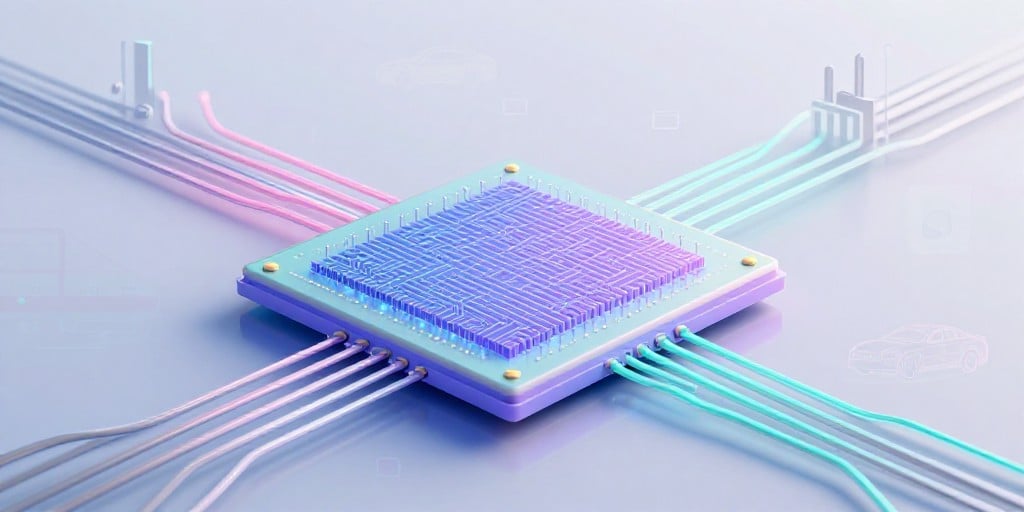
Intel Corp. Expands Quantum Research While Strengthening Edge AI and Automotive Partnerships
Intel Corp. has reiterated its commitment to broadening its footprint in quantum technology, while simultaneously advancing complementary ventures that reinforce its overarching semiconductor strategy. The company’s quantum initiative is spearheaded by a relatively small, yet rapidly growing team that focuses on silicon‑spin qubits. Leveraging Intel’s extensive fabrication expertise, the team evaluates whether quantum processors can be produced at scale, a critical consideration for commercial viability.
Quantum Initiative: A Strategic Ambition Amidst Competitive Alternatives
Intel’s leadership emphasizes that the direction of its quantum technology remains undecided, acknowledging a competitive landscape that includes superconducting circuits, ion traps, photonics, and neutral‑atom approaches. The company is actively researching whether silicon‑spin qubits can achieve parity with these alternatives in terms of coherence time, error rates, and manufacturability. In addition to foundational research, Intel is working toward delivering practical quantum products. Key components of this effort involve:
- Reliable error correction mechanisms to mitigate decoherence and operational noise.
- Control software capable of orchestrating quantum operations across distributed hardware.
- Industrial‑grade scalability to transition from laboratory prototypes to production‑ready devices.
These priorities align with broader industry trends that view quantum computing as a high‑impact, long‑term investment, while recognizing the immediate commercial pressures of delivering functional hardware within a reasonable timeframe.
Edge AI and Automotive Collaborations
Parallel to its quantum research, Intel is deepening its engagement with partners in edge computing and automotive applications. A recent partnership integrates Intel’s edge‑AI platform into a shared‑intelligence layer that is being adopted by transportation and manufacturing firms. The collaboration aims to deliver real‑time operational insights by processing data near its source rather than in centralized data centers. The key features of this joint effort include:
- Core‑ultra architecture from Intel, optimized for low‑latency inference.
- Orchestration platform that aggregates sensor data and applies AI models locally.
- Proof‑of‑value target within the first three months, with an emphasis on mission‑critical use cases such as autonomous vehicle navigation and predictive maintenance.
By demonstrating tangible benefits early in the deployment cycle, Intel seeks to cement its role as a trusted partner in sectors where reliability, latency, and security are paramount.
Market Context and Competitive Positioning
Intel’s broader market context is shaped by a shift toward high‑performance compute for artificial‑intelligence workloads. The semiconductor sector continues to be a key driver of investor interest, with Intel’s performance frequently benchmarked against peers such as AMD, Nvidia, and Micron. Recent market activity has seen Intel’s shares move modestly, reflecting a backdrop of positive sentiment for AI‑enabled chip demand. Several factors influence this dynamic:
- Supply‑chain resilience: Intel’s advanced manufacturing capabilities mitigate some of the bottlenecks that have plagued competitors.
- Product portfolio diversification: By balancing foundational research in emerging quantum technologies with immediate commercial opportunities in edge AI and industrial automation, Intel positions itself to capture growth in both nascent and established segments of the chip market.
- Strategic alliances: Partnerships with automotive and industrial leaders reinforce Intel’s presence in mission‑critical environments, which are often less price‑sensitive and more focused on reliability.
Conclusion
Intel Corp. exemplifies an adaptive corporate strategy that merges long‑term research ambitions with near‑term commercial imperatives. By investing in silicon‑spin qubits while simultaneously advancing edge AI solutions for transportation and manufacturing, the company leverages its core strengths in fabrication and architecture design. As the semiconductor industry evolves, Intel’s dual focus on emerging quantum technologies and high‑performance AI workloads positions it to maintain relevance and drive growth across both emerging and mature markets.