Infineon Technologies AG Navigates Market Turbulence While Reinforcing Long‑Term Strategy
A Week of Volatility Amid a Resilient Fundamentals Landscape
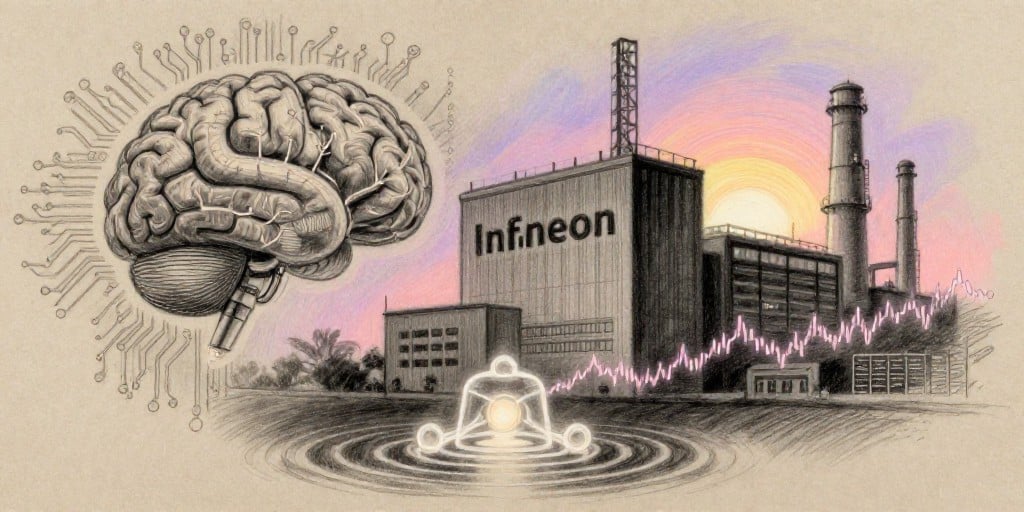
Infineon Technologies AG has experienced a turbulent week on the German equity market, with its shares slipping below the €50 threshold on Monday. This decline arrived despite the company’s announcement of a historically strong quarterly performance and a robust revenue outlook for 2027. Market observers attribute the sell‑off to broader weakness among technology stocks and lingering uncertainty over the firm’s artificial‑intelligence (AI) business, echoing a wider slide in the chip sector that has been pressured by international market conditions and the fallout from Nvidia CEO Jensen Huang’s resignation.
The Buy‑Back as a Signal of Confidence
In the midst of this market volatility, Infineon has continued to execute its 2026 share‑buyback programme, purchasing over two million shares in a three‑day window at Xetra. The buy‑back, carried out on the company’s behalf by an independent financial institution, is part of an effort to support the share price and demonstrate confidence in the company’s long‑term prospects. While the manoeuvre does not alter underlying fundamentals, it does provide a tangible signal to investors that management remains committed to shareholder value amid a volatile backdrop.
Underlying Strength: A Record‑Breaking Quarter
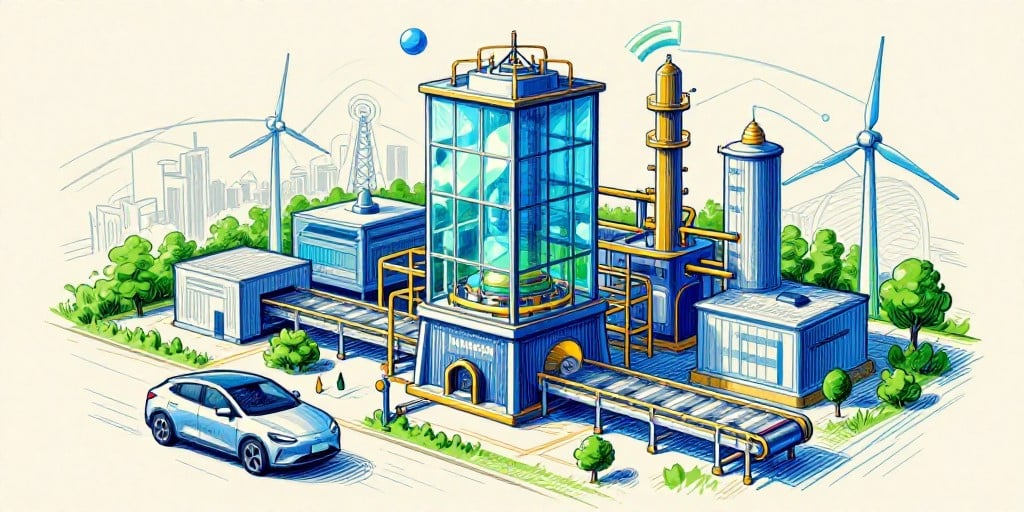
Despite the short‑term decline, the company’s underlying fundamentals remain robust. Infineon’s most recent quarterly results were the best in its history, driven by growth in automotive and industrial semiconductor demand, and a significant expansion of its power‑management solutions for data‑centre and edge computing. The firm is also advancing new products, such as a single‑stage 22‑kW on‑board charger developed in partnership with Visteon‑Shinry, which aims to simplify charging infrastructure for electric vehicles.
Automotive and Industrial Momentum
The automotive semiconductor segment has continued to outpace expectations, propelled by the rapid adoption of electrification and autonomous driving technologies. Industrial demand, meanwhile, remains buoyant as manufacturers upgrade their automation stacks and adopt Industry 4.0 solutions. Infineon’s position as a leading supplier of power‑management ICs for these segments gives it a sustained competitive advantage.
Data‑Centre and Edge Expansion
Infineon’s power‑management solutions for data‑centres and edge computing are experiencing accelerated demand. As cloud providers push for higher density and energy efficiency, the company’s portfolio of power‑management ICs has become a critical enabler. This trend is reinforced by the broader shift toward edge computing, where low‑power, high‑performance solutions are increasingly sought after.
AI‑Related Power‑Management: The Emerging Growth Lever
While investors remain cautious about the company’s AI business, Infineon is investing heavily in AI‑related power‑management technologies. This focus aligns with a broader industry trend, as semiconductor manufacturers look to reduce power consumption while maintaining computational performance in AI workloads. By leveraging its expertise in power‑management ICs, Infineon is positioned to capture a share of the fast‑growing AI market without relying on direct AI chip design.
Challenging Conventional Wisdom
Traditional narratives often treat AI as a distinct segment requiring dedicated chip design. Infineon’s strategy challenges this view by emphasizing the foundational importance of power‑management solutions that enable AI workloads across a spectrum of devices, from edge sensors to high‑end data‑centre accelerators. This perspective positions Infineon as a key enabler rather than a direct competitor in the AI hardware space.
Market Dynamics and Geopolitical Context
The broader uncertainty in the technology sector is amplified by geopolitical tensions, particularly those involving supply‑chain restrictions and export controls. These dynamics have pressured the chip sector, causing investors to reassess risk exposure. Additionally, the planned IPO of AI platform provider Anthropic—an event that could reshape the AI landscape—has heightened volatility as market participants speculate on its potential impact on related semiconductor firms.
A Buying Opportunity or a Cautionary Tale?
Market observers suggest that the current dip could present a buying opportunity, given Infineon’s continued investment in AI‑related power‑management and its position in key growth markets. However, investors must weigh this against the broader uncertainty in the technology sector and the potential ripple effects of geopolitical tensions. The upcoming quarterly reports and the trajectory of the AI platform IPO will be critical in determining whether the market’s current valuation is justified.
Strategic Outlook: Sustaining Growth Amid Volatility
- Diversified Revenue Streams – Continued expansion in automotive, industrial, and data‑centre segments provides a balanced revenue base that can absorb volatility in any single market.
- Power‑Management Leadership – By advancing power‑management solutions for AI, Infineon taps into a high‑growth niche without the capital intensity of designing AI processors.
- Shareholder Confidence – Ongoing buy‑back activity signals management’s commitment to long‑term shareholder value, potentially stabilizing the share price in turbulent times.
- Geopolitical Resilience – Leveraging a diversified global supply chain can mitigate the impact of regional restrictions and geopolitical shocks.
Forward‑Looking Analysis
In the coming months, Infineon’s ability to navigate the dual challenges of market volatility and geopolitical uncertainty will hinge on its execution of the 2026 buy‑back programme, its capacity to sustain growth in the automotive and industrial segments, and its success in embedding power‑management solutions into AI workloads. If the firm can demonstrate tangible progress in AI‑related power‑management, it may shift investor perception from uncertainty to opportunity, reinforcing its position as a cornerstone of the global semiconductor ecosystem.