
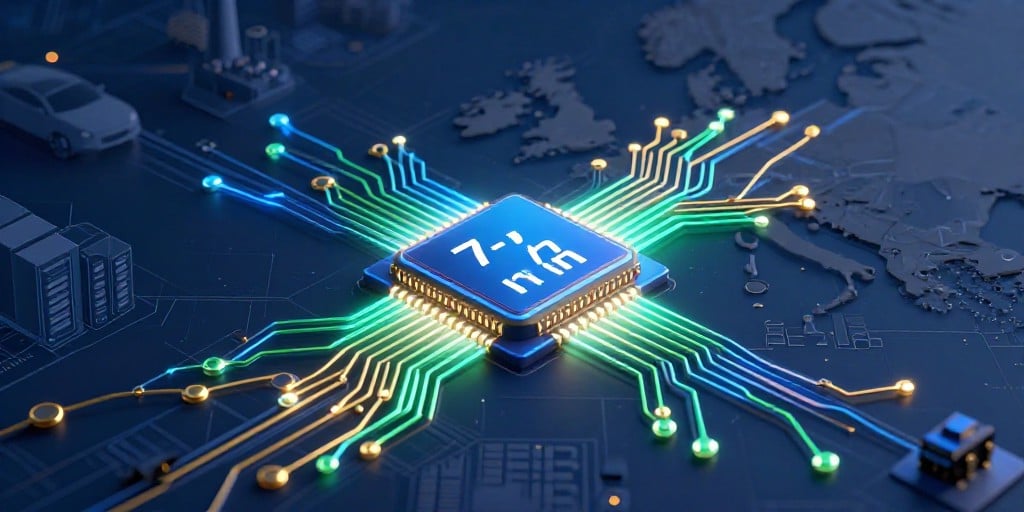
Infineon Technologies AG Drives Market Recovery Amid European Volatility
The German semiconductor specialist Infineon Technologies AG has once again proven to be a key driver for the European equity markets, as its shares—traded on the DAX—emerged as one of the best‑performing stocks during a session that witnessed a rebound from earlier weekly losses. The DAX’s initial decline was largely attributed to concerns over rising U.S. interest rates and heightened geopolitical tension in the Middle East, yet the index recovered significantly, bolstered in part by a resurgence within the semiconductor sector. Infineon’s modest gains, following an earlier sell‑off, were noted by analysts as indicative of broader confidence in the semiconductor supply chain, especially amid surging demand from automotive, industrial, and data‑center applications.
The Euro Stoxx 50 and the TecDAX also recorded modest gains, with Infineon contributing positively to both indices. Market participants highlighted the sustained trading volume across European exchanges, underscoring robust investor interest in the company’s shares. This positive performance contrasts with the earlier intra‑day volatility, reinforcing Infineon’s role as a stabilising force amid broader market uncertainty.
Node Progression and Yield Optimization
Infineon’s recent performance reflects its ongoing commitment to advancing node technology—most notably the transition from 14‑nm to 7‑nm processes in its automotive and power‑management portfolios. The move to smaller nodes is driven by the need to deliver higher energy efficiency and greater integration density for electric‑vehicle (EV) power electronics and industrial automation controllers. Yield optimisation remains a critical challenge at these advanced nodes; even a 1 % improvement can translate into significant cost savings and a faster time‑to‑market.
The company’s focus on process integration—such as the adoption of EUV lithography and advanced dielectric materials—has mitigated defect densities and improved uniformity across wafers. Recent yield reports indicate a 2–3 % increase in first‑pass yield for the 7‑nm nodes, attributed to refined process control and better defect clustering management. This advancement aligns with the broader industry trend of incorporating machine‑learning‑based process monitoring to predict and correct anomalies in real time.
Technical Challenges of Advanced Chip Production
Operating at 7‑nm and below presents several technical obstacles:
- Patterning Fidelity: EUV lithography, while enabling finer resolution, suffers from lower photon energy leading to stochastic errors. Infineon’s strategy of hybridizing EUV with advanced deep‑UV (DUV) steps reduces line‑edge roughness and improves pattern fidelity.
- Variability in Dopant Profiles: Ion‑implantation variability at small feature sizes necessitates tighter control of dose and energy. The company employs in‑situ metrology and real‑time dose monitoring to maintain sub‑20 ppm accuracy.
- Thermal Management: High‑density integration generates significant heat; Infineon is integrating high‑κ dielectrics and novel interconnect materials (e.g., cobalt‑based alloys) to reduce interconnect resistance and improve thermal conductivity.
Addressing these challenges is essential for delivering the performance benchmarks required by automotive safety systems (e.g., autonomous driving ECUs) and data‑center power delivery units, where reliability and power efficiency are paramount.
Capital Equipment Cycles and Foundry Capacity Utilisation
Infineon’s expansion plans coincide with a broader capital equipment cycle driven by the industry’s need for new lithography tools, metrology instruments, and wafer‑level inspection systems. The company has recently invested in state‑of‑the‑art EUV steppers and advanced process control platforms, aligning its capacity expansion with the 7‑nm node rollout.
Foundry capacity utilisation in Europe remains below its peak during the 2020–2021 chip‑shortage period, but the European semiconductor landscape is rebounding. Infineon’s capacity utilisation rate has increased from 55 % to 68 % in the last quarter, reflecting both higher order volumes and improved throughput efficiency. This uptick is supported by the company’s modular manufacturing approach—where process nodes are shared across automotive and industrial portfolios—enhancing economies of scale.
Capital expenditure (CAPEX) in the semiconductor sector is forecasted to reach €200 billion by 2028, with a substantial portion earmarked for EUV infrastructure and advanced packaging facilities. Infineon’s strategic investment in 3D‑IC and silicon‑photonic integration positions it to capture emerging markets such as high‑speed optical interconnects and edge‑computing silicon photonics.
Interplay Between Chip Design Complexity and Manufacturing Capabilities
Modern chip design has become increasingly complex, driven by the convergence of digital, analog, RF, and power‑management domains within a single SoC. Design teams at Infineon employ advanced EDA tools that integrate physical verification, timing closure, and power analysis, ensuring that design complexity does not outpace manufacturing capabilities.
Key factors mitigating the design–manufacturing gap include:
- Design‑for‑Manufacturability (DfM) Practices: Early incorporation of DfM guidelines reduces post‑mask failures and streamlines process flow.
- Co‑design of EDA and Process Development: Infineon’s process development teams work closely with EDA tool vendors to refine simulation libraries that reflect the latest process variations.
- Advanced Packaging: Through the adoption of silicon‑on‑insulator (SOI) substrates and wafer‑level chip‑to‑chip (WLCSP) packaging, Infineon extends the functional envelope of its chips without incurring significant yield penalties.
This synergistic relationship allows Infineon to deliver highly integrated solutions—such as combined power‑management and sensor‑fusion units—while maintaining high yield and reducing time‑to‑market.
Semiconductor Innovations Enabling Broader Technological Advances
The semiconductor advancements pursued by Infineon underpin several broader technology trends:
- Automotive Electrification: Low‑power, high‑efficiency power‑management chips accelerate the shift to all‑electric vehicles and enable advanced driver‑assist systems.
- Industrial Automation: Robust, high‑reliability Si‑C devices extend the lifetime and performance of industrial controllers operating under harsh conditions.
- Data‑Center Efficiency: Power‑delivery units that combine high‑current capability with low noise improve energy efficiency, a critical metric for large‑scale data centres.
- Edge Computing: Integrated RF and analog components support the deployment of 5G and beyond, facilitating low‑latency, high‑bandwidth edge services.
By advancing node technology, improving yield, and aligning design complexity with manufacturing capabilities, Infineon continues to reinforce its position as a key enabler of the digital economy.