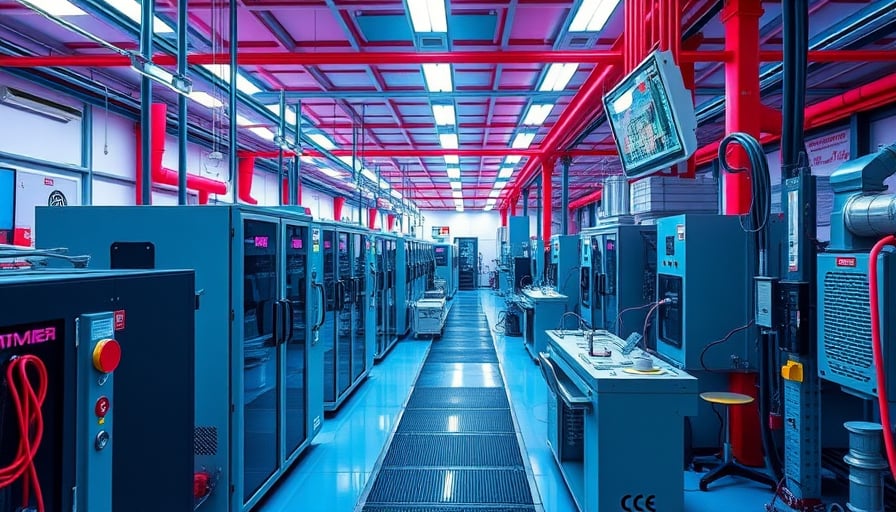
Corporate Governance and Capital Expenditure Dynamics in the Beauty‑Manufacturing Sector
Executive Summary
Ulta Beauty Inc. has recently reported a modest decline in its share price, a movement that outpaced the broader equity market during the same trading session. While the stock performance reflects market sentiment toward the company’s governance and strategic direction, the announcement of its forthcoming virtual shareholder meeting on June 9, 2026 underscores the firm’s commitment to transparency and robust governance. The proxy materials highlight a full slate of director elections, amendments to the certificate of incorporation aimed at limiting officer liability, and the ratification of key governance and compensation initiatives.
From a capital‑investment perspective, Ulta’s governance updates dovetail with industry‑wide trends in manufacturing automation, process optimization, and supply‑chain resilience. This article examines how corporate governance decisions influence capital allocation in the beauty‑manufacturing sector, the role of technology in enhancing productivity, and the macro‑economic forces shaping infrastructure and equipment spending.
1. Governance Structure and Capital‑Investment Implications
1.1 Independent Directors and Board Renewal
The board’s policy of capping director age at 75 and maintaining a majority of independent directors aligns with best practices in risk management. Independent oversight facilitates objective evaluation of capital‑expenditure projects, ensuring that decisions are based on rigorous cost‑benefit analyses rather than managerial bias. In manufacturing contexts, such scrutiny is vital for approving large‑scale equipment purchases—such as robotic assembly lines or advanced process‑control systems—whose payback periods can span 5‑7 years.
1.2 Certification Amendments and Liability Limitation
Amending the certificate of incorporation to incorporate forum‑selection provisions and limit officer liability reduces legal exposure. This creates a more favorable environment for pursuing cross‑border investments in manufacturing facilities, enabling the company to expand production capacity in regions with lower labor costs and favorable regulatory regimes. Moreover, a clear legal framework supports the adoption of cutting‑edge manufacturing technologies that may raise compliance complexities.
1.3 Compensation and Incentive Alignment
The proxy outlines an executive compensation advisory resolution and a 2026 incentive‑award plan. Aligning executive pay with key performance indicators—such as units produced per hour, energy consumption per batch, and supply‑chain lead time—provides a direct incentive for leaders to champion lean‑manufacturing initiatives and technology upgrades.
2. Technological Innovation in Beauty‑Product Manufacturing
2.1 Automation and Robotics
The beauty‑industry’s move toward high‑throughput, highly customizable product lines necessitates robotic dispensing and packaging systems. These systems, governed by programmable logic controllers (PLCs) and human‑machine interfaces (HMIs), reduce manual labor costs and improve consistency. Capital budgets now routinely allocate up to 20 % of total manufacturing spend to automation upgrades.
2.2 Process‑Control and Data Analytics
Integrated process‑control systems, such as distributed control systems (DCS) and supervisory control and data acquisition (SCADA), enable real‑time monitoring of critical parameters—temperature, pressure, viscosity—during formulation. Coupled with advanced analytics platforms, these systems support predictive maintenance, thereby extending equipment life expectancy by 15‑20 % and reducing downtime.
2.3 Sustainable Production and Circular Economy Initiatives
Capital investments in water‑recycling units, low‑energy formulation reactors, and biodegradable packaging are gaining traction. The adoption of green chemistry principles often requires upfront expenditure on specialized reactors and waste‑treatment infrastructure. However, regulatory incentives—such as tax credits for renewable‑energy‑powered facilities—offset initial costs.
3. Capital Expenditure Trends and Economic Drivers
3.1 Infrastructure Spending and Supply‑Chain Resilience
In the wake of global supply‑chain disruptions, manufacturers are investing in dual‑source suppliers and strategic inventory buffers. Capital budgets now include investments in warehousing automation and advanced logistics platforms. The resulting increase in fixed assets translates to a higher depreciation expense, yet the overall return on investment (ROI) improves through reduced stock‑out incidents.
3.2 Regulatory Landscape
The European Union’s REACH (Registration, Evaluation, Authorization and Restriction of Chemicals) framework imposes stringent requirements on ingredient safety. Compliance necessitates new analytical laboratories and robust traceability systems. In the United States, the Consumer Product Safety Commission’s (CPSC) new labeling mandates require data‑collection capabilities embedded in production lines.
3.3 Macro‑Economic Factors
Interest‑rate fluctuations directly impact the cost of borrowing for large equipment purchases. In periods of tightening monetary policy, companies often defer non‑critical capital expenditures. Conversely, favorable financing terms and low corporate tax rates incentivize investment in high‑value manufacturing equipment.
4. Supply‑Chain Impacts and Strategic Response
4.1 Component Sourcing
The beauty‑manufacturing sector relies on specialty chemicals that may be sourced from geographically diverse locations. Capital expenditures in secure transportation corridors—such as refrigerated railcars—reduce spoilage risk, thereby improving yield and cost‑effectiveness.
4.2 Logistics Automation
Automated guided vehicles (AGVs) and robotic palletizers in distribution centers lower labor costs and speed up order fulfillment. These systems integrate with enterprise resource planning (ERP) platforms to provide end‑to‑end visibility, a critical factor for maintaining inventory accuracy and meeting regulatory reporting requirements.
5. Conclusion
Ulta Beauty’s recent governance announcements, while centered on shareholder engagement and board composition, have broader implications for the company’s capital‑investment strategy. Robust governance frameworks enhance decision‑making around large‑scale manufacturing upgrades, ensuring that investments in automation, process control, and sustainability align with both shareholder value and regulatory compliance. As capital expenditure trends shift toward data‑driven, energy‑efficient, and resilient manufacturing infrastructures, companies that couple sound governance with technological innovation will be best positioned to capitalize on market opportunities while mitigating operational risks.