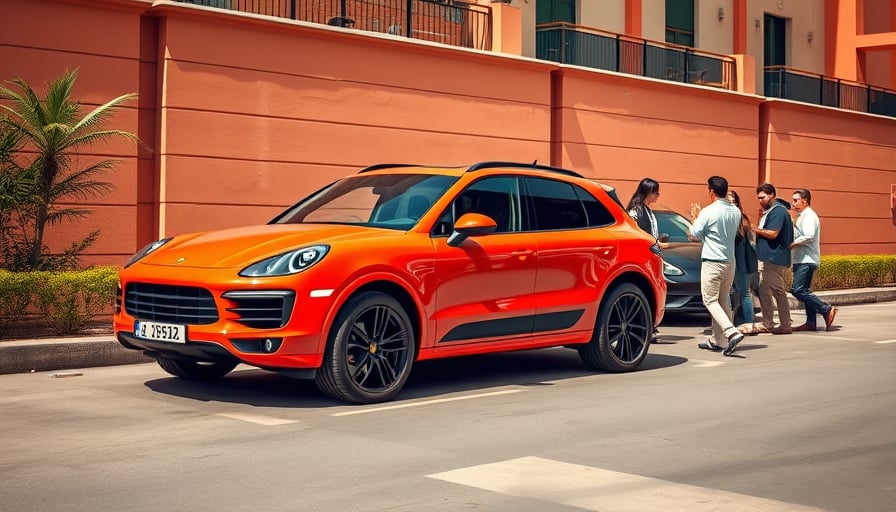
Porsche Automobil Holding SE Reports Q1 2025 Results and Outlook for 2026
Porsche Automobil Holding SE, the German‑based holding company that manages the Porsche and Lamborghini brands, released its first‑quarter financial results for the fiscal year ending 31 December 2025. The company disclosed a range of indicators that underscore the challenges it faces amid the broader shift in the automotive industry toward electrification and sustainability.
Q1 2025 Financial Highlights
- Operating Margin: Porsche reported an operating margin for 2025 that falls short of the 7 %–8 % range projected by most analysts. The management has therefore projected that the group’s operating margin for 2026 will remain in the lower band of 5 % to 7½ %, signalling a tighter profitability profile for the upcoming year.
- After‑Tax Profit: The after‑tax profit for the quarter was significantly lower than in the same period last year, largely driven by sizeable investment outlays associated with the company’s transition away from internal‑combustion‑engine (ICE) platforms.
- Revenue Trend: Porsche’s revenue figures point to a downward trajectory in sales for 2026, a trend that management expects will continue in the near term as the company realigns its product mix and navigates supply‑chain constraints.
Strategic Shift Toward Higher‑Margin Product Segments
In a statement to investors, CEO Oliver Blume announced that Porsche is actively exploring entry into new product segments beyond its current core offerings—the two‑door sports cars (such as the 911) and the Cayenne SUV. The objective is to expand into higher‑margin categories, which may include larger SUVs, premium sedans, or technologically advanced electrified vehicles. This move reflects a broader industry pattern where premium automakers are diversifying their product lines to capture more profitable market segments and mitigate the pricing pressures associated with electric vehicle (EV) development.
Contextualizing Porsche’s Performance within Industry Dynamics
Electrification Investment Costs The automotive sector is undergoing a seismic shift toward electrification, which requires substantial capital for research and development, battery technology, and manufacturing re‑tooling. Porsche’s significant investment in EV‑related infrastructure has reduced its short‑term profitability, a trend mirrored across many luxury and mainstream OEMs.
Supply‑Chain Constraints Global semiconductor shortages and raw‑material price volatility have disrupted production schedules. Porsche’s Q1 2025 results reflect the broader industry‑wide challenges of maintaining supply‑chain resilience while scaling EV production.
Competitive Positioning By broadening its product portfolio, Porsche seeks to differentiate itself from competitors such as Mercedes‑Benz (EQ series) and BMW (iX/ i4), which have aggressively pushed into premium electrified segments. The ability to offer higher‑margin models may help Porsche sustain its profitability margins in a rapidly evolving market.
Economic Factors Macro‑economic headwinds—rising interest rates, inflationary pressures, and potential geopolitical uncertainties—could further dampen consumer demand in 2026. Porsche’s conservative margin forecasts reflect an awareness of these risks and a strategy to preserve financial health during an uncertain period.
Forward‑Looking Outlook
Porsche’s management acknowledges that sales revenue for 2026 is expected to decline relative to prior years, and that operating earnings will likely deteriorate further. The company’s focus on developing higher‑margin product categories is intended to counterbalance the impact of EV transition costs. However, the success of this strategy hinges on several variables:
- Execution Speed: The timeline for launching new models in higher‑margin categories must be carefully managed to avoid diluting brand equity.
- Market Acceptance: Consumer demand for new product segments—particularly in the premium SUV and sedan markets—will determine the commercial viability of Porsche’s expansion.
- Cost Control: Continued investment will require disciplined cost management to ensure that the long‑term benefits of new product lines outweigh short‑term financial headwinds.
Conclusion
Porsche Automobil Holding SE’s first‑quarter 2025 results reveal a company in transition, balancing the immediate financial impact of electrification investments against a strategic plan to broaden its product mix into higher‑margin segments. While the projected operating margin for 2026 falls below analyst expectations, the company’s proactive approach to diversification and cost management reflects a broader industry trend of premium automakers seeking resilience amid a rapidly shifting automotive landscape.