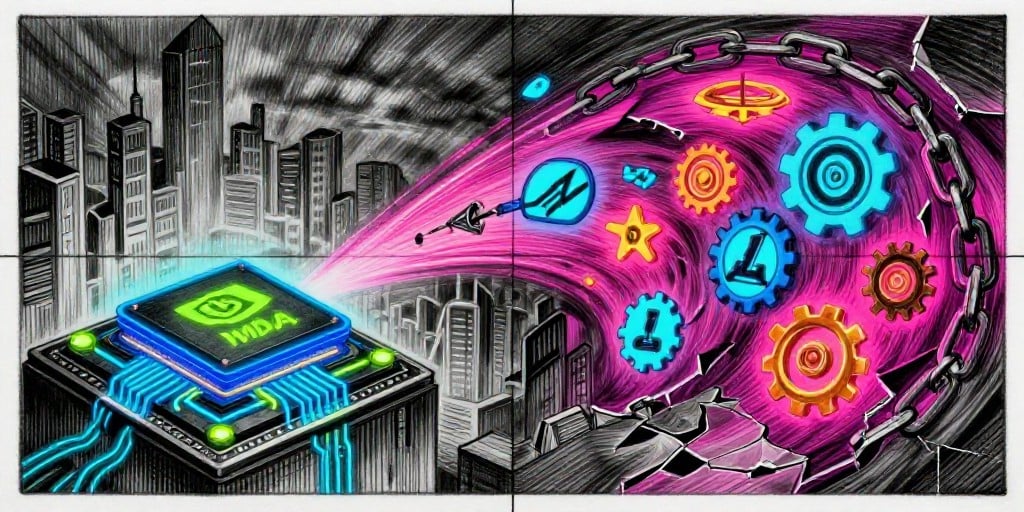
Executive Resignation Amidst Market Turbulence
Nvidia’s unexpected leadership shake‑up has reverberated across the technology sector, prompting a reevaluation of governance practices and competitive dynamics. The former chief executive, Jensen Huang, stepped down on Thursday, effective immediately, amid allegations that raised doubts about internal culture and oversight. The company’s board, led by newly appointed chair Harvey C. Jones, named chief financial officer Colette Kress as interim CEO while it begins a full‑scale search for a permanent successor.
Immediate Market Impact
Within hours of the announcement, Nvidia’s stock dropped sharply, erasing a significant portion of its market capitalisation. Although the core AI‑chip business—particularly the demand for GPUs in generative AI and data‑center workloads—remains robust, investor sentiment turned cautious. Retail trading volume spiked as the price fell, and several brokerage houses revised their rating frameworks, ranging from “hold” to “sell.” The market’s reaction underscores the weight of leadership credibility in a company whose value proposition is tightly coupled to brand trust and technological leadership.
Governance and Culture: A Broader Conversation
Huang’s departure brings governance concerns to the fore. Analysts have long pointed out that rapid growth can erode internal controls, and the allegations suggest that the company’s internal culture may have been stretched thin. The appointment of an experienced director as chair and a long‑serving CFO to the interim CEO role signals a deliberate move toward stability. Kress, who joined Nvidia in 2013 and has overseen significant financial milestones, is expected to maintain operational continuity while the board searches for a new CEO. Her stewardship will be judged not only on fiscal prudence but also on how she signals a culture of accountability.
Competitive Positioning: The CUDA Challenge
Nvidia’s CUDA platform has been the cornerstone of its AI strategy, enabling developers to harness GPU power for large‑scale neural network training and inference. However, competitors—particularly those investing in specialized AI hardware and alternative programming frameworks—have demonstrated the ability to run large models on non‑GPU architectures. This raises the specter that Nvidia’s competitive moat could erode if CUDA’s dominance is challenged by more efficient or cost‑effective solutions.
The market is split on this assessment. Some experts argue that the ecosystem built around CUDA is too mature to be displaced quickly, citing the breadth of libraries, tooling, and community support. Others warn that the rapid pace of hardware innovation could force Nvidia to rethink its software strategy, especially if it loses first‑mover advantage in emerging AI workloads such as multimodal or real‑time inference.
Succession Dynamics and Strategic Implications
The board’s search for a permanent chief executive will likely weigh both internal and external candidates. Internally, Ian Buck—an architect of GPU architecture and a key technical lead—could provide continuity in product vision. Externally, a figure with cross‑industry experience in scaling technology firms could inject fresh perspective on diversification and risk management. The chosen leader will need to address two primary imperatives: reinforcing Nvidia’s technological edge while restoring investor confidence through transparent governance.
Strategically, the company may accelerate diversification beyond GPUs, leveraging its AI stack into sectors like autonomous vehicles, robotics, and edge computing. A new CEO could also revisit Nvidia’s partnership model, deepening collaborations with cloud providers, academia, and start‑up ecosystems to broaden adoption of CUDA and mitigate the risk of platform lock‑in.
Forward‑Looking Outlook
While the immediate aftermath of the resignation has introduced volatility, the long‑term trajectory will depend on several factors:
| Factor | Likelihood of Positive Impact | Rationale |
|---|---|---|
| Succession Timing | Moderate | A swift, well‑communicated transition can mitigate uncertainty. |
| Governance Reforms | High | Strengthening oversight may restore investor trust. |
| CUDA Ecosystem Resilience | Moderate | The depth of developer engagement could sustain market dominance. |
| Competitive Pressure | High | Emerging hardware and software platforms pose a tangible threat. |
| Diversification into New Verticals | Moderate | Expanding the customer base can offset GPU market saturation. |
In the short term, the market will likely continue to monitor board decisions and leadership messaging closely. In the medium to long term, Nvidia’s ability to adapt its product strategy, nurture ecosystem partnerships, and demonstrate robust governance will determine whether the company can preserve its status as a bellwether for AI hardware innovation. The next few weeks and months will be decisive in shaping investor perception and, ultimately, Nvidia’s strategic course.