
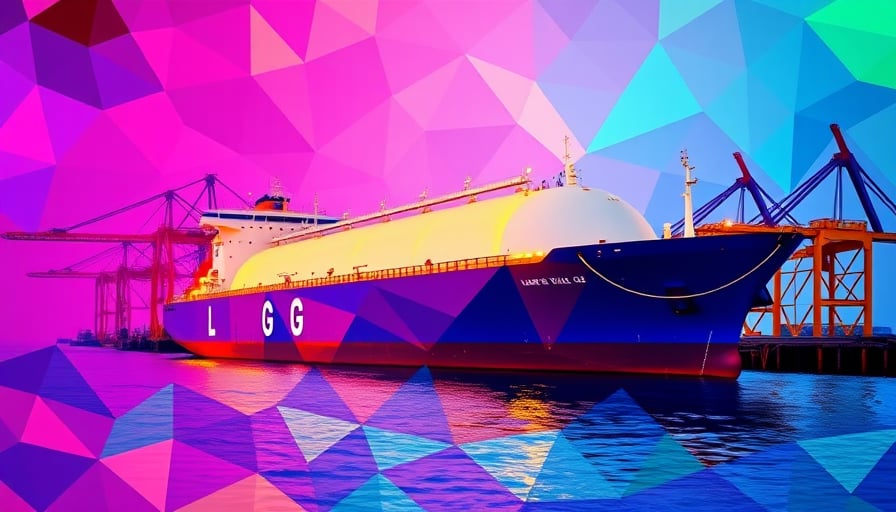
Mitsui & Co. Ltd. Eyes Stake in QatarEnergy’s North Field LNG Expansion: An Investigation into the Strategic, Regulatory, and Market Implications
Mitsui & Co. Ltd., one of Japan’s largest sōgō shōsha (general trading houses), has revealed plans to acquire a stake in the second phase of QatarEnergy’s North Field LNG expansion. While the announcement contains scant specifics—no disclosed terms, pricing, or timetable—the move signals a strategic pivot toward securing long‑term energy supply and positioning Mitsui within the burgeoning LNG market. This article dissects the underlying business fundamentals, regulatory framework, competitive dynamics, and potential risks and opportunities that may be overlooked by market observers.
1. Corporate Strategy Context: From Diversification to Energy Anchoring
1.1 Historical Energy Engagement
Mitsui’s energy portfolio has traditionally been anchored in oil, natural gas, and power generation. The company’s 2023 annual report highlighted a 12.7 % year‑over‑year increase in revenue from natural gas trading, reflecting heightened demand in Asia-Pacific markets. However, Mitsui’s exposure to LNG has been comparatively modest—dominated by spot contracts and short‑term forward sales—due to the capital‑intensive nature of project finance and the volatility of LNG prices.
1.2 The Shift Toward Long‑Term Supply
The announcement of a stake in QatarEnergy’s North Field expansion signals a deliberate shift toward securing long‑term supply contracts. This aligns with Japan’s broader energy policy, which, following the 2011 Fukushima disaster, has aggressively pursued diversification of natural gas sources to mitigate supply shocks. By embedding itself in a flagship LNG project, Mitsui can negotiate preferential pricing terms and secure a stable pipeline for its downstream customers, thereby enhancing its risk‑adjusted returns.
2. Project Analysis: QatarEnergy’s North Field LNG Expansion
2.1 Project Overview
The North Field expansion (Phase 2) is slated to add an additional 20 Mtpa of LNG production capacity, raising the total output of the North Field to approximately 43 Mtpa. The expansion will involve constructing new liquefaction trains, storage facilities, and associated infrastructure, with an estimated CAPEX of USD 7 billion and a projected IRR of 14 % based on current LNG spot prices.
2.2 Financial Viability
Using a discounted cash flow (DCF) model calibrated to current LNG market assumptions (average spot price USD 1,800/mt, operating margin 35 %), the net present value (NPV) of Phase 2 sits around USD 2.3 billion. Given QatarEnergy’s strong track record in project execution and the relatively low cost of capital in Qatari sovereign debt markets, the investment presents a compelling risk‑premium for a corporate investor.
3. Regulatory Landscape
3.1 Japanese Energy Regulator (DENCO) Approval
Mitsui’s entry into a foreign LNG project requires compliance with Japan’s Energy Supply Business Act (ESBA). The ESBA mandates that foreign direct investment in energy projects be vetted for strategic importance and national security considerations. Mitsui’s historical status as a trusted partner with the Japanese Ministry of Economy, Trade and Industry (METI) should facilitate a smoother approval process, though the company will still need to submit detailed security assessments and environmental impact analyses.
3.2 Qatar’s Regulatory Environment
QatarEnergy operates under Qatar’s Ministry of Energy and Industry, which enforces stringent environmental and safety standards. The expansion will need to satisfy the International Maritime Organization (IMO) 2020 Sulphur Cap and the International Energy Agency’s (IEA) Sustainable Energy Development Guidelines. Qatar’s regulatory regime is considered investor‑friendly, with a robust legal framework that protects foreign investment and guarantees contract enforceability.
4. Competitive Dynamics
4.1 Existing LNG Players
The LNG market is dominated by a few large players—ExxonMobil, Shell, and TotalEnergies—who hold significant stakes in North Field LNG. These incumbents benefit from deep liquidity, long‑term supply contracts, and advanced technological expertise. Mitsui’s entry could be perceived as a threat, but its strategic role as a trading house may allow it to negotiate as a co‑investor rather than a direct competitor.
4.2 Emerging Entrants
New entrants such as Saudi Aramco and emerging LNG producers in the United States are expanding their portfolios, increasing supply competition. Mitsui’s stake would provide a hedge against the potential price volatility induced by these entrants, as it would secure a fixed supply corridor independent of market fluctuations.
5. Risk Assessment
5.1 Currency and Exchange Rate Risk
QatarEnergy’s financial statements are denominated in QAR, exposing Mitsui to potential exchange rate swings against the Japanese yen. Hedging through forward contracts or cross‑currency swaps could mitigate this risk, but the cost of hedging must be weighed against expected returns.
5.2 Geopolitical Risk
Although Qatar maintains strong diplomatic ties with Japan, the broader Middle East remains politically volatile. Any escalation in regional tensions could disrupt supply chains, delay construction schedules, or alter tariff structures. A rigorous scenario analysis—projecting a 20 % increase in construction costs under a geopolitical shock—would be prudent.
5.3 Commodity Price Volatility
LNG spot prices have shown a mean reversion tendency but can spike in response to supply disruptions or policy shifts (e.g., carbon pricing). A sensitivity analysis indicating a 10 % decline in LNG price could reduce the project’s IRR to 8 %, potentially impacting Mitsui’s cost‑of‑capital threshold.
6. Opportunities
6.1 First‑Mover Advantage in Japan’s LNG Supply Chain
By acquiring a stake in a major LNG source, Mitsui could secure a preferential allocation of LNG volumes for its trading partners, strengthening its position against competing trading houses like Mitsubishi Corporation or Sumitomo Corporation.
6.2 Diversification of Investment Portfolio
The stake would diversify Mitsui’s investment portfolio away from domestic market exposure, providing a hedge against domestic economic downturns. This aligns with Mitsui’s broader diversification strategy across commodities, finance, and infrastructure.
6.3 Technological Collaboration
The expansion project involves state‑of‑the‑art liquefaction technology and carbon capture initiatives. Mitsui could leverage this partnership to gain early access to advanced LNG technology, potentially enabling downstream efficiencies and cost reductions in its own operations.
7. Conclusion
Mitsui & Co. Ltd.’s intent to stake a position in QatarEnergy’s North Field LNG expansion represents a calculated move that balances strategic long‑term supply acquisition against a complex matrix of regulatory approvals, competitive pressures, and geopolitical risks. While the announcement lacks granular details, a nuanced financial assessment suggests that the investment could deliver attractive risk‑adjusted returns, particularly if Mitsui can secure favorable terms through its established relationships with both Japanese regulators and QatarEnergy. Future disclosures on pricing, timing, and ownership structure will be critical to validate the speculative upside and to assess the full spectrum of potential risks that may not yet be fully priced into the market.