
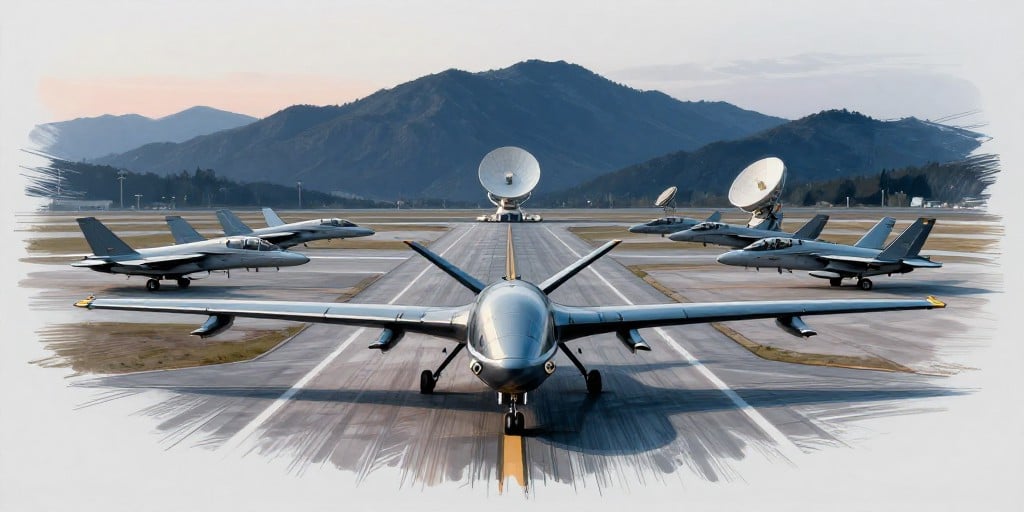
Mitsubishi Heavy Industries and the Global Combat Air Programme: An Analytical Perspective
International Defence Collaboration
Mitsubishi Heavy Industries (MHI) has reaffirmed its status as a pivotal partner in the Global Combat Air Programme (GCAP). During recent consultations between the Canadian and Japanese defence ministries held in Tokyo, the advanced fighter programme was highlighted as a promising initiative capable of attracting new partners beyond the founding consortium of Britain, Japan, and Italy.
The prospect of expanding GCAP has generated interest from several potential observers, notably Canada, Saudi Arabia, and Germany. However, any enlargement will require unanimous agreement among the current members, reflecting the complex diplomatic calculus that underpins multinational defence projects.
Market Performance and Broader Economic Context
MHI’s performance within the Japanese market mirrors a broader trend of modest declines across Japan’s trading sector. Shares of the company slipped slightly, yet this movement occurs against a backdrop of a robust Nikkei 225 index, buoyed by renewed optimism surrounding technology stocks and developments in artificial intelligence.
In the same environment, heightened investor interest in unmanned maritime assets has surfaced. MHI has secured contracts for coastal defence drones, reinforcing its broader strategy to support Japan’s asymmetric defence posture. The company’s dual focus on cutting‑edge technology and defence‑specific applications positions it favorably amid evolving security demands.
Sector Dynamics and Commodity Influences
Financially, MHI operates within a sector that has experienced mixed activity. While Japan’s manufacturing and defence sectors attract consistent investment attention, commodity price fluctuations—particularly in crude oil—exert pressure on energy‑related shares. These dynamics underscore the importance of diversified revenue streams and the value of participation in advanced programmes such as GCAP.
Strategic Positioning
MHI’s involvement in GCAP and its expanding portfolio of drone technology signal a deliberate strategy to maintain a competitive edge in the global defence market. By aligning with international partners and embracing emerging technologies, the company is well‑positioned to navigate both geopolitical shifts and market volatility.
In sum, Mitsubishi Heavy Industries demonstrates a blend of traditional manufacturing strength and forward‑looking innovation, enabling it to remain a key player amid the evolving intersection of technology, security, and global trade.