Mitsubishi Heavy Industries and the Evolving Global Combat Air Programme (GCAP)
Context and Strategic Significance
Mitsubishi Heavy Industries (MHI) has long been a cornerstone of advanced aerospace and heavy‑industry manufacturing, providing a portfolio that spans from propulsion systems to complex industrial automation platforms. Its involvement in the Global Combat Air Programme (GCAP) underscores the company’s capacity to integrate cutting‑edge stealth technologies with robust production pipelines. The GCAP, launched in 2022 by Italy, Japan, and the United Kingdom, aims to deliver a next‑generation multirole stealth fighter by the mid‑2030s, a milestone that demands unprecedented collaboration across national defence industries.
The programme’s architecture hinges on a distributed manufacturing model in which each partner contributes distinct modules—airframe sections, avionics suites, propulsion units, and stealth‑coating application. This model aligns with contemporary industrial engineering principles that emphasize modularity, supply‑chain resilience, and economies of scale through shared intellectual property (IP).
Capital Expenditure Trends and Industrial Investment
Investing in a stealth fighter program represents a substantial capital outlay, typically ranging from €10 billion to €12 billion for the full lifecycle, including research, development, and production. Recent budget allocations indicate that participating nations are increasing R&D spending by 3–5 % annually to keep pace with evolving threat environments. MHI’s strategic positioning within GCAP allows it to capture a proportionate share of these expenditures, especially in the manufacturing of composite structures and low‑observable radar‑absorbing materials.
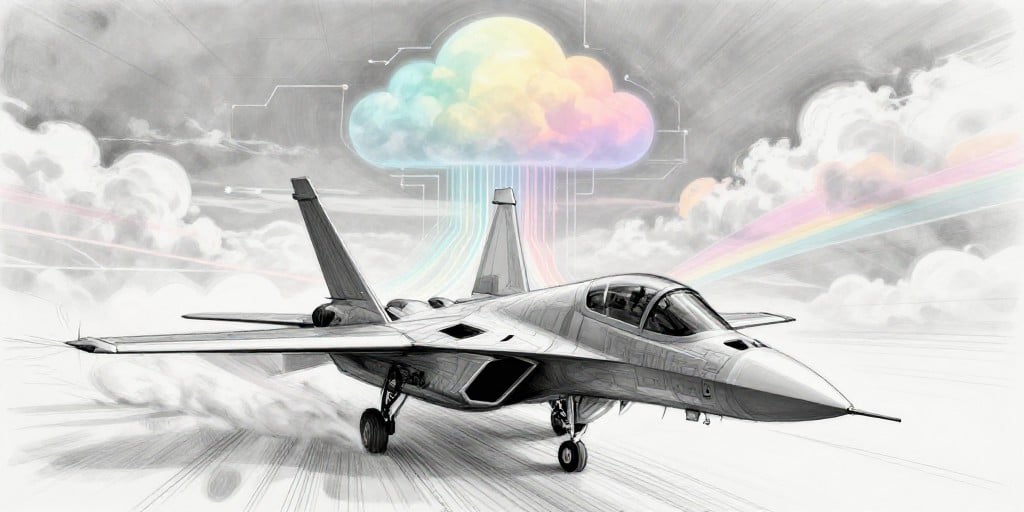
The anticipated entry of Airbus, a major European aerospace conglomerate, is poised to elevate the capital intensity of GCAP further. Airbus’s potential participation would bring an additional €1–2 billion in upfront investment, largely directed toward digital twin simulations, additive manufacturing of critical components, and the deployment of an integrated “combat cloud.” This digital backbone would facilitate real‑time data sharing among aircraft, unmanned aerial systems (UAS), and ground control stations, thereby reducing operational latency and enhancing mission efficacy.
Technological Innovation and Production Efficiency
Stealth and Materials Engineering: MHI’s expertise in low‑observable coatings and radar‑absorbing composite laminates is integral to the aircraft’s stealth envelope. By leveraging vacuum‑bonded composite panels and active electronic countermeasure (ECM) packages, MHI enhances both the survivability and the aerodynamic performance of the airframe. The use of high‑temperature polymer matrix composites (PMCs) enables weight reduction by up to 12 %, translating into higher payload capacity and fuel efficiency.
Additive Manufacturing and Digital Integration: The incorporation of additive manufacturing (AM) for critical internal components—such as fuel lines, electrical harnesses, and avionics housings—reduces lead times by approximately 30 % and material waste by 20 %. The “combat cloud” initiative introduces a federated cloud architecture that hosts distributed simulation environments and predictive maintenance analytics. Through edge computing nodes embedded in each aircraft, sensor data is processed locally, reducing bandwidth demands and ensuring compliance with data sovereignty regulations.
Autonomous “Collaborative Combat Aircraft”: The collaboration with BAE Systems on autonomous systems explores the integration of swarming algorithms and AI‑driven mission planning. By implementing cooperative multi‑agent coordination protocols, GCAP aims to deploy formations that can self‑organize around target vectors while maintaining optimal separation distances to minimize collision risk. This capability hinges on high‑bandwidth, low‑latency communication links—facilitated by the aforementioned combat cloud.
Supply Chain Implications and Regulatory Landscape
The expansion of GCAP to include additional partners such as Airbus, Germany, and Canada introduces complexity into the supply chain. Each partner’s domestic regulatory frameworks, export controls, and industrial policy directives must be harmonized to prevent bottlenecks. For instance, Germany’s stringent environmental regulations necessitate the adoption of low‑emission manufacturing processes, while Canada’s procurement policies require a certain threshold of domestic content.
Moreover, the Defence Export Control Regulations (DECR) across participating nations impose compliance requirements on the flow of dual‑use technologies. MHI and its partners must navigate the European Union’s Wassenaar Arrangement provisions, ensuring that all sensitive components—particularly those related to stealth and avionics—remain within approved export licenses.
Infrastructure Spending and Economic Drivers
Capital investment in GCAP is also influenced by broader infrastructure spending trends. European Union initiatives such as Horizon Europe and the Next Generation EU funds provide financial incentives for high‑tech defence projects. In Japan, the Ministry of Defense’s “Strategic Defense Revitalization Plan” allocates significant resources to domestic production capabilities, particularly in precision engineering and AI integration.
Economic drivers such as currency volatility, global supply chain disruptions (e.g., semiconductor shortages), and geopolitical tensions affect cost structures. MHI’s established relationships with suppliers of high‑performance titanium alloys and silicon‑on‑insulator (SOI) substrates allow it to mitigate price volatility through long‑term contracts and dual sourcing strategies.
Market Implications and Future Outlook
The inclusion of Airbus and the potential entry of Germany and Canada are expected to redistribute production allocations. MHI could secure a larger share of the composite manufacturing segment, while Airbus may take a lead role in avionics and digital systems. The diversified partnership model enhances resilience, as failures in one national supply chain can be offset by alternative routes.
From a market perspective, the GCAP serves as a catalyst for technological spill‑over into civilian aerospace and heavy‑industry sectors. Innovations in stealth coatings, additive manufacturing, and AI‑driven systems are likely to find applications in commercial aircraft, offshore wind turbines, and precision agriculture. Consequently, capital expenditure decisions are increasingly driven by dual‑use potential, enabling defence firms to capture value across both sectors.
Conclusion
Mitsubishi Heavy Industries remains pivotal to GCAP’s success, not only due to its technical expertise in stealth and manufacturing but also because of its strategic positioning within a multinational collaboration that is reshaping the heavy‑industry defence landscape. The programme’s evolving partnership structure, coupled with robust capital investment and regulatory alignment, positions GCAP as a flagship example of how advanced manufacturing, digital integration, and international cooperation can converge to deliver cutting‑edge aerospace capabilities in the 21st century.