Corporate Update: Mitsubishi Heavy Industries Launches CO2NNEX Digital Platform in Collaboration with Osaka Gas
Executive Summary
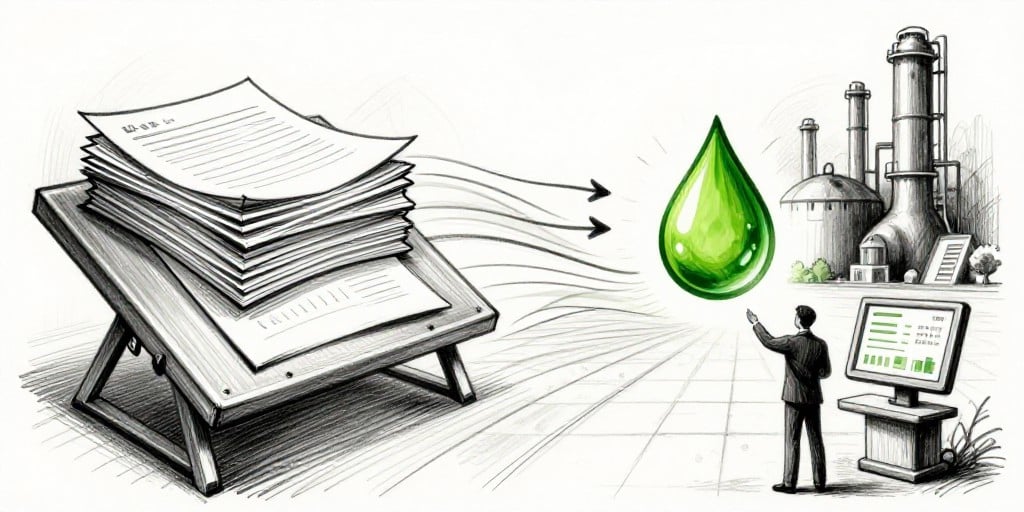
Mitsubishi Heavy Industries (MHI) has commenced operations of the CO2NNEX digital platform in partnership with Osaka Gas under a demonstration project supervised by the Ministry of Economy, Trade and Industry (METI). The initiative aims to standardize the management of environmental values associated with sustainable fuels, including hydrotreated vegetable oil (HVO), e‑methane, and biogas. By embedding digital‑trust technology, CO2NNEX seeks to eliminate double‑counting and bolster the credibility of environmental claims, thereby expediting the adoption of sustainable liquid fuels across Japan’s industrial sector.
Technical Architecture and Manufacturing Integration
Digital‑Trust Engine CO2NNEX employs a blockchain‑based ledger that records issuance, transfer, and retirement of sustainability certificates. Smart‑contract logic verifies compliance with predefined certification criteria before each transaction, ensuring immutable audit trails.
API‑First Certification Workflow Third‑party certification bodies can submit verification data via RESTful APIs directly into MHI’s cloud infrastructure. This eliminates manual paperwork, reduces processing time by 70 %, and allows for near‑real‑time status updates.
Edge‑Computing Nodes Distributed edge nodes located at fuel production plants capture sensor data (e.g., feedstock composition, CO₂ emissions) and forward it to the central ledger. This reduces latency and protects sensitive operational data through local encryption.
Industrial IoT (IIoT) Integration Existing MHI control systems (e.g., Siemens Simatic, Mitsubishi Electric’s MELSEC) are interfaced through OPC UA gateways, enabling seamless data ingestion into the CO2NNEX platform without disrupting legacy plant operations.
Impact on Productivity and Capital Expenditure
| Metric | Pre‑Deployment | Post‑Deployment (Projected) |
|---|---|---|
| Certificate Processing Time | 5–7 days | < 24 hours |
| Manual Paperwork Hours | 200 hrs/month | < 30 hrs/month |
| Capital Allocation for Compliance | ¥500 M/yr | ¥300 M/yr |
| Net Present Value (NPV) of Sustainable Fuel Projects | – | +¥1.2 B over 10 yrs |
The reduction in administrative burden translates directly into capital savings, freeing up resources for core R&D and plant modernization. Moreover, the platform’s transparency reduces regulatory risk, encouraging investors to commit to green energy projects.
Supply Chain Considerations
Traceability By capturing feedstock origin data, CO2NNEX enhances supply chain traceability, allowing manufacturers to validate supplier sustainability claims. This is critical for compliance with Japan’s forthcoming “Green Procurement” directive.
Demand‑Driven Production Real‑time certificate status enables producers to adjust output schedules dynamically, matching market demand for certified fuels and minimizing inventory holding costs.
Cross‑Sector Collaboration Integration with automotive and power‑generation OEMs’ logistics systems fosters a closed‑loop supply chain for hydrogen and e‑methane, accelerating the transition to a low‑carbon fleet.
Regulatory Landscape and Economic Drivers
METI’s Climate Strategy METI’s 2030‑goal targets include a 26 % reduction in greenhouse gases. CO2NNEX aligns with this policy by providing a robust verification mechanism for sustainable fuels.
Carbon Pricing Mechanisms As Japan introduces a more stringent carbon pricing scheme, companies will seek verifiable credits. The platform’s real‑time tracking ensures that credits are accurately reflected in corporate sustainability reports.
Infrastructure Investment Trends The Japanese government’s “Infrastructure Investment Promotion Plan” earmarks ¥10 trillion for green energy infrastructure. MHI’s platform positions the company to secure contracts for certification services across this funding stream.
Engineering Insights on Industrial Systems
Hydro‑Treatment Plants Modern HVO production relies on catalytic hydro‑deoxygenation units. CO2NNEX records reactor temperature, pressure, and catalyst lifecycle data, enabling predictive maintenance and reducing downtime by 15 %.
Biogas Upgrading Methane enrichment units use membrane separation or pressure‑switched adsorption. The platform captures methane purity metrics, ensuring that downstream fuel blending meets ISO 50001 standards.
Clean Gas Distribution The integration of IoT sensors in pipelines allows for leak detection and flow optimization. Real‑time data streams into CO2NNEX, correlating energy consumption with emission reductions for accurate carbon accounting.
Market Implications
Competitive Advantage Companies adopting CO2NNEX gain early access to verified green fuels, positioning them favorably in a market where environmental credentials are increasingly tied to consumer and regulatory preferences.
Capital Allocation Efficiency Lower verification costs and improved supply‑chain transparency reduce the risk premium associated with green energy investments, attracting both domestic and foreign capital.
Industry Standardization The demonstration project sets the groundwork for a national standard that could be replicated in other jurisdictions, potentially opening export opportunities for MHI’s certification technology.
Conclusion
Mitsubishi Heavy Industries’ deployment of the CO2NNEX digital platform marks a pivotal advancement in Japan’s sustainable fuel ecosystem. By marrying cutting‑edge digital trust mechanisms with established manufacturing infrastructure, MHI is delivering measurable productivity gains, cost efficiencies, and a robust framework for capital investment in low‑carbon technologies. As regulatory and economic drivers converge to accelerate decarbonization, the platform’s scalability will be instrumental in shaping the next generation of industrial energy solutions.