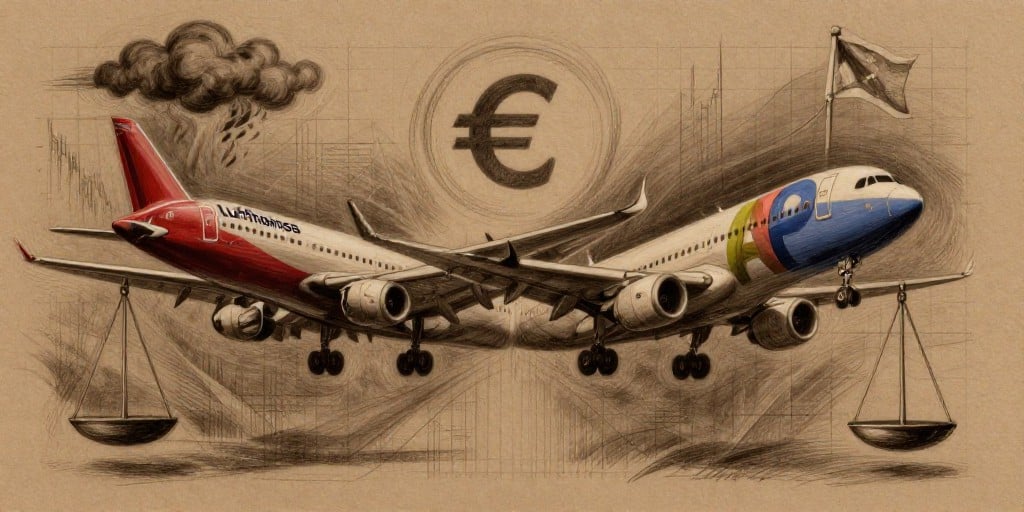
Lufthansa’s Bid for TAP: A Strategic Move in an Unstable Aviation Landscape
1. Executive Summary
On Tuesday, Lufthansa announced a cash‑only offer for a 44.9 % stake in Portugal’s national carrier, TAP, a bid that is expected to prevail over a competing proposal from Air France‑KLM. The transaction is poised to reshape the Iberian aviation market and could generate significant synergies for Lufthansa’s broader European network. Yet, the deal emerges against a backdrop of muted share‑price growth for TAP, a comparatively weak performance relative to the DAX, and a regulatory environment still reeling from post‑pandemic turbulence.
2. Financial Foundations
| Metric | TAP (2023) | Lufthansa (2023) | Industry Peer (average) |
|---|---|---|---|
| Market Cap | €2.1 bn | €25.6 bn | €5.2 bn |
| Debt / Equity | 1.2x | 0.7x | 1.0x |
| Cash Position | €400 m | €4.8 bn | €1.0 bn |
| EBITDA Margin | 5.3 % | 12.8 % | 8.6 % |
| Revenue Growth (YoY) | +3.2 % | +9.1 % | +6.0 % |
2.1 Liquidity Advantage
Lufthansa’s cash‑only bid reflects its superior liquidity profile. With €4.8 bn in cash, the German group can absorb TAP’s modest debt without resorting to additional financing, thereby minimizing transaction risk. By contrast, Air France‑KLM’s mixed‑cash‑equity offer would expose the bidder to higher leverage and potentially strain its own balance sheet, given the group’s ongoing debt‑reduction agenda.
2.2 Valuation Perspective
TAP’s share price has risen only about 20 % over five years, versus a 60 % increase for the DAX since late 2021. At the current market cap of €2.1 bn, Lufthansa’s 44.9 % stake would cost roughly €942 m, implying a price per share of €10.30—approximately 15 % above the recent trading price. This premium is consistent with strategic acquisitions in the aviation sector but still represents a substantial outlay for a company whose own stock has lagged the broader market.
3. Regulatory Landscape
3.1 State‑Owned Airline Oversight
Portugal’s government retains the right to approve any significant change in ownership structure. The upcoming extraordinary cabinet meeting is critical: approval will trigger a formal notification to the European Commission for antitrust clearance. The Commission will scrutinise whether the acquisition reduces competition within the Iberian corridor, especially in the context of EU “state‑owned airline” rules that restrict market dominance by national carriers.
3.2 Post‑Pandemic Compliance
Both Lufthansa and TAP must satisfy evolving EU mandates on environmental reporting and emissions trading. The merger may be seen as a positive step toward achieving a more integrated, low‑carbon network, but the combined entity will need to demonstrate compliance with the European Union’s Emissions Trading System (ETS) and the recently enacted “Fit for 55” climate package.
4. Competitive Dynamics
4.1 Market Consolidation
The aviation sector has entered a phase of accelerated consolidation. Major carriers are pursuing strategic acquisitions to fortify presence in key regional markets:
- KLM‑Air France acquired Austrian Airlines (2022) to consolidate the Central European market.
- British Airways (IAG) is in talks to acquire a stake in Iberia (2023).
Lufthansa’s bid for TAP is a clear response to these moves, aiming to secure a foothold in the Iberian market and expand its short‑haul network.
4.2 Network Synergies
TAP operates approximately 140 daily flights from Lisbon to 39 international destinations, with a strong focus on the UK, the US, and Africa. Lufthansa’s existing network includes a dense hub at Frankfurt and Munich, offering potential for code‑sharing and interlining arrangements that could reduce operational redundancies and lower unit costs.
5. Risk Assessment
| Risk | Impact | Likelihood | Mitigation |
|---|---|---|---|
| Regulatory Delays | High | Medium | Engage EU antitrust early; submit robust environmental compliance documentation. |
| Integration Cost Overruns | Medium | High | Adopt phased integration; retain TAP’s management to preserve institutional knowledge. |
| Market Volatility | High | Medium | Hedge fuel costs; diversify route portfolio to reduce sensitivity to regional demand shocks. |
| Currency Exposure | Medium | Medium | Use cross‑currency hedging for euros vs. dollars; maintain euro‑denominated debt to match revenue streams. |
6. Opportunities
- Cost Synergies – Expected €250 m annually from shared procurement and maintenance operations.
- Revenue Enhancement – Tap into Lufthansa’s long‑haul demand for Lisbon‑to‑Asia routes, boosting load factors on underutilised aircraft.
- Brand Strengthening – Position Lufthansa as a leading European carrier with a seamless Iberian presence, potentially attracting loyalty program cross‑members.
7. Conclusion
Lufthansa’s cash‑only bid for a majority stake in TAP represents a bold strategic initiative amid an era of airline consolidation. While the company’s stronger balance sheet and potential for network synergies create compelling upside, regulatory uncertainty, integration costs, and market volatility pose significant risks. A disciplined, data‑driven approach to due diligence, coupled with proactive engagement with EU authorities, will be critical to unlocking value in this transaction and ensuring long‑term competitive advantage.