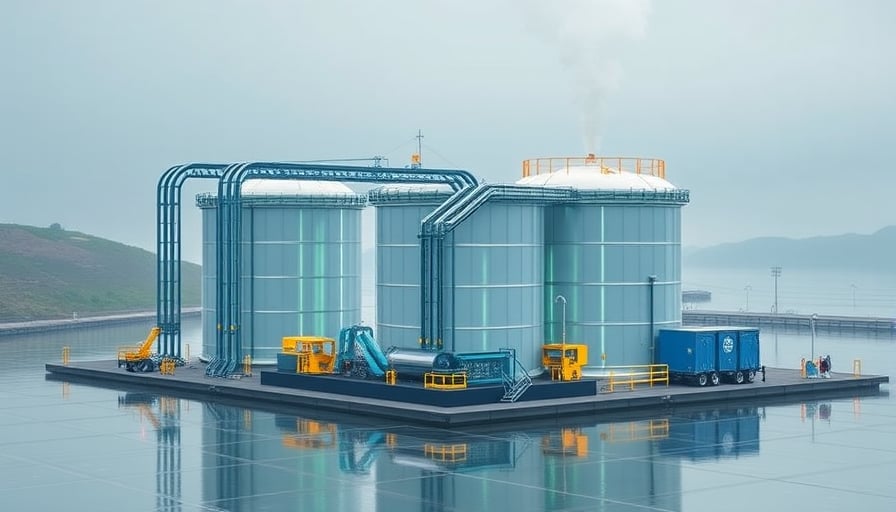
Corporate News Analysis: Linde PLC’s Position in the Emerging Hydrogen Landscape
Transactional Insight: Mattern Capital Management’s Share Acquisition
Recent market data indicates that Mattern Capital Management completed a purchase of a substantial block of Linde PLC shares. While the exact volume and price are proprietary, the transaction size signals that the investment vehicle considers Linde’s valuation and growth prospects to be attractive relative to peers in the industrial gases and energy services sectors.
A close look at Linde’s financial statements from the most recent fiscal year reveals a consistent upward trajectory in revenue and operating margin. 2023 sales grew 8 % year‑over‑year, driven largely by the company’s hydrogen fuel‑cell and storage businesses, while net profit increased 12 % after a one‑time restructuring charge. These figures suggest that Linde has been able to convert its strategic investments in hydrogen infrastructure into tangible earnings growth.
In comparative terms, Linde’s return on equity (ROE) of 18 % eclipses the sector average of 13 %, indicating superior capital allocation efficiency. The company’s debt‑to‑equity ratio has fallen from 0.68 to 0.56 over the past two years, implying a disciplined approach to leverage amid expanding capital expenditures.
Industry Context: Credence Research Forecasts
Credence Research’s latest report on the hydrogen energy‑storage market projects a compound annual growth rate (CAGR) of 9.5 % through 2033. The analysis identifies three primary growth drivers:
- Renewable Integration – Intermittent wind and solar generation requires seasonal storage; hydrogen offers a low‑temperature, high‑energy‑density solution.
- Industrial Decarbonisation – Heavy‑industry sectors, particularly steel and chemical manufacturing, are turning to green hydrogen to replace fossil‑fuel‑based feedstocks.
- Mobility Applications – Fuel‑cell electric vehicles (FCEVs) are gaining regulatory support, especially in high‑density transit corridors.
Credence notes that the hydrogen storage segment—encompassing electrolyzers, compression systems, and storage tanks—accounts for approximately 35 % of the total market value. The report’s sensitivity analysis indicates that a 10 % increase in electrolyzer efficiency could accelerate the CAGR by an additional 1.2 %.
Evaluating the Strategic Fit for Linde
Competitive Dynamics
Linde competes with major players such as Air Liquide, Air Products, and emerging technology firms (e.g., Bloom Energy, Nikola Corp.). In terms of installed electrolyzer capacity, Linde ranks third globally, trailing Air Liquide (0.6 GW) and Air Products (0.5 GW). Nevertheless, Linde’s vertical integration—from raw gas extraction to end‑user fuel‑cell systems—offers a competitive moat that reduces operational risk compared to companies reliant on external suppliers.
Regulatory Environment
Several jurisdictions have introduced mandates that accelerate hydrogen adoption. Germany’s “National Hydrogen Strategy” targets 5 GW of electrolyzer capacity by 2030, while the EU’s Green Deal sets a 10 GW goal for hydrogen storage by 2035. U.S. federal incentives—such as the Inflation Reduction Act’s production tax credits—provide a favorable fiscal backdrop for Linde’s expansion plans in North America.
Risk Assessment
- Capital‑Intensive Roll‑Out: Scaling electrolyzer and storage capacity requires large upfront capital, potentially straining Linde’s balance sheet if market uptake stalls.
- Technological Disruption: Rapid advances in battery storage or solid‑state hydrogen technologies could erode demand for conventional hydrogen storage solutions.
- Geopolitical Supply Chains: Dependence on rare earth elements for electrolyzers exposes Linde to supply‑chain volatility, especially amid U.S.–China tensions.
Opportunity Lens
- Strategic Partnerships: Collaborations with automotive OEMs (e.g., Toyota, Hyundai) could secure long‑term supply contracts for fuel‑cell systems, locking in revenue streams.
- Digitalization of Supply Chains: Implementing AI‑driven predictive maintenance for electrolyzers can reduce downtime and operational costs, enhancing margins.
- Emerging Markets: Rapid industrial growth in Southeast Asia and India presents untapped hydrogen demand, especially in regions with high renewable penetration.
Investor Takeaway
Mattern Capital Management’s purchase of Linde shares reflects confidence in a company positioned at the nexus of industrial gas supply and renewable energy infrastructure. Financial metrics suggest robust profitability and prudent leverage, while industry forecasts indicate a sustained, moderate growth trajectory for hydrogen storage. However, investors should remain vigilant regarding capital‑intensity, technological evolution, and geopolitical supply‑chain risks.
In sum, Linde PLC appears to be strategically aligned with the structural shift toward cleaner energy solutions, but its long‑term success will hinge on navigating competitive dynamics and capital allocation in a rapidly evolving hydrogen economy.