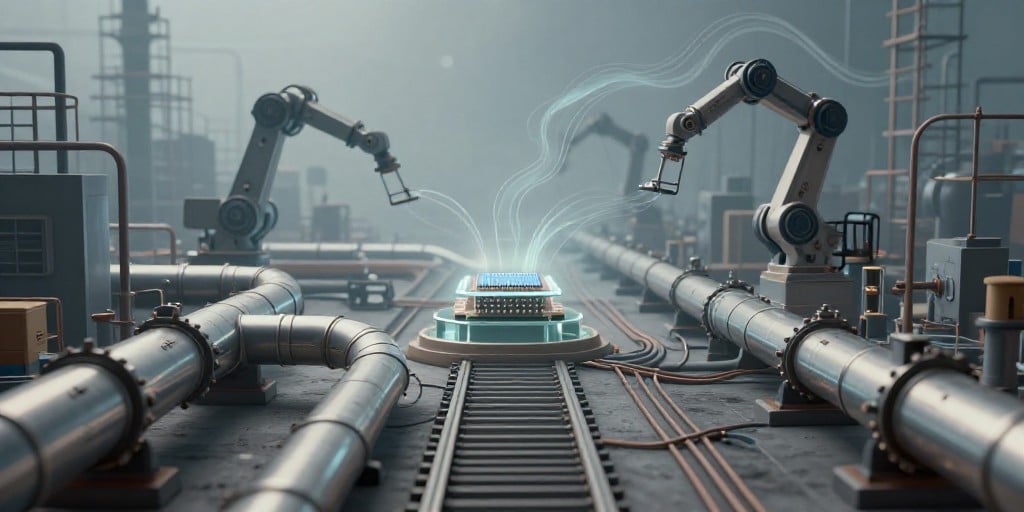
Corporate News – In‑Depth Analysis of Linde PLC’s Emerging Role in the Artificial‑Intelligence Chip Supply Chain
Linde PLC, the world’s largest industrial gas supplier, has recently attracted significant analyst attention for its growing involvement in the artificial‑intelligence (AI) chip market. A senior equity analyst from a leading financial publication highlighted the company’s strategic positioning as a key supplier within the supply chain that supports the rapid expansion of AI hardware. The analyst noted that Linde is securing a substantial share of new contracts in this sector, thereby establishing itself as a strategic partner for manufacturers of advanced computing components.
Contextualizing Linde’s Diversification Strategy
Linde’s recent comments arrive against a backdrop of the company’s broader strategic initiatives, which encompass investments in technology platforms and collaborations designed to enhance production efficiency and expand market reach. While the analyst’s remarks underscore Linde’s influence in the AI chip space, market reactions have been muted, suggesting that investors are adopting a cautious or neutral stance regarding the immediate implications for the company’s valuation.
This development reflects a wider trend of diversification among traditional industrial gas firms, which are increasingly leveraging their existing infrastructure to support high‑technology markets. Linde’s ability to integrate emerging technologies into its operations may serve as a catalyst for future growth, although the immediate impact on the company’s share price remains modest.
Industry Analysis: The Intersection of Gas Supply and AI Hardware Production
Supply Chain Dynamics: The manufacturing of AI chips is highly dependent on precise environmental controls, including temperature regulation and inert gas atmospheres. Linde’s expertise in providing high‑purity gases positions it to supply essential process gases used in semiconductor fabrication, such as nitrogen, oxygen, and specialty gases for etching and deposition.
Competitive Positioning: Within the industrial gas market, Linde competes with companies such as Air Products & Chemicals, Praxair (now part of Linde), and Air Liquide. By expanding into AI chip manufacturing support, Linde differentiates itself from competitors that focus solely on traditional industrial and medical gas applications.
Economic Drivers: The AI chip market is projected to grow at a compound annual growth rate of 15–20% over the next decade, driven by increasing demand for AI‑enabled applications in data centers, automotive, and consumer electronics. Linde’s entrance into this high‑growth sector aligns with broader economic trends favoring digital infrastructure investment.
Cross‑Sector Implications
Linde’s foray into the AI chip supply chain exemplifies how companies rooted in traditional industrial sectors can capitalize on emerging technological trends. The company’s robust logistics network and global manufacturing footprint provide a scalable platform to support semiconductor fabs located across North America, Asia, and Europe. Moreover, Linde’s experience in managing stringent quality standards for gases translates well to the demanding environment of chip fabrication.
The potential for synergies is significant: as AI workloads increase, so does the need for more sophisticated cooling solutions, where industrial gases can play a role. Linde’s participation could therefore extend beyond raw gas supply to encompass integrated environmental control solutions for data centers, further broadening its value proposition.
Investor Perspective and Market Sentiment
Despite the analyst’s positive assessment, the market’s restrained reaction suggests a measured evaluation of Linde’s prospects in the AI chip arena. Investors appear to view the company’s current contracts as early-stage and may be waiting for clearer evidence of scalability and profitability before adjusting their valuation models. Additionally, concerns about the cyclical nature of industrial gas demand and the capital intensity of semiconductor fabs may temper enthusiasm.
Outlook
Linde’s expansion into the AI chip supply chain signals a strategic shift from a purely commodity‑focused business model toward a service‑enabled, high‑technology orientation. If the company can sustain its contract pipeline and demonstrate cost efficiencies in this niche, it may unlock new growth avenues and enhance its competitive resilience. However, the immediate financial impact remains limited, and investors will likely continue to monitor the company’s execution pace and the broader semiconductor market dynamics before making significant portfolio adjustments.
In sum, Linde PLC’s emerging influence beyond conventional gas supply underscores a broader industry trend of diversification, as traditional industrial players seek to embed themselves in the rapidly evolving landscape of artificial‑intelligence infrastructure.