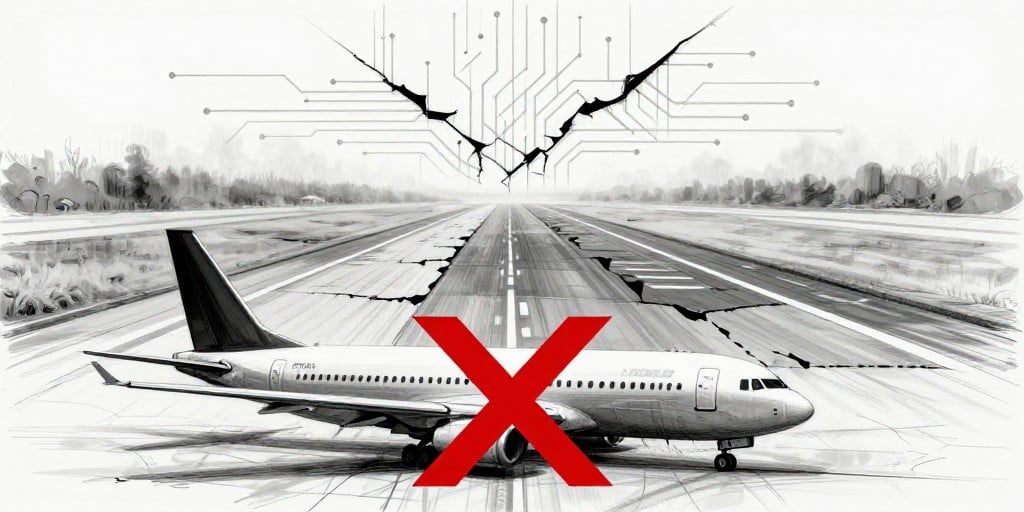
L3Harris Technologies Faces Market Retracement Amid FAA Modernization Fallout
L3Harris Technologies Inc. has experienced a significant decline in its share price after a nationwide ground stop halted commercial flights across the United States. The stoppage was triggered by a technical failure of a router installed by L3Harris during an upgrade of the Federal Aviation Administration’s (FAA) telecommunications network from copper to fiber‑optic infrastructure. According to the incident report, the router—situated at a remote FAA facility—overwhelmed the system with connection requests, causing a cascade of disruptions in the air‑traffic control network.
Regulatory Context and Oversight
The FAA, tasked with ensuring the safety and reliability of the national airspace, has been in the process of modernizing its aging communication backbone. The upgrade is part of a broader $3.8 billion modernization plan announced by the Department of Transportation in 2023, aimed at replacing legacy copper cabling with high‑bandwidth fiber‑optic lines. In light of this, the FAA has instituted stringent contractor vetting protocols and real‑time monitoring requirements for all network components that interface with the national air traffic control system.
The incident has prompted a review by FAA officials and the Federal Bureau of Investigation (FBI) to exclude the possibility of a cyber‑attack. The FAA’s investigation focuses on the router’s firmware integrity, supply chain provenance, and the vendor’s compliance with NIST SP 800‑53 security controls. The FBI’s involvement underscores the federal mandate to treat any disruption that jeopardizes civil aviation safety as a potential national security matter.
Financial Impact and Market Perception
In early trading, L3Harris shares fell approximately 4 %, adding to a broader year‑to‑date decline of 10.3 %. The decline reflects investor concern over the company’s role in the FAA’s critical infrastructure and its capacity to deliver on high‑visibility, high‑risk projects. Analysts note that the incident has amplified scrutiny of L3Harris’s quality assurance protocols and its contractual obligations under the FAA modernization contract, which carries a $1.5 billion total value.
Key financial metrics reveal a $0.83 billion net loss for the most recent quarter, driven in part by $152 million in repair and warranty expenses tied to the incident. The company’s cash burn rate has risen by 12 % year over year, prompting concerns about its ability to sustain long‑term investment in research and development without additional capital infusion.
Competitive Dynamics and Market Position
L3Harris competes in a high‑barrier, defense‑grade telecommunications market dominated by a handful of large players, including Raytheon Technologies, Lockheed Martin, and Northrop Grumman. While L3Harris has historically held a 15 % market share in military and civil aviation networking, this incident threatens to erode that position as the FAA explores alternative suppliers for its fiber‑optic rollout.
Furthermore, the emerging market for 5G‑enabled air‑traffic control solutions—estimated to grow at a CAGR of 9.7 % over the next decade—has intensified competition. Firms that can demonstrate robust cyber‑resilience and rapid deployment capabilities are poised to capture a larger slice of this expanding market. The current incident raises questions about L3Harris’s readiness to meet these evolving expectations, potentially pushing the company towards strategic partnerships or divestiture of non-core assets.
Risks and Opportunities
Risks
- Reputational Damage: The public nature of the outage and subsequent regulatory scrutiny could lead to loss of future contracts, especially if the FAA issues a formal penalty or reassigns portions of the modernization project to competitors.
- Regulatory Penalties: Failure to adhere to FAA’s Security Performance Management System (SPMS) could result in sanctions, affecting the company’s eligibility for future federal contracts.
- Capital Allocation Constraints: The need to shore up quality control and security infrastructure may divert funds from other growth initiatives, limiting L3Harris’s ability to pursue next‑generation technologies such as quantum‑secure communications.
Opportunities
- Process Improvements: The incident provides a catalyst to overhaul L3Harris’s Supplier Risk Management (SRM) framework, potentially positioning the company as a best‑practice leader in secure infrastructure deployments.
- Expanded Service Portfolio: By investing in cyber‑security-as-a-service offerings tailored to aviation clients, L3Harris could tap into a new revenue stream, especially as the FAA and other agencies seek comprehensive security solutions.
- Strategic Alliances: Collaborations with telecommunication giants such as AT&T or Verizon could enhance L3Harris’s network expertise, mitigating future incidents and strengthening its competitive edge.
Conclusion
The L3Harris incident underscores the delicate balance between rapid infrastructure modernization and the uncompromising security and reliability standards required in civil aviation. While the company faces immediate financial and reputational headwinds, the episode also offers a strategic inflection point. By rigorously addressing the underlying engineering, regulatory, and competitive challenges highlighted by the incident, L3Harris can reposition itself as a trusted partner in the next wave of aviation technology evolution.