
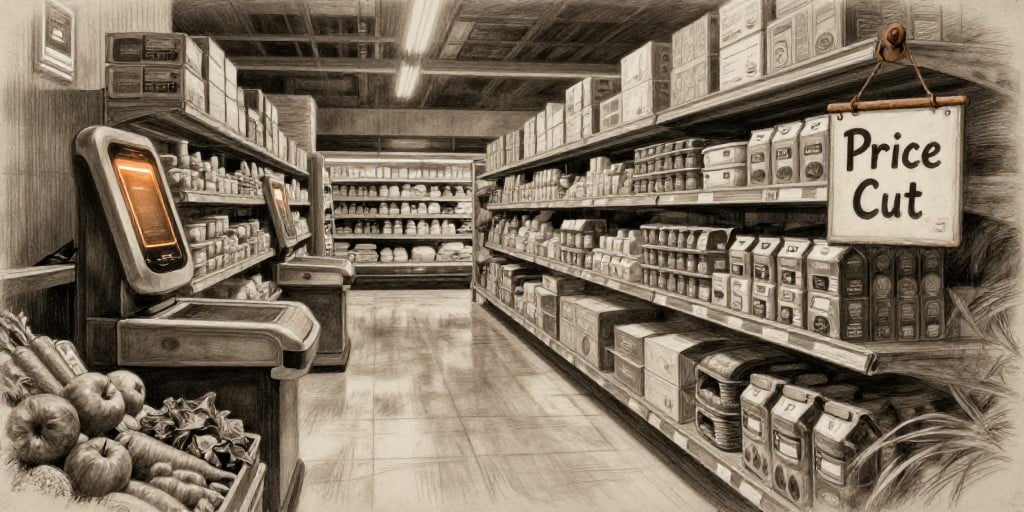
Kroger Co. Signals Strategic Pricing Shift Amid Omnichannel Growth
Kroger Co. has scheduled its first‑quarter 2026 earnings conference call for Thursday, June 18. The presentation will be streamed online, with an on‑demand replay available later that day. Management will review financial and operational results for the quarter ending May 23, 2026, as part of its routine investor‑relations updates.
Executive Outlook and Market Reaction
The day after the call, the company’s shares fell modestly as newly‑appointed Chief Executive Officer Greg Foran outlined a plan to implement significant price reductions across a broad range of products. Foran, who assumed leadership in February, emphasized a strategy of gradual price cuts, coupled with tighter sourcing and simplified operations, to better compete with Amazon, Walmart, and Costco. The announcement came against a backdrop of cooling identical‑sales growth, while the e‑commerce segment continued to expand at double‑digit rates for consecutive quarters.
The broader market shift toward defensive names amplified the impact. Utilities gained momentum, while consumer staples, including Kroger, faced pressure after Walmart’s earnings report. Analysts still view Kroger as a moderate buy, citing potential upside from the planned price cuts.
Omnichannel Momentum and Consumer Behavior
Kroger’s e‑commerce growth underscores a sector‑wide pivot toward omnichannel retailing. Double‑digit expansion of online sales demonstrates that consumers increasingly expect a seamless blend of in‑store and digital experiences. Kroger’s strategy to lower prices online aligns with this trend, aiming to attract price‑sensitive shoppers while maintaining in‑store traffic through convenient pickup and delivery options.
Cross‑sector analysis reveals that consumer staples are experiencing a shift from volume‑based sales to value‑driven purchasing. Price elasticity is higher than previously estimated, especially among middle‑income households that are now balancing health‑conscious spending with cost considerations. Retailers that combine competitive pricing with convenient omnichannel service are likely to capture greater market share.
Supply‑Chain Efficiency as a Competitive Lever
Operational efficiencies remain at the core of Kroger’s turnaround plan. By tightening sourcing and simplifying processes, the company aims to reduce margin pressure that typically accompanies aggressive price reductions. This approach mirrors industry trends where large retailers are leveraging data analytics, automated replenishment, and cross‑border sourcing to lower costs without compromising quality.
The integration of technology into the supply chain—such as real‑time inventory tracking and AI‑driven demand forecasting—has already begun to deliver measurable savings. These efficiencies will support the company’s ability to sustain lower price points while protecting profitability over the long term.
Short‑Term Market Movements vs. Long‑Term Transformation
In the short term, Kroger’s stock performance reflects market volatility and investor caution amid a shift toward defensive sectors. However, the long‑term trajectory appears aligned with broader industry transformations:
| Trend | Short‑Term Impact | Long‑Term Implication |
|---|---|---|
| Omnichannel expansion | Positive for online sales, mixed effect on in‑store traffic | Consolidation of channel boundaries, higher customer lifetime value |
| Aggressive pricing | Market pressure, stock dip | Competitive parity, increased market share |
| Supply‑chain automation | Cost savings, operational risk mitigation | Sustainable margins, scalability |
By aligning aggressive pricing with robust supply‑chain efficiencies and a strengthened omnichannel presence, Kroger is positioning itself to capitalize on evolving consumer preferences while safeguarding its financial health. The company’s upcoming earnings call will likely provide further clarity on the effectiveness of these initiatives and their impact on the quarterly results.