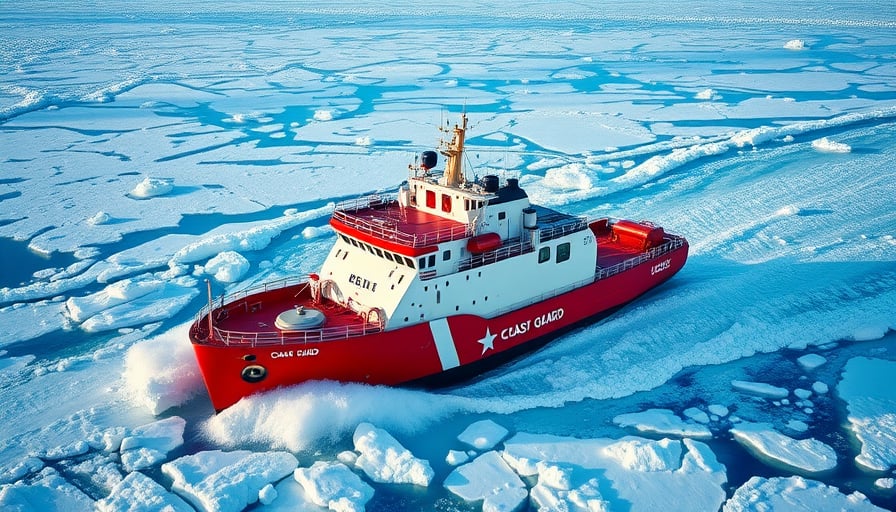
Corporate News – In‑Depth Analysis of Kongsberg Gruppen ASA’s New Canadian Maritime Contract
Executive Summary
Kongsberg Gruppen ASA (KGS) has secured a pivotal design contract for the Canadian Coast Guard’s next generation of Mid‑Shore Multi‑Mission vessels (MSMVs). The deal, announced in March, is part of Canada’s National Shipbuilding Strategy and positions KGS as a key contributor to the country’s maritime security and industrial development agenda. While the contract signals growth and strategic alignment with Canada’s procurement framework, it also surfaces potential risks and opportunities that merit closer scrutiny.
1. Contract Context and Scope
| Item | Details |
|---|---|
| Client | Canadian Coast Guard (CCG) |
| Programme | Mid‑Shore Multi‑Mission Vessels (MSMVs) |
| Consortium Partners | Kongsberg Defence & Aerospace, Salt Ship Design, Adaptive Marine Solutions Inc. |
| Contract Phase | Design and specification development |
| Strategic Purpose | Deliver vessel specifications for shipyard tendering under the National Shipbuilding Strategy (NSS) |
| Domestic Production Alignment | Emphasis on Canadian supply chain participation and local shipyard utilisation |
| Estimated Economic Impact | Enhanced export opportunities for Canadian businesses; projected creation of ~120–150 direct jobs in design and engineering functions |
KGS’s role is to provide advanced naval architecture, propulsion system integration, and mission‑specific outfitting capabilities. The consortium’s collaborative framework leverages Salt Ship Design’s expertise in multi‑mission platform architecture, while Adaptive Marine Solutions contributes innovative ice‑breaking technology.
2. Underlying Business Fundamentals
2.1 Revenue Diversification
The MSMV contract adds a new revenue stream to KGS’s core defence and aerospace businesses. Historically, KGS’s revenue mix has been dominated by naval vessels and missile systems. The addition of a civilian‑government maritime contract diversifies income, reducing exposure to the cyclical nature of military procurement.
2.2 Technological Edge
KGS’s investment in Integrated Platform Management Systems (IPMS) and energy‑efficient propulsion aligns with the CCG’s requirement for low‑impact, high‑availability vessels. The contract offers a testbed for KGS’s emerging Autonomous Surface Vehicle (ASV) integration, potentially catalysing future commercial sales.
2.3 Cost Structure Implications
Design contracts are typically low‑margin but high‑volume. KGS must manage engineering resources efficiently to preserve profitability. The consortium arrangement spreads fixed costs, yet introduces coordination overhead that could erode the anticipated margin if not tightly managed.
3. Regulatory and Policy Landscape
3.1 National Shipbuilding Strategy (NSS)
The NSS mandates that at least 50 % of shipbuilding work be conducted in Canada, with a focus on sustaining and growing domestic shipyard capabilities. KGS’s design contribution must adhere to Canadian Standards Association (CSA) certification requirements and the Defence Acquisition Regulations (DAR) for foreign suppliers.
3.2 Export Control Compliance
Design documents and intellectual property will be subject to Canada’s Export Control Act (EC Act), requiring KGS to navigate dual‑use controls for certain propulsion and sensor technologies. Early engagement with Canadian customs and defence procurement authorities is essential to mitigate compliance risk.
3.3 Supply‑Chain Localization
Canada’s procurement guidelines favour local sourcing. KGS’s consortium partners, notably Adaptive Marine Solutions, are headquartered in Canada, easing localization compliance. However, KGS must ensure that critical components supplied from Norway are covered by dual‑licensing arrangements that respect Canadian export controls.
4. Competitive Dynamics
| Competitor | Offerings | Strengths | Weaknesses |
|---|---|---|---|
| Saab AB | Ice‑breaking vessels, sensor suites | Strong European presence, integrated systems | Limited Canadian local presence |
| Fincantieri | Mid‑size naval vessels | Large shipyard network, cost competitiveness | Less focus on ice‑breaking tech |
| Austal | Hybrid propulsion, modular designs | Rapid construction, sustainability | Smaller scale in Arctic operations |
KGS’s advantage lies in its proven track record with polar‑capable vessels (e.g., Norwegian Coast Guard’s HNoMS Svalbard). However, competitors are aggressively pursuing similar contracts by emphasizing modular construction and lower upfront costs. KGS must demonstrate clear cost‑benefit advantages in life‑cycle support and interoperability with existing CCG platforms.
5. Market Reaction and Broader Geopolitical Context
5.1 Defence Shares Volatility
Following announcements that Ukraine–Russia negotiations are advancing, European defence stocks—including KGS, Rheinmetall, and Hensoldt—experienced modest declines. Investor sentiment shifted as the perceived demand for new naval assets appeared to wane, reflecting a broader trend of risk‑aversion in the defence sector during potential de‑escalation.
5.2 Construction & Materials Upswing
Conversely, construction and materials equities rallied, buoyed by expectations of post‑conflict reconstruction demand. This divergence illustrates that while direct defence procurement may contract, ancillary sectors linked to infrastructure rebuilding can offer compensatory growth opportunities.
5.3 Implications for KGS
The short‑term share price dip is unlikely to undermine the long‑term strategic value of the Canadian contract. Nonetheless, KGS should monitor geopolitical developments closely, as any resurgence in regional tensions could reverse demand curves for Arctic-capable vessels.
6. Risks & Opportunities
| Risk | Mitigation Strategy |
|---|---|
| Regulatory Delays | Early and continuous engagement with Canadian regulatory bodies; secure dual‑licensing agreements. |
| Supply‑Chain Bottlenecks | Develop local supplier network; maintain inventory buffers for critical components. |
| Cost Overruns | Implement rigorous project management protocols; use fixed‑price design milestones. |
| Technological Obsolescence | Incorporate modularity to allow future upgrades; align with Canadian R&D initiatives. |
| Currency Fluctuations | Hedge Norwegian Krone exposure; price contracts in CAD where feasible. |
| Opportunity | Potential Impact |
|---|---|
| Export Growth | Leveraging Canadian procurement success to pitch similar contracts in other Commonwealth nations. |
| Innovation Showcase | Demonstrating advanced polar navigation systems to attract civilian and research vessel operators. |
| Domestic Partnerships | Strengthening ties with Canadian shipyards could unlock further government incentives. |
| Data & Intelligence | Early access to Canadian hydrographic and oceanographic data may enhance KGS’s global maritime analytics services. |
7. Conclusion
Kongsberg Gruppen ASA’s acquisition of the Canadian Coast Guard design contract represents a strategically sound expansion into civilian maritime markets while reinforcing its core defence pedigree. The deal aligns with Canada’s national shipbuilding objectives, provides a platform for technological advancement, and offers a buffer against cyclical defence spending volatility. Nonetheless, the firm must navigate complex regulatory environments, coordinate across a multinational consortium, and remain vigilant to geopolitical shifts that could influence both demand and risk exposure. A disciplined approach to cost control, supply‑chain localisation, and regulatory compliance will be pivotal to turning this contract into a sustainable growth lever.