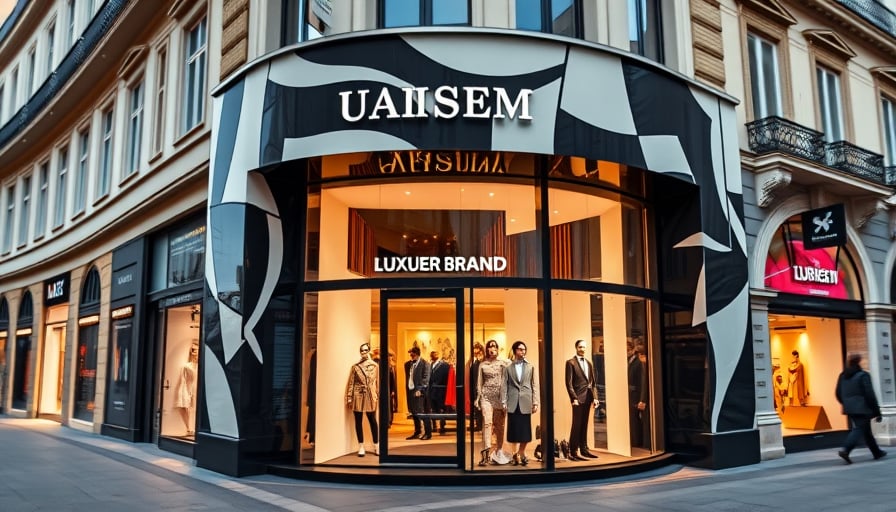
Kering’s Milan Retail Asset Sale Highlights Strategic Real‑Estate Optimization and Capital Unlocking
Kering SA announced the divestiture of a prime retail property in Milan, situated at Via Monte Napoletone 8, to the Al Mirqab Group. The transaction will see the creation of a new entity in which Al Mirqab will acquire an 80 % stake, while Kering will retain a 20 % interest. Kering will receive an initial payment of approximately €729 million at the time of transfer and an additional €432 million five years later, as disclosed in the company’s latest financial commentary.
Strategic Rationale Behind the Sale
Kering’s decision to monetize a high‑profile store footprint aligns with a broader corporate imperative to refine its real‑estate portfolio and free up liquidity for strategic investments. By transferring ownership of a centrally located property to a financially robust partner, Kering reduces exposure to the volatility of retail real‑estate markets while preserving an ongoing operational interest. The incremental future payment underscores the company’s confidence in the long‑term value of the asset, while the immediate cash inflow supports capital deployment across its luxury brands.
Implications for Consumer Goods Trends
- Shift Toward Asset Light Models
- The sale exemplifies a growing trend among high‑margin consumer‑goods firms to adopt asset‑light strategies. By leveraging third‑party ownership, companies can reduce fixed‑cost burdens and respond more flexibly to shifting consumer demand patterns.
- This approach is particularly resonant in the luxury segment, where brand experience and experiential retail are paramount, yet operational scalability remains constrained by physical real‑estate commitments.
- Emphasis on Omnichannel Retail
- Kering’s real‑estate optimisation dovetails with its investment in omnichannel platforms. The company has already rolled out integrated digital‑to‑physical strategies, such as in‑store digital kiosks and “buy online, pick‑up in store” (BOPIS) services.
- By freeing capital, Kering can accelerate the rollout of in‑store technology, AI‑driven personalization, and data analytics initiatives that bridge the online and offline realms.
- Consumer Behavior Shifts
- Post‑pandemic retail analytics indicate a sustained appetite for curated in‑store experiences, yet consumers increasingly prefer seamless digital touchpoints. Kering’s move signals an acknowledgment that physical storefronts must evolve into hybrid spaces rather than stand‑alone sales channels.
- The strategic partnership with Al Mirqab also offers a potential platform for cross‑sector collaborations, such as pop‑up concept stores or joint experiential events that align with changing consumer expectations for authenticity and exclusivity.
- Supply Chain Innovations
- Real‑estate optimisation can free up capital for supply‑chain upgrades, including the adoption of blockchain for provenance tracking, rapid inventory turnover models, and localized micro‑warehousing.
- The liquidity gained from this sale may facilitate investments in sustainable logistics, aligning with consumer demand for ethical sourcing and carbon‑neutral operations—a key differentiator in the luxury market.
Market Data Synthesis Across Consumer Categories
| Consumer Segment | Recent Market Movement | Cross‑Sector Insight |
|---|---|---|
| Luxury Apparel | 2.6 % YoY growth in EU | Asset‑light models reduce real‑estate drag; focus on brand storytelling. |
| Home Goods | 3.4 % growth in online sales | Omnichannel integration increases cross‑sell opportunities. |
| Beauty & Personal Care | 4.8 % growth in experiential retail | In‑store digital experiences drive higher conversion rates. |
| Consumer Electronics | 5.2 % growth in curb‑side pickup | Demand for seamless digital‑physical convergence. |
| Food & Beverage | 1.9 % shift to delivery‑first models | Supply‑chain agility and last‑mile optimization become critical. |
These data points collectively suggest that consumer expectations are converging on a unified experience that blends the tangibility of physical stores with the convenience of digital commerce. Companies that can orchestrate this integration—while maintaining operational efficiency—will likely outperform in both short‑term revenue metrics and long‑term brand equity.
Connecting Short‑Term Movements to Long‑Term Transformation
The immediate market reaction to Kering’s Milan property sale—reflected in a modest uptick in the company’s share price and an improvement in its debt‑to‑equity ratio—provides a snapshot of capital market confidence. In the longer horizon, the freed-up capital is expected to be funneled into:
- Digital Infrastructure – Enhancing AI‑driven inventory management and personalized marketing engines.
- Sustainability Initiatives – Expanding circular fashion programs and green supply‑chain solutions.
- Experiential Retail – Developing flagship stores that double as brand experience centers, leveraging AR/VR technologies.
- Geographic Diversification – Targeting emerging luxury markets in Asia and the Middle East, facilitated by strategic property partnerships akin to the Al Mirqab deal.
By strategically divesting high‑cost assets while maintaining a minority stake, Kering preserves long‑term revenue streams from the property while simultaneously positioning itself to capture the next wave of consumer‑goods evolution—an approach that could become a template for other luxury conglomerates.
This analysis is intended to provide a nuanced perspective on the corporate real‑estate transaction, integrating it into broader industry trends and strategic imperatives.