
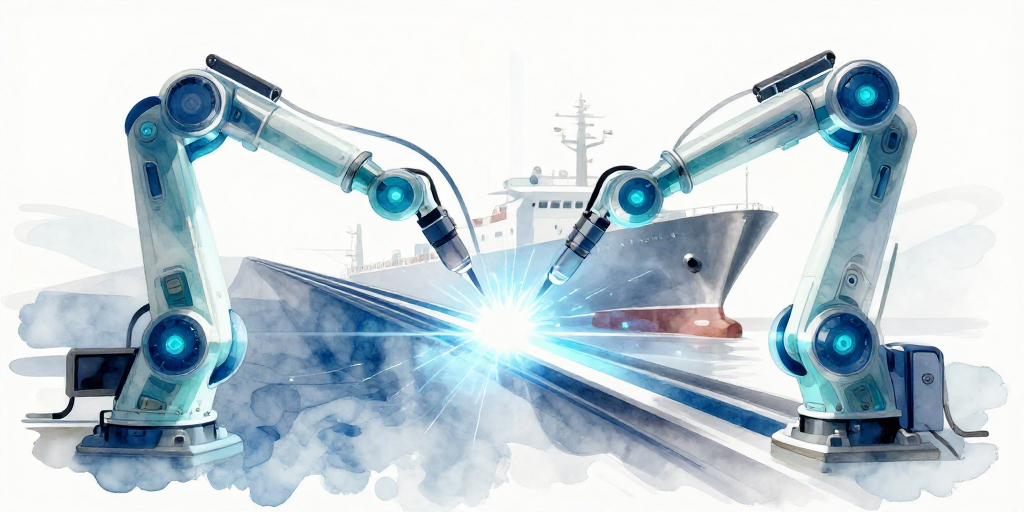
Kawasaki Heavy Industries Accelerates AI‑Powered Welding Robotics Amid Labor Shortages
Kawasaki Heavy Industries (KHI) announced a new initiative to develop an artificial‑intelligence‑equipped robot designed specifically for ship‑building welding operations. The company indicated that the advanced system could potentially double the productivity of welding tasks, thereby mitigating the impact of the current shortage of skilled welders in Japan’s heavy‑industry sector. While details on deployment timelines and exact system specifications remain undisclosed, the announcement underscores KHI’s broader strategy to integrate robotics and AI into its manufacturing pipeline.
Technical Context: From Manual Welding to Intelligent Automation
Welding constitutes a critical bottleneck in shipbuilding, with skilled technicians required to perform precise, repetitive tasks that demand high levels of dexterity and endurance. Conventional robotic welders—typically programmed via offline simulation and controlled by deterministic algorithms—are effective for high‑volume, repetitive welds but lack the adaptability needed for complex, variable geometries encountered in modern naval and commercial vessels.
KHI’s proposed AI‑equipped robot aims to bridge this gap by incorporating real‑time sensor fusion, machine‑learning inference, and adaptive control loops. Key technical features likely include:
- Vision‑based defect detection: Convolutional neural networks (CNNs) analyze high‑resolution images of weld seams in real time, adjusting torch parameters to correct deviations from target profiles.
- Dynamic path planning: Reinforcement‑learning agents optimize welding paths on the fly, balancing speed and quality while avoiding interference with other equipment or structural constraints.
- Predictive maintenance: Sensors monitoring torque, voltage, and temperature feed into predictive models that forecast tool wear and schedule preventive servicing, minimizing unplanned downtime.
- Human‑robot collaboration: Advanced force‑feedback systems and collaborative work envelopes enable semi‑autonomous operation, allowing skilled technicians to supervise or intervene when necessary.
By leveraging these capabilities, the system can maintain weld quality at a higher throughput, translating into a projected productivity increase of up to 100 % relative to current manual and conventional robotic practices.
Capital Expenditure Dynamics in Heavy Industry
The adoption of such advanced robotics represents a significant capital outlay. Recent capital expenditure (CapEx) trends in heavy manufacturing indicate a shift toward “Industry 4.0” investments, with firms allocating 10–15 % more of their annual CapEx budgets to automation, digital twins, and AI‑driven systems. Factors driving this shift include:
- Labor market constraints: Aging workforces and low entry barriers for high‑skill labor in Japan create pressure to replace human tasks with reliable automation.
- Cost‑of‑delay: Shipbuilding projects have long lead times; delays due to workforce shortages can incur substantial penalties, incentivizing upfront automation spending.
- Global competitive pressures: Export‑oriented manufacturers in South Korea and China are deploying similar AI‑augmented welding solutions, prompting KHI to maintain parity.
Capital budgeting models for such projects often involve net present value (NPV) calculations that consider projected productivity gains, reduced labor costs, and potential regulatory incentives. For example, a 5‑year NPV analysis for a $200 million investment might project an internal rate of return (IRR) of 18–22 % when factoring in labor savings, quality improvements, and reduced warranty claims.
Supply Chain Implications
Deploying AI‑powered welding robots also alters the supply chain landscape:
- Component sourcing: High‑precision sensors, GPUs, and custom control boards require reliable semiconductor supply chains, exposing firms to geopolitical risks and component shortages.
- Vendor relationships: Partnerships with AI software developers and sensor manufacturers become strategic; long‑term contracts may secure priority access to cutting‑edge algorithms.
- Inventory management: Predictive maintenance reduces unplanned downtime, enabling just‑in‑time inventory practices for welding consumables and spare parts.
KHI’s integration strategy must therefore include risk mitigation plans for component scarcity, such as dual sourcing, inventory buffers, and localized manufacturing of critical parts.
Regulatory and Infrastructure Considerations
Japan’s Industrial Robot Act and Automation Promotion Law provide regulatory frameworks that encourage the adoption of advanced robotics through tax incentives and subsidies. Recent amendments emphasize safety standards for collaborative robots (c‑bots) and require stringent validation of AI safety protocols. Compliance will be a prerequisite for deploying the new welding system in production facilities.
On the infrastructure front, smart factory initiatives funded by the Japanese Ministry of Economy, Trade and Industry (METI) are expanding the digital backbone of shipyards. KHI will likely need to upgrade networking, edge computing, and data storage capabilities to support real‑time AI inference and telemetry. Integration with existing MES (Manufacturing Execution System) and ERP (Enterprise Resource Planning) platforms will also be critical for end‑to‑end process visibility.
Market Implications and Competitive Positioning
By potentially doubling welding productivity, KHI could:
- Reduce per‑unit labor costs: Lower staffing needs translate directly into cost savings.
- Accelerate production schedules: Higher throughput can meet tighter delivery windows demanded by naval contracts and commercial clients.
- Improve quality consistency: AI‑driven defect detection reduces rework rates, enhancing reputation for precision.
These benefits position KHI favorably against competitors such as Mitsubishi Heavy Industries and Hitachi, who are also investing heavily in AI and robotics. In markets where labor scarcity is acute—particularly in Southeast Asia where shipyards face aging worker pools—the ability to outsource critical welding processes to autonomous systems may become a decisive factor for clients.
Conclusion
Kawasaki Heavy Industries’ plan to develop an AI‑equipped welding robot reflects a broader industry shift toward intelligent automation driven by labor constraints, cost‑of‑delay considerations, and competitive dynamics. While specific timelines and deployment scopes remain undisclosed, the anticipated productivity gains underscore the strategic importance of such investments. Successful implementation will hinge on robust supply chain management, regulatory compliance, and integration with advanced industrial infrastructure—all of which will shape the company’s competitive trajectory in the evolving landscape of heavy industry.