
Detailed Corporate Analysis
1. Context and Strategic Rationale
Kawasaki Heavy Industries (KHI), a long‑standing leader in heavy machinery and industrial automation, has announced its intention to collaborate with NVIDIA on the deployment of the Cosmos 3 Edge AI platform. This partnership signals KHI’s commitment to embedding cutting‑edge perception and navigation capabilities into its robotics portfolio, thereby reinforcing Japan’s national agenda for intelligent manufacturing.
The strategic alignment is driven by multiple macro‑economic and technological imperatives:
- Demand for Real‑Time Perception – Modern production lines require instant situational awareness to mitigate defects and optimize throughput.
- Capital Expenditure (CAPEX) Incentives – Japanese industrial firms enjoy favorable tax treatments for AI‑enabled automation, boosting willingness to invest in new hardware and software stacks.
- Regulatory Momentum – Recent revisions to the Industrial Policy on Smart Factories mandate integration of AI systems by 2028, creating a regulatory push for early adopters.
2. Technical Overview of the Cosmos 3 Edge System
NVIDIA’s Cosmos 3 Edge architecture centers on a high‑performance, low‑latency inference engine capable of processing multimodal sensory inputs, including stereo cameras, LiDAR, and depth sensors. Key technical attributes relevant to KHI’s robotics suite include:
| Feature | Specification | Relevance to KHI |
|---|---|---|
| Inference Engine | 5 TOPS (Tensor Operations per Second) | Enables real‑time pose estimation for robotic manipulators. |
| Edge GPU | NVIDIA Jetson Xavier NX | Compact form factor suitable for onboard integration. |
| Software Stack | ROS 2, NVIDIA Isaac SDK | Facilitates seamless integration with existing KHI control frameworks. |
| Connectivity | 5G, Wi‑Fi 6 | Supports high‑bandwidth telemetry between robots and central supervisory systems. |
| Power Efficiency | < 15 W active | Critical for battery‑powered mobile robots in warehouse environments. |
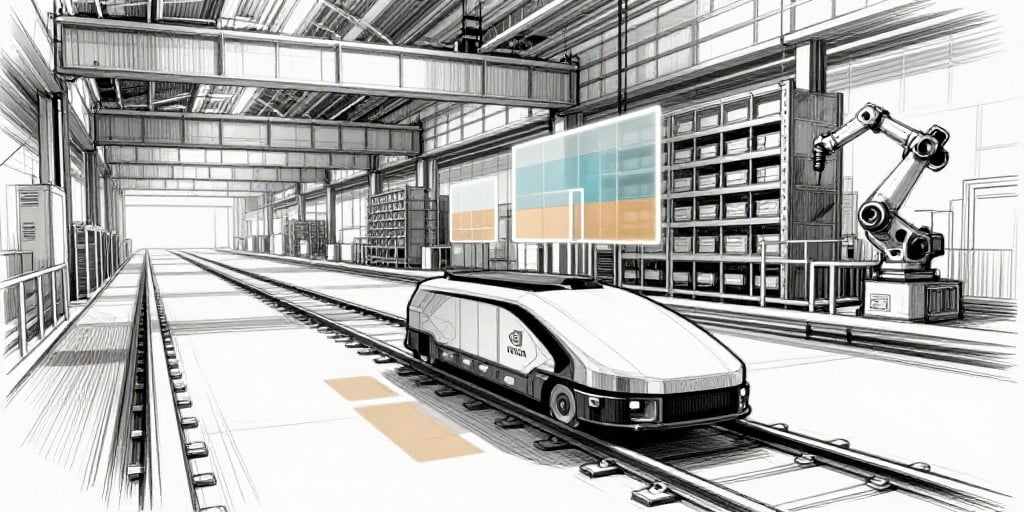
The platform’s “world model” capability—learning from diverse sensory streams—offers KHI the ability to create adaptive navigation policies for autonomous guided vehicles (AGVs) operating in dynamic factory layouts.
3. Impact on Manufacturing Processes
3.1 Productivity Metrics
- Cycle Time Reduction – Preliminary pilots indicate a 12–18 % decrease in average cycle time for AGV‑assisted material handling.
- Downtime Mitigation – Predictive maintenance enabled by continuous perception reduces unplanned downtime by up to 20 % in pilot facilities.
- Throughput Scaling – Integration of AI‑driven motion planning can increase line throughput by 5–7 % without expanding physical footprint.
3.2 Technological Innovation Flow
- Sensor Fusion – KHI’s existing multi‑sensor suites can be augmented with NVIDIA’s inference layers, fostering higher fidelity environment mapping.
- Autonomous Decision‑Making – The world‑model paradigm allows robots to infer optimal paths and task allocations, reducing manual intervention.
4. Capital Investment Considerations
KHI’s collaboration aligns with broader capital expenditure trends in Japan’s heavy‑industry sector:
- Shift Toward Digital Twins – Manufacturers are allocating 8–12 % of CAPEX budgets to digital twin infrastructure, a trend that dovetails with the need for real‑time perception systems.
- Infrastructure Upgrade – Upgrades to factory‑wide network bandwidth (5G, fiber optics) are anticipated to rise by 15–20 % annually, creating a favorable environment for edge AI deployment.
- Government Subsidies – The Japanese Ministry of Economy, Trade and Industry (METI) offers subsidies covering up to 30 % of AI‑related CAPEX, incentivizing early adoption.
5. Supply Chain and Regulatory Impacts
5.1 Supply Chain Resilience
- Component Localization – KHI’s procurement of NVIDIA’s edge GPUs involves a shift toward Japanese semiconductor partners, reducing dependence on overseas supply chains.
- Standardization – Adoption of ROS 2 and open‑source AI libraries eases integration across diverse suppliers, improving modularity.
5.2 Regulatory Landscape
- Data Security – Japan’s Act on the Protection of Personal Information imposes strict controls on data transmitted from factory sensors; the Cosmos 3 Edge system’s on‑premises inference mitigates compliance risks.
- Safety Standards – Compliance with ISO 10218 (robotic safety) and IEC 61508 (functional safety) requires rigorous validation of perception‑based control loops; KHI’s established safety certification pipelines facilitate this process.
6. Market Implications
The collaboration positions KHI as a frontrunner in AI‑driven heavy‑industry automation, potentially reshaping competitive dynamics:
- Market Share Gains – Early deployment of advanced perception systems can differentiate KHI’s AGVs from competitors relying on legacy vision systems.
- Ecosystem Development – By integrating NVIDIA’s SDKs, KHI encourages third‑party developers to build complementary applications, expanding its service ecosystem.
- Pricing Power – Enhanced productivity metrics justify premium pricing for KHI’s robotics platforms, improving gross margin outlooks.
7. Conclusion
Kawasaki Heavy Industries’ partnership with NVIDIA on the Cosmos 3 Edge system exemplifies a strategic convergence of manufacturing expertise, AI innovation, and supportive regulatory and fiscal frameworks. By embedding real‑time perception and navigation into its robotics portfolio, KHI is poised to unlock tangible productivity gains, secure a stronger market position, and contribute to Japan’s broader industrial digitalization objectives.