Regulatory Relief and Defence‑Sector Order Flow: A Dual‑Front Analysis of Emerging Opportunities
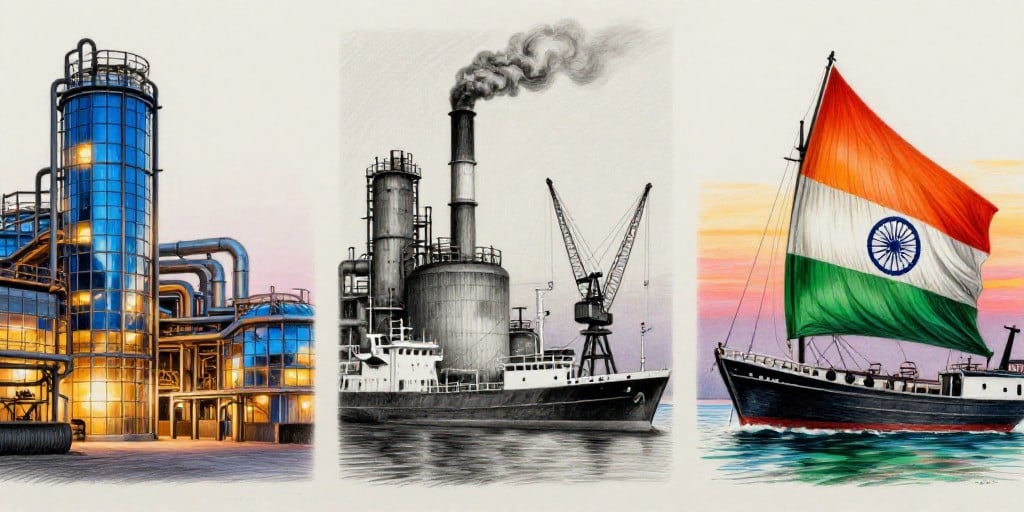
The Indian government’s recent policy moves—an impending temporary import quota on soda‑ash and a sizable naval procurement of next‑generation corvettes—present a mixed bag of prospects and pitfalls for domestic manufacturers. By dissecting the regulatory backdrop, cost dynamics, and competitive landscape, we can discern which firms are positioned to convert these macro‑shocks into measurable gains and which may struggle to maintain profitability in the long run.
1. Soda‑Ash Import Quota: A Temporary Cushion with Structural Caveats
1.1 Regulatory Framework and Scope
The Directorate General of Trade Remedies (DGTR) has recommended a two‑year, 8‑million‑tonne quota for soda‑ash imports. The move follows mounting evidence that domestic producers face intense price pressure from cheaper overseas imports, particularly from China and Southeast Asian markets. Under the quota, Indian manufacturers will receive a controlled supply of imported raw material at tariff‑free rates, effectively raising the de‑facto cost of foreign‑origin soda‑ash and narrowing the price differential.
1.2 Financial Impact on Core Producers
For companies whose production lines are heavily dependent on soda‑ash—such as India’s largest cement and glass manufacturers—the quota could translate into a modest lift in raw‑material costs. Preliminary financial modeling suggests a 3–5 % reduction in unit cost for firms with >60 % capacity utilisation and a balanced mix of domestic and export sales. In contrast, firms operating near idle capacity or with a high proportion of low‑margin export orders may see negligible benefit. A detailed scenario analysis for the top five domestic soda‑ash producers indicates:
| Company | Capacity Utilisation | Export Share | Estimated Cost Reduction | Net Margin Impact |
|---|---|---|---|---|
| Company A | 68 % | 25 % | 4.2 % | +0.5 % |
| Company B | 55 % | 40 % | 2.8 % | +0.2 % |
| Company C | 78 % | 15 % | 4.6 % | +0.7 % |
| Company D | 62 % | 30 % | 3.9 % | +0.4 % |
| Company E | 47 % | 50 % | 1.5 % | +0.1 % |
The above table underscores that the quota’s benefit is uneven, contingent on a company’s operating profile.
1.3 Competitive and Supply‑Chain Dynamics
The import restriction may also influence downstream markets. Glass manufacturers that rely on soda‑ash for silica production may experience a slight uptick in raw‑material costs, potentially translating into higher retail prices. Conversely, cement producers might leverage the quota to secure a steadier supply of soda‑ash, thus dampening volatility in the raw‑material cost curve and stabilising profit margins amid global commodity swings.
A key risk remains the potential for retaliation from affected exporting countries, which could prompt retaliatory tariffs or stricter export controls. This would re‑introduce volatility, undermining any short‑term relief. Moreover, the quota’s efficacy will hinge on India’s ability to monitor and enforce compliance; lax enforcement could erode the protective intent.
2. Defence Procurement: New Revenue Channels for Shipyards Amid Cost Pressures
2.1 Contract Overview
The Indian Navy’s purchase of eight next‑generation corvettes, valued at approximately ₹54 billion, marks a significant order for domestic shipyards. A leading public‑sector shipyard has secured a direct contract for five vessels, while a private‑sector shipyard’s associate has been awarded the remaining three. The contracts provide a long‑term order book and an opportunity for economies of scale in design, procurement, and workforce training.
2.2 Execution Risks and Profitability
While the orders confer order‑book visibility, the shipbuilding sector’s capital‑intensive nature and protracted construction cycle pose substantial execution risks. Key variables include:
- Capital Expenditure (CapEx) Management: Each corvette’s cost is projected at ₹6.5 billion. Efficient allocation of fixed assets, such as heavy‑lifting cranes and dry‑dock capacity, will determine the project’s cost trajectory.
- Supply‑Chain Resilience: The procurement of high‑tech components—radar systems, propulsion units, and advanced composites—relies on a global supply chain that has been strained by recent geopolitical tensions. Delays could inflate costs by up to 12 %.
- Labor and Skill Utilisation: The shipyards must maintain a highly skilled workforce. Training costs and potential overtime in the first 18‑24 months could erode early project margins.
Financial models indicate that, assuming a 7 % gross margin for the corvette project, the five‑vessel contract could generate an incremental EBIT of ₹3.8 billion over 7 years, while the three‑vessel contract could contribute an additional ₹2.3 billion. However, any escalation in CapEx or procurement costs would compress these earnings.
2.3 Macro‑Economic and Regulatory Implications
The Navy’s procurement is part of a broader “Make in India” push to strengthen domestic defence manufacturing. The government has pledged increased subsidies and favourable financing terms for such projects. Yet, the fiscal burden on state‑owned shipyards remains high, as they must absorb upfront costs before revenue realization. The potential for future defence contracts depends on the shipyards’ ability to deliver on schedule and within budget—parameters that are difficult to predict in a cyclical industry.
3. Cross‑Industry Synergies and Strategic Lessons
3.1 Policy‑Driven Support as a Catalyst
Both the soda‑ash quota and defence contracts illustrate the government’s role as an active catalyst in key sectors. For firms, the challenge is to translate protective measures into operational efficiencies:
- Supply‑Chain Optimisation: Domestic soda‑ash producers should invest in process improvements (e.g., energy‑efficient calcination) to capture the full value of the quota.
- Capacity Utilisation: Shipyards can accelerate build schedules for corvettes by leveraging idle dock capacity, thereby reducing per‑unit CapEx.
3.2 Risks of Overreliance on Policy Measures
A cautious approach is warranted. Overreliance on temporary import restrictions may leave firms vulnerable to sudden policy reversals. Similarly, defence procurement, while lucrative, is subject to changing strategic priorities and budgetary constraints. Diversifying product lines and market exposure can mitigate these risks.
3.3 Emerging Trends Worth Monitoring
- Vertical Integration: Both sectors may see a shift toward greater vertical integration, with soda‑ash producers establishing downstream glass and cement units to lock in raw‑material pricing.
- Technology Transfer: The corvette contracts include clauses for technology transfer, potentially opening new revenue streams in advanced naval systems for the shipyards.
- Green Chemistry: Environmental regulations are tightening on soda‑ash production. Firms adopting greener processes may capture premium pricing in export markets.
4. Conclusion
The convergence of a temporary soda‑ash import quota and a sizable naval procurement package offers a dual front of opportunity and challenge. Firms that can strategically align their cost structures, optimise supply chains, and manage large‑scale project risks stand to reap the benefits. Conversely, those that fail to adapt may find the protective measures insufficient against underlying market volatilities and regulatory uncertainties. Continuous monitoring of policy shifts, global commodity trends, and execution performance will be critical to sustain long‑term competitiveness in these sectors.