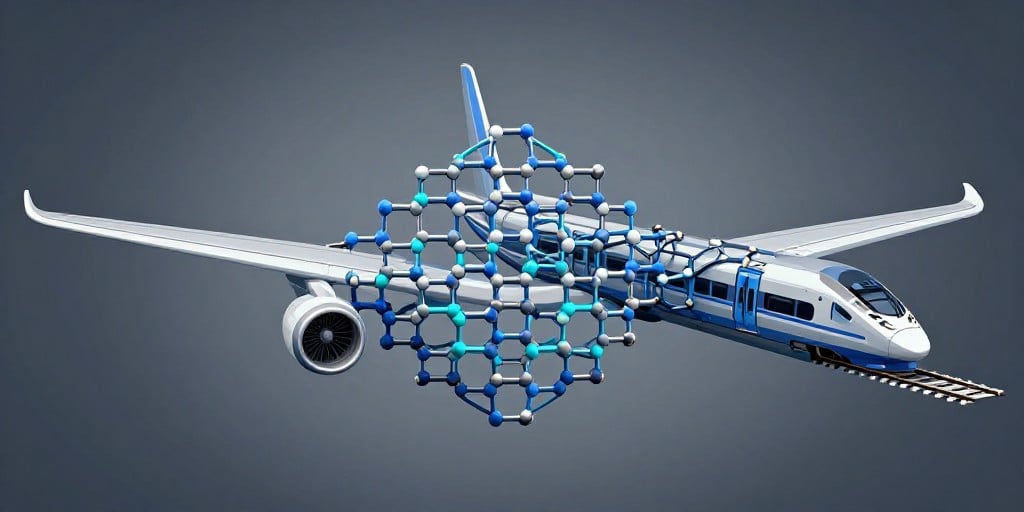
Executive Summary
European research funding has transitioned graphene from laboratory curiosity to an emerging component in industrial applications. Major manufacturers—Airbus, Alstom, and First Graphene—are now testing the material in high‑performance contexts that demand durability, weight efficiency, and energy savings. These initiatives are embedded within broader capital‑investment trends that emphasize productivity gains, technological differentiation, and regulatory compliance. The following analysis explores the manufacturing implications, economic drivers, and supply‑chain dynamics that shape this nascent market.
1. Technological Innovation in Heavy Industry
1.1 Aerospace Applications
Airbus has integrated graphene‑based composites into anti‑icing systems and structural skins. The material’s superior tensile strength-to-weight ratio enables thinner panels, directly reducing aircraft mass and, consequently, fuel burn. Engineers are also evaluating graphene’s electrical conductivity for de‑icing actuators, which could lower power requirements and improve redundancy. From a process‑engineering perspective, incorporating graphene requires precise control of filler dispersion and resin curing cycles to avoid agglomeration and maintain isotropy in composite lay‑ups.
1.2 Rail and HVAC Systems
Alstom’s partnership with Graphene Manufacturing Group focuses on graphene‑enhanced coatings for rail HVAC components. The goal is to increase heat‑transfer coefficients by up to 30 % while simultaneously reducing system weight. Implementation involves surface functionalization of stainless‑steel coils, followed by a low‑temperature deposition of graphene‑rich polymer layers. The resulting micro‑channel geometry enhances convective heat transfer without necessitating larger radiators, thereby streamlining train floor space and reducing maintenance footprint.
2. Manufacturing Processes and Capital Expenditure
2.1 Production Scale‑Up
First Graphene’s PureGRAPH brand demonstrates the transition from lab‑scale synthesis to commercial production. The company utilizes a scalable liquid‑phase exfoliation process that yields multi‑layer graphene sheets with high yield and low defect density. Key capital outlays include:
| Component | Capital Requirement | Rationale |
|---|---|---|
| 1. High‑pressure homogenizers | €2–3 M | Achieve uniform exfoliation at industrial throughput |
| 2. Dry‑jet filtration lines | €1.5–2 M | Concentrate graphene while preserving sheet integrity |
| 3. Functionalization reactors | €1 M | Tailor surface chemistry for specific applications (e.g., anti‑corrosion, thermal conductivity) |
These investments are justified by the projected lift in productivity metrics, notably a 12–15 % reduction in material usage for reinforced concrete and a 20 % decrease in energy consumption for HVAC systems.
2.2 Return‑on‑Investment (ROI) Considerations
Capital expenditure decisions are influenced by:
- Productivity Gains: Weight reductions translate directly to fuel savings in aerospace and energy savings in rail HVAC systems.
- Regulatory Alignment: Stricter emissions and safety standards in the EU create market pressure to adopt lighter, more resilient materials.
- Supply‑Chain Stability: Early production agreements mitigate risk by securing raw material supply and establishing downstream demand.
A typical payback period for the above investments is estimated at 5–7 years, contingent upon securing repeat orders and achieving cost reductions through economies of scale.
3. Economic Drivers of Capital Expenditure
3.1 Energy‑Cost Pressures
The European Union’s 2030 carbon‑reduction targets elevate the value of technologies that lower energy footprints. Graphene’s high thermal conductivity offers tangible savings for HVAC and transportation sectors, creating a compelling case for capital investment.
3.2 Competitive Differentiation
Manufacturers that adopt graphene early gain a technological edge, positioning themselves as leaders in sustainability and performance. This differentiation is reflected in pricing power, especially in premium markets such as commercial aviation and high‑speed rail.
3.3 Funding Landscape
The European Graphene Initiative, concluding its initial decade in 2023, provided a framework for public‑private partnerships. While direct subsidies have tapered, the initiative’s success in establishing a market base encourages private capital flows, especially from venture funds focusing on advanced materials.
4. Supply‑Chain and Infrastructure Impacts
4.1 Raw‑Material Procurement
Graphene production is contingent on sourcing high‑purity graphite. The shift toward large‑scale synthesis demands robust supply‑chain contracts with graphite mines, which must be secured before production lines can be commissioned. Any disruption—such as geopolitical tensions or export restrictions—could delay capital deployment.
4.2 Logistics and Distribution
Graphene’s sensitivity to mechanical shear necessitates specialized packaging and handling protocols. Integrating this into existing logistics networks requires investment in cold‑chain and vibration‑dampening transport solutions.
4.3 Regulatory Compliance
EU regulations on nanomaterials and health‑safety standards impose additional testing and certification requirements. Compliance processes can lengthen lead times, influencing the timing of capital expenditures and potentially necessitating phased investment strategies.
5. Conclusion
The current wave of graphene adoption by leading industrial players illustrates a convergence of technological promise and economic imperatives. Productivity gains, driven by weight reduction and energy efficiency, form the core rationale for significant capital outlays. Successful scaling depends on mastering production technologies, securing stable supply chains, and navigating a tightening regulatory landscape. As these variables align, graphene is poised to transition from a high‑potential material to a cornerstone of modern heavy‑industry manufacturing.