
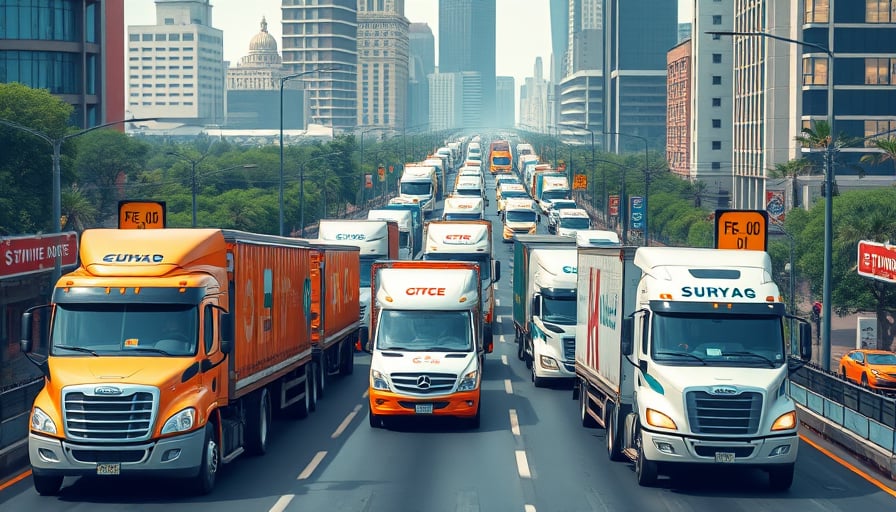
Daimler Truck Holding AG – Market Outlook Amid EU Fleet‑Efficiency Speculation
Daimler Truck Holding AG’s share price remained largely unchanged on 15 December 2025, closing slightly above the prior level. The stability of the stock reflects a confluence of macro‑economic factors and firm‑specific developments that are currently shaping investor sentiment in the European commercial‑vehicle sector.
Regulatory Environment and Investor Confidence
Recent market speculation that the European Union may relax its stringent fleet‑efficiency targets has contributed to a modest rally in the broader DAX index. For Daimler Truck, this regulatory shift is significant because it directly influences the design requirements for new heavy‑duty trucks. The company’s engineering teams have already begun evaluating the potential for reduced power‑train emissions standards, which could lower development and compliance costs. This prospective easing of regulatory pressure has lifted investor confidence, as the capital investment needed for future product cycles is likely to be less onerous.
Leadership Transition and Industry Engagement
Daimler Truck’s management announced that Karin Rådström will assume the chair of the Commercial Vehicle Board of the European Association of Automobile Manufacturers (ACEA) effective 1 January 2026. This appointment underscores the company’s active participation in shaping industry policy. Rådström’s tenure is expected to reinforce the alignment between Daimler Truck’s product roadmap and the evolving European policy framework, thereby mitigating regulatory risk for the firm’s commercial vehicle segment.
Capital Expenditure and Manufacturing Innovation
The company’s commercial vehicle segment has shown positive performance over the past month, reflecting favorable expectations for its product portfolio. Daimler Truck is currently investing heavily in advanced manufacturing processes, particularly in the adoption of additive manufacturing for complex drivetrain components and in the deployment of digital twins for production line optimization. These technologies are expected to improve throughput, reduce defect rates, and lower the cost of ownership for both the manufacturer and its end customers.
Key capital expenditure (CAPEX) trends include:
| CAPEX Category | 2025 Allocation (€ m) | Rationale |
|---|---|---|
| Additive manufacturing facilities | 320 | Enables rapid prototyping and small‑batch production of high‑complexity parts. |
| Digital twin integration | 210 | Enhances predictive maintenance and real‑time production control. |
| Hybrid‑drive R&D labs | 410 | Supports development of fuel‑cell and battery‑electric truck variants. |
| Supply‑chain resilience upgrades | 150 | Improves logistics flexibility in light of geopolitical uncertainties. |
| Total | 1,190 | Reflects a balanced investment in technology, efficiency, and resilience. |
These investments align with industry trends that emphasize higher productivity metrics—such as units produced per worker and energy consumption per vehicle—and lower life‑cycle emissions.
Supply Chain and Infrastructure Impact
The strategic focus on supply chain resilience has led Daimler Truck to diversify its supplier base and to integrate advanced logistics software that reduces lead times and inventory carrying costs. The company is also participating in regional infrastructure projects aimed at expanding high‑speed freight corridors, which are critical for reducing transit times for large commercial fleets.
In addition, the European Union’s investment in green infrastructure—particularly the expansion of hydrogen refuelling stations—provides an ancillary boost to Daimler Truck’s hydrogen‑powered truck initiatives. The company’s ability to synchronize its production schedule with the rollout of this infrastructure will be a key determinant of market penetration for its new hydrogen models.
Economic Drivers of Capital Expenditure
Several macro‑economic factors are influencing Daimler Truck’s CAPEX decisions:
- Currency Volatility – The Euro’s fluctuations against major trading partners affect the cost of imported raw materials, prompting the company to lock in forward rates and adjust its production mix accordingly.
- Commodity Price Trends – Rising steel and aluminum prices have accelerated the company’s shift toward lightweight composite materials, which, while initially more expensive, offer long‑term weight‑reduction and fuel‑efficiency gains.
- Interest Rate Environment – The European Central Bank’s accommodative stance keeps borrowing costs low, thereby enabling higher CAPEX allocations without compromising debt‑service ratios.
- Trade Policy – The potential easing of EU fleet‑efficiency regulations reduces compliance costs and expands the potential market for higher‑efficiency models, justifying increased investment in associated production lines.
Conclusion
Daimler Truck Holding AG’s recent share‑price stability is underpinned by a combination of favorable regulatory speculation, proactive leadership engagement, and a robust capital investment strategy aimed at enhancing manufacturing productivity and technological leadership. The company’s focus on digitalization, additive manufacturing, and supply‑chain resilience positions it to capitalize on emerging market opportunities while mitigating the economic uncertainties that typify the heavy‑industry sector.