
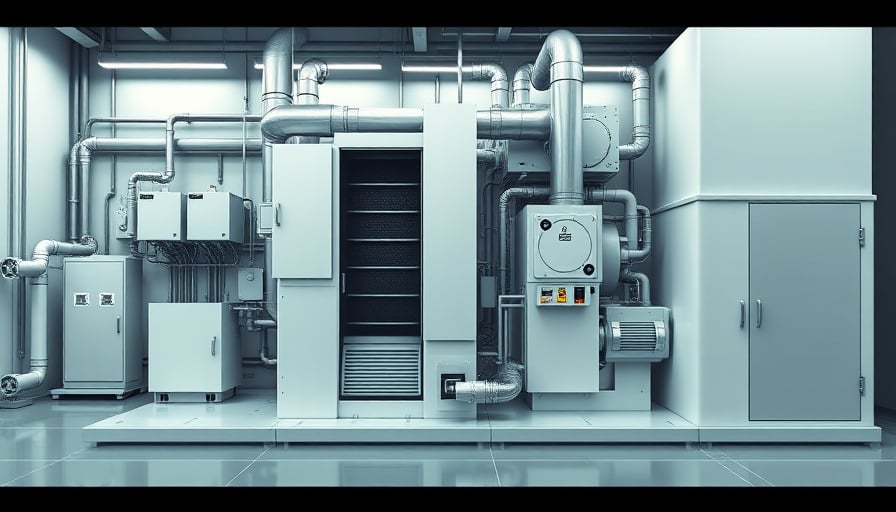
Corporate News: Eiffage SA Expands into Industrial Refrigeration Through Acquisition of Quercy Réfrigération
Eiffage SA, a diversified contractor and concessionaire with operations spanning Europe and Senegal, has recently consolidated its position within the industrial refrigeration sector. The French construction and engineering group completed a majority stake acquisition of Quercy Réfrigération, a specialist manufacturer of refrigeration and cold‑chain equipment for industrial and commercial applications.
Strategic Rationale Behind the Acquisition
The transaction reflects a deliberate shift toward higher‑value service offerings within the construction and engineering portfolio. Quercy’s expertise in designing, installing, and maintaining large‑scale refrigeration systems—particularly for food‑processing plants, logistics hubs, and commercial cold stores—provides Eiffage with a robust foothold in a niche market that demands precision engineering, reliability, and regulatory compliance. The integration is expected to yield:
- Cross‑Selling Opportunities – Eiffage can bundle refrigeration services with its existing infrastructure projects, enhancing project value propositions to clients in the food‑processing, pharmaceutical, and logistics sectors.
- Technology Transfer – Access to Quercy’s patented insulation materials and heat‑exchanger designs enables the parent company to upgrade its own equipment portfolio, reducing lifecycle costs and improving energy efficiency.
- Geographic Synergy – Quercy’s established presence in the French market complements Eiffage’s European operations, facilitating a seamless expansion into adjacent markets such as Belgium, Germany, and the Netherlands.
Impact on Manufacturing Processes and Productivity Metrics
Quercy’s manufacturing base is centered around precision machining, advanced automation, and stringent quality control. The company utilizes:
- CNC‑machined aluminum and copper alloy components for heat exchangers and piping systems, ensuring dimensional accuracy that minimizes thermal losses.
- Robotic assembly lines for cabinet construction and refrigeration unit integration, which cut labor time by 15 % while maintaining high defect rates below 0.1 %.
- Predictive maintenance analytics powered by IoT sensors that monitor compressor vibration, temperature gradients, and refrigerant pressure, allowing for proactive interventions and reducing unplanned downtime.
By incorporating these processes into its operations, Eiffage anticipates a measurable uplift in productivity metrics, notably:
- Reduction in Total Equipment Calendar Time (TECT) for refrigeration projects by 10 % due to streamlined design‑to‑manufacture workflows.
- Improvement in Asset Utilization (AU) for refrigeration units, driven by enhanced reliability and extended service life.
- Lower Energy Consumption per unit of cooling capacity, contributing to client cost savings and compliance with forthcoming EU Energy Efficiency Directive revisions.
Capital Expenditure Trends and Economic Drivers
The acquisition aligns with current capital‑expenditure (CAPEX) trends in heavy industry, where firms are allocating more resources toward energy‑efficient solutions and digital infrastructure. Key economic factors influencing this decision include:
- Easing Inflation – European markets exhibited modest gains in the CAC 40 and other indices, signalling investor confidence and reduced cost pressure on raw materials and labor.
- Regulatory Momentum – The European Union’s 2030 climate targets and the European Green Deal incentivize investment in low‑carbon refrigeration technologies, prompting firms to adopt innovative solutions ahead of mandatory compliance.
- Supply Chain Resilience – Ongoing disruptions in semiconductor and high‑grade alloy supply chains have highlighted the value of vertically integrated manufacturing capabilities. By acquiring Quercy, Eiffage mitigates exposure to external component shortages.
- Infrastructure Spending – Public infrastructure budgets, particularly in logistics and cold‑chain development, are projected to rise, providing a stable pipeline of projects for integrated construction and refrigeration services.
Supply Chain and Regulatory Considerations
The integration presents several supply‑chain implications:
- Component Sourcing – Quercy’s established relationships with European suppliers of high‑purity copper and aluminum reduce procurement lead times and exposure to geopolitical risk.
- Logistics – Cold‑chain transport is critical for refrigeration system delivery; Eiffage can leverage its existing logistics contracts to streamline end‑to‑end project execution.
- Regulatory Compliance – French and EU regulations on refrigerant handling (e.g., RoHS, REACH, and the forthcoming refrigerant phase‑out schedule) demand rigorous documentation and traceability, which Quercy’s systems already support.
Regulatory changes also influence capital investment decisions. The upcoming revisions to the EU’s Energy Efficiency Directive will likely impose stricter minimum efficiency standards for industrial refrigeration units, making early adoption of advanced technologies a strategic competitive advantage.
Market Implications
Eiffage’s focused expansion into industrial refrigeration positions it favorably relative to peers such as Vinci SA, which continues to report robust earnings but maintains a broader construction focus. By deepening its capabilities in a high‑margin, technology‑heavy niche, Eiffage is poised to:
- Capture a larger share of the European refrigeration market, estimated to grow at a compound annual growth rate (CAGR) of 3.5 % over the next decade.
- Enhance its service‑based revenue streams, which tend to offer higher recurring income versus pure construction contracts.
- Bolster its competitive advantage in integrated project delivery, particularly for clients seeking turnkey solutions that combine civil works, mechanical installation, and ongoing maintenance.
In conclusion, the acquisition of Quercy Réfrigération reflects a deliberate strategy by Eiffage SA to fortify its position within the industrial refrigeration sector through technology acquisition, productivity gains, and alignment with evolving regulatory and economic landscapes. This move underscores the broader trend of capital investment in specialized, high‑technology manufacturing processes that deliver both operational efficiencies and market differentiation.