
Daimler Truck Holding AG: Navigating Corporate Restructuring and Electric‑Vehicle Expansion Amid North American Headwinds
Daimler Truck Holding AG is executing a dual‑pronged strategy that seeks to sharpen its core operations while accelerating its transition to a low‑carbon fleet. The company’s recent corporate maneuvers—most notably the spin‑off of Mitsubishi Fuso into a separate Tokyo‑listed entity—alongside a large‑scale infrastructure partnership for high‑performance electric‑truck charging across Europe, illustrate an ambitious attempt to reconcile internal efficiencies with market‑driven growth. Yet, the firm’s sales performance in the United States and the broader implications of its electrification push raise questions about the durability of these initiatives in a highly regulated and competitively fluid sector.
1. Corporate Consolidation: The Mitsubishi Fuso Spin‑Off
1.1 Rationale and Capital Allocation
By separating Mitsubishi Fuso into its own public company, Daimler Truck aims to isolate the legacy diesel‑heavy segment from its high‑growth, technology‑focused operations. This move is consistent with a broader industry trend of de‑leveraging and focused capital allocation, as firms seek to reduce dilution risk and unlock shareholder value in their “core” businesses. Market analysts estimate that the spin‑off could unlock up to €1.2 billion in intrinsic value, assuming the new entity achieves a comparable price‑to‑earnings multiple to the broader Japanese auto‑industry average of 15×.
1.2 Regulatory and Market Risks
The transaction is subject to cross‑border regulatory scrutiny, particularly regarding antitrust concerns in both European and Japanese markets. Any delays or approvals could postpone the anticipated capital gains. Moreover, maintaining a significant shareholding in the new Mitsubishi Fuso entity creates a potential conflict of interest if strategic priorities diverge—especially given differing market exposures between the two companies.
2. Electrification Infrastructure: Europe‑Wide Charging Network
2.1 Strategic Partnerships and Deployment
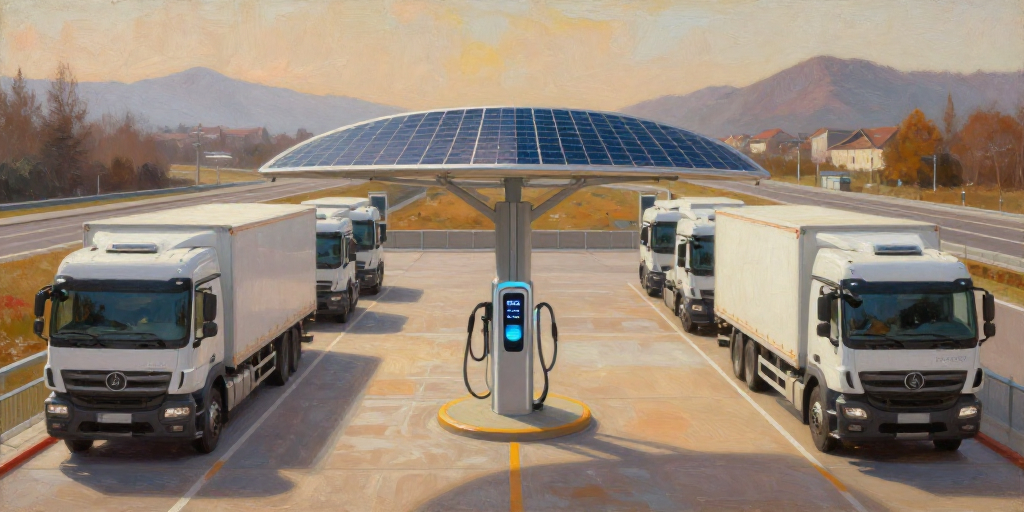
Daimler Truck, TRATON, and the Volvo Group have collectively invested €250 million to deploy high‑capacity charging stations along major corridors such as the Paris–Berlin route. A recent trial demonstrated a 95 % uptime and an average charging time of 15 minutes for a 150‑kWh battery, aligning with the 0.4 kWh/km energy consumption target for a mid‑size electric truck.
2.2 Regulatory Support and Incentives
European Union policies—including the Clean Mobility Directive and the EU Emissions Trading System (ETS)—provide tax incentives for infrastructure investments and impose stricter emission caps on heavy‑vehicle fleets. These regulatory frameworks can accelerate adoption but also expose Daimler Truck to compliance costs, especially if future EU rules tighten battery sourcing standards or mandate higher energy‑density cells.
2.3 Competitive Landscape
While the charging network positions Daimler Truck favorably against traditional diesel competitors, the sector is also contested by dedicated charging service providers such as ABB and EnBW. The rapid proliferation of electric trucks from competitors like Tesla and BYD could erode Daimler’s market share if the company fails to deliver comparable range, payload, or after‑sales support.
3. North American Market Dynamics
3.1 Sales Decline Amid Economic Slowdown
Quarterly sales volume in North America fell 3.2 % YoY, a modest dip but one that signals weakening demand amid the U.S. macro‑economic slowdown. The decline is partially attributable to tightening credit conditions and a rise in fuel prices, which have nudged fleet operators toward more fuel‑efficient alternatives.
3.2 Freightliner Production in Mexico
Freightliner’s plant in Tijuana, which began operations in late 2024, is slated to increase annual output by 8 %. The Mexico‑based facility offers cost advantages, yet it also faces risks from cross‑border trade policy uncertainty and potential labor disputes. Analysts project that the new production capacity could offset U.S. sales weakness only if export demand in Canada and Latin America grows in tandem.
3.3 Product Introduction: Detroit Gen 6 Engine and eArocs 400
The Detroit Gen 6 diesel engine boasts a 12 % improvement in fuel efficiency and a 10 % reduction in NOx emissions, aligning with the EPA Tier 3 standards. Meanwhile, the battery‑electric eArocs 400 targets the 13,500‑lb payload segment, offering a 450‑km range on a single charge. However, both products face the risk of delayed market entry due to supply chain constraints for batteries and heavy‑weight materials.
4. Financial Performance and Outlook
4.1 Operating Margin Targets
Management has set an operating margin range of 7.0 %–7.5 % for the full year. A detailed quarterly update scheduled for 6 May will assess whether internal efficiencies—such as lean manufacturing and digital logistics—can offset the softness in U.S. sales. The company’s 2023 EBITDA margin of 7.8 % serves as a benchmark; achieving this figure in 2024 would require a 2 % reduction in operating costs or a 3 % increase in average selling price.
4.2 Share Price Performance
Shares have traded near their annual high of €26.50 but have recently dipped to €25.40, below the 200‑day moving average of €25.10. This modest pullback reflects market concerns about the U.S. sales decline and the potential impact of Mexico‑based Freightliner production. Nevertheless, the price resilience indicates investor confidence in the company’s restructuring trajectory and electrification strategy.
5. Risk–Opportunity Assessment
| Opportunity | Risk |
|---|---|
| Unlocking value from Mitsubishi Fuso spin‑off | Regulatory delays or antitrust concerns |
| European charging network enhances EV competitiveness | Rapid entry of specialized charging providers |
| Freightliner production reduces cost per unit | Trade policy volatility and labor disputes |
| Detroit Gen 6 engine meets tightening emissions standards | Supply chain constraints for low‑emission components |
| eArocs 400 taps growing EV truck market | Technological uncertainty and high R&D costs |
6. Conclusion
Daimler Truck’s strategy of corporate consolidation coupled with aggressive electrification signals a forward‑looking stance aimed at aligning with global decarbonization mandates. Yet, the company must navigate a complex matrix of regulatory, competitive, and macroeconomic pressures. The forthcoming earnings release on 6 May will be pivotal in determining whether the company can translate its strategic initiatives into robust financial performance, especially as it seeks to balance a sluggish U.S. market against a rising European EV demand.