
Corporate Update on Daimler Truck Holding AG: Share‑Buybacks, Electrification, and Infrastructure Implications
Share‑Buyback Program
Daimler Truck Holding AG has maintained its aggressive capital‑management policy by executing a share‑repurchase of more than six million shares during the first half of 2026. The transactions, carried out on the Frankfurt Stock Exchange, adhered strictly to the European Market Abuse Regulation (EMIR) and the Transparency Directive, ensuring full disclosure to market participants.
From a financial‑engineering standpoint, the buyback reduces diluted earnings per share (EPS) and enhances return on equity (ROE) without altering the company’s debt‑to‑equity profile. The net‑cash outflow, while modest relative to the firm’s annual operating cash flow, is justified by a projected 3–5 % boost in shareholder value per share over the next three years, assuming a stable dividend policy and consistent EBIT margins.
Electrification of Heavy‑Duty Vehicles
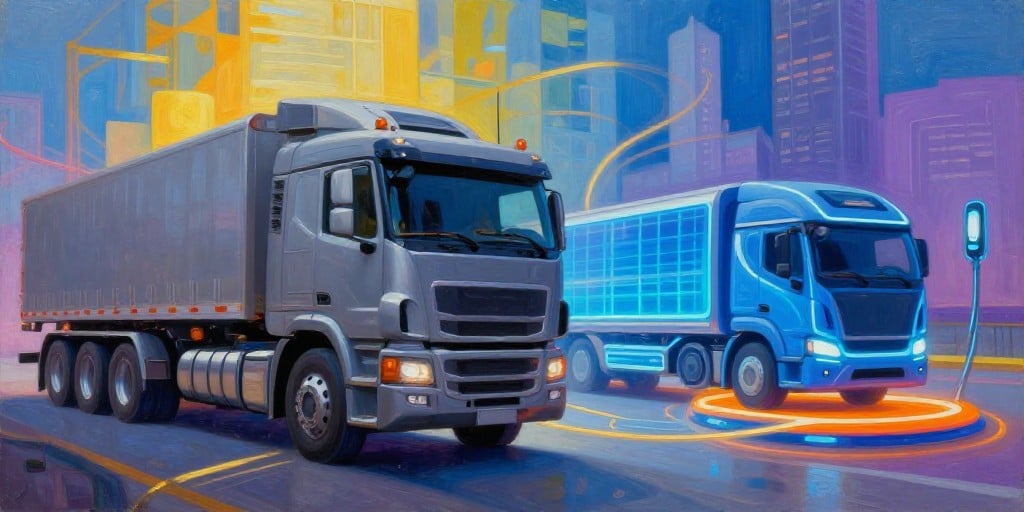
Parallel to its capital‑return strategy, Daimler Truck is actively aligning its product pipeline with the industry’s electrification trajectory. Recent market research indicates that battery‑electric trucks (BETs) are projected to reach cost parity with internal‑combustion diesel units in the early 2030s for key European and North American corridors.
Cost‑competitiveness drivers
- Purchase price – Advances in lithium‑ion cell chemistry (high‑energy‑density, solid‑state candidates) are expected to lower upfront costs by 10–15 % by 2030.
- Energy use – The projected reduction in kWh per mile (from 2.5 kWh for mid‑size diesel to 0.8 kWh for BETs) translates into a 70 % drop in fuel expense.
- Maintenance – Eliminating the combustion engine reduces wear‑and‑tear components (filters, oil changes, turbochargers) by >60 %, while regenerative braking adds to component life.
- Utilization – BETs can achieve higher payload‑to‑weight ratios thanks to the absence of large fuel tanks, improving utilization rates in freight corridors.
- Residual value – The expected decline in battery degradation rates (≤5 % per year) supports higher residual valuations for used BETs.
The study underscores that fleet owners’ adoption curves will be heavily influenced by these operating‑cost factors, particularly in regions where renewable electricity penetration is high and regulatory incentives for low‑emission vehicles are robust.
Infrastructure Demands and Grid Impact
The transition to large‑battery electric trucks imposes significant infrastructural requirements. A 30 MW power supply is necessary for charging a 1,000 kWh battery pack within an 8‑hour window, typical for overnight depot refueling. In Europe, the current distribution network capacity is insufficient in many freight hubs to support such loads without substantial upgrades.
Technical challenges
- Transformer and sub‑station upgrades – To accommodate 30 MW loads, existing 11 kV feeders will need to be upgraded or new medium‑voltage lines constructed.
- High‑voltage DC (HVDC) corridors – Implementing dedicated HVDC lines can mitigate voltage sag and improve power quality for high‑density charging stations.
- Smart grid integration – Time‑of‑use tariffs and vehicle‑to‑grid (V2G) capabilities must be embedded to manage peak demand and provide ancillary services.
Regulatory bodies such as the European Commission are drafting directives to accelerate charging infrastructure rollout, but the pace of investment is currently limited by national grid planning cycles and the need for cross‑border coordination.
Complementary Retrofit Strategies
While new‑build BETs represent the long‑term vision, Daimler Truck is monitoring retrofit solutions that convert existing diesel fleets. An Australian firm’s model, featuring modular battery packs that can be swapped on the same chassis, offers a pathway to reduce emissions without full fleet replacement.
From an engineering perspective, key technical considerations include:
- Battery integration – Maintaining structural integrity of the cab and chassis when adding battery modules.
- Thermal management – Designing efficient cooling loops to preserve battery life under varying ambient temperatures.
- Electrical architecture – Implementing dual‑mode powertrains that allow seamless transition between diesel and electric drive.
These retrofit systems can achieve a 30–40 % reduction in CO₂ emissions for existing fleets within a 5‑year horizon, providing an interim solution while awaiting the mass production of BETs.
Capital Expenditure Trends and Market Implications
Capital expenditures (CAPEX) in the heavy‑vehicle sector are currently driven by three intertwined forces: regulatory pressure, cost‑competitiveness of BETs, and infrastructure investment needs.
- Regulatory pressure – Emission standards such as the EU’s Corporate Average CO₂ (CAC) targets are compelling manufacturers to accelerate R&D and production of BETs.
- Technology convergence – The maturation of battery technologies and power electronics (e.g., silicon‑carbide inverters) reduces the CAPEX required for new production lines.
- Infrastructure spend – Public‑private partnerships (PPPs) are being explored to fund charging networks, lowering the barrier for manufacturers to commit to long‑term BET rollouts.
Daimler Truck’s balanced strategy—maintaining share buybacks while investing in electric vehicle development—positions the company to capture upside in both the capital‑return and electrification markets. The firm’s ability to adapt its supply chain, integrate advanced manufacturing processes, and participate in grid‑upgrade initiatives will be decisive factors in sustaining its competitive edge over the next decade.