
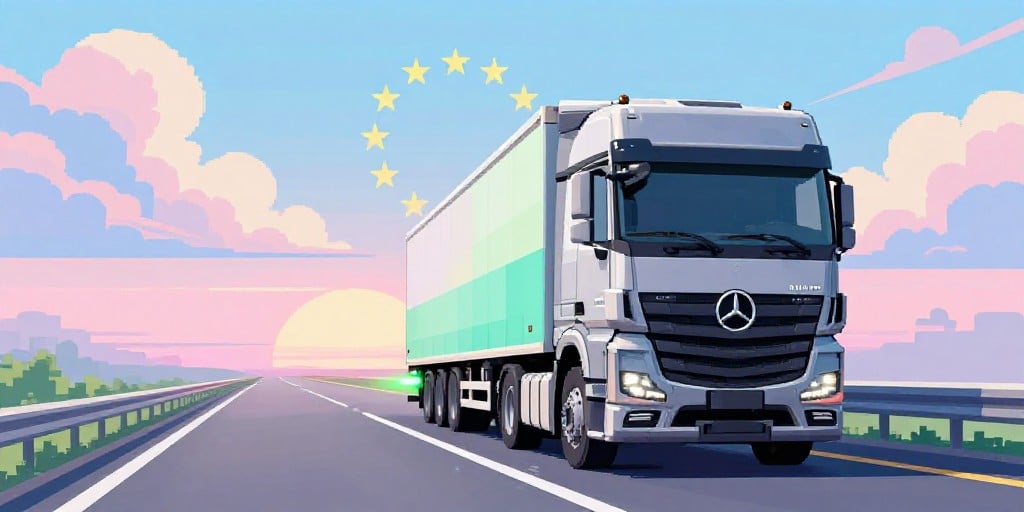
Daimler Truck Holding Raises Concerns Over European Commercial‑Vehicle Regulation
Daimler Truck Holding, a leading German manufacturer of commercial vehicles, has drawn heightened scrutiny following remarks by its chief executive, Karin Rådström. In a briefing to the German press, Rådström articulated a growing apprehension that the trajectory of CO₂ regulations could threaten the long‑term competitiveness of the European commercial‑vehicle sector. She underscored a perceived deficiency in the speed and coherence of policy responses, while simultaneously reaffirming her stewardship of the European Automobile Manufacturers’ Association (ACEA) commercial‑vehicle committee.
Regulatory Dynamics and Market Fundamentals
The European Union’s Green Deal and the forthcoming Corporate Sustainability Reporting Directive (CSRD) set the backdrop for a tightening regulatory environment that demands rapid decarbonisation of heavy‑duty transport. Daimler Truck’s concerns are not isolated: industry‑wide analyses project that the cost of compliance—ranging from retrofitting engines to developing fully electric fleets—could erode margins unless matched by clear incentives or phased implementation schedules.
Financial data from the past three fiscal years reveal a steady decline in gross margins for the commercial‑vehicle segment, from 8.4 % in 2021 to 7.2 % in 2023, despite a 5.6 % increase in sales volume. This contraction coincides with a tightening of the European CO₂ target regime, suggesting that regulatory pressure is already influencing profitability. Should the EU advance to a 55 % reduction in emissions by 2030, the cost of compliance could exceed the projected savings from electrification, amplifying the margin squeeze.
Competitive Landscape and Innovation Trajectory
Within the competitive sphere, German rivals such as Volkswagen, MAN, and Volvo are investing aggressively in electric and hydrogen propulsion platforms. Volkswagen’s recent restructuring dialogue—centred on avoiding plant closures and favouring “smarter operational adjustments”—highlights a broader industry shift towards flexible, modular production lines. This pivot is not only a response to sustainability imperatives but also to the volatility of raw‑material prices and supply‑chain disruptions amplified by the pandemic and geopolitical tensions.
Daimler Truck’s strategy appears to prioritize incremental innovation, favouring the development of hybrid powertrains and advanced driver‑assist systems over a rapid full‑electrification shift. While this cautious stance may preserve short‑term financial stability, it risks ceding market share to more aggressive competitors, particularly in emerging markets where regulatory support for low‑emission vehicles is intensifying.
Risks and Opportunities
| Risk | Impact | Mitigation |
|---|---|---|
| Regulatory Overreach | Potential margin erosion | Lobby for phased implementation; diversify product mix |
| Supply‑Chain Disruptions | Production bottlenecks | Invest in dual‑source suppliers; build buffer inventory |
| Technology Lag | Loss of market share | Accelerate R&D partnerships; adopt modular platform designs |
Conversely, opportunities emerge from the rising demand for sustainable logistics solutions in the European market. Daimler Truck could capitalize by positioning itself as a leader in hybrid heavy‑duty freight solutions, combining lower emissions with the proven reliability of internal combustion engines. Additionally, the company’s involvement in the ACEA commercial‑vehicle committee offers a platform to influence regulatory timelines and advocate for incentive schemes that align with commercial viability.
Regulatory Scrutiny Beyond the Automotive Sector
The European Commission’s review of a potential acquisition by Austrian furniture retailer XXXLutz—though unrelated to Daimler Truck—underscores a broader trend of heightened regulatory oversight across German industries. This scrutiny extends to cross‑border mergers, capital flows, and sustainability commitments. For Daimler Truck, it signals the importance of maintaining robust governance structures and transparent ESG reporting to navigate an evolving regulatory landscape.
Conclusion
Karin Rådström’s candid assessment reflects a critical juncture for the European commercial‑vehicle sector. By balancing environmental targets with realistic market dynamics, Daimler Truck seeks to safeguard its competitive position while contributing to the EU’s decarbonisation goals. The company’s future hinges on its ability to translate regulatory engagement into tangible business strategies, thereby mitigating risks and unlocking opportunities that may otherwise be overlooked by industry peers.